


























Views
Downloads


Complete Analytic Conics Worksheet | Grade 12 Precalculus
Paste this activity's link or code into your existing LMS (Google Classroom, Canvas, Teams, Schoology, Moodle, etc.).
Students can open and work on the activity right away, with no student login required.
You'll still be able to track student progress and results from your teacher account.
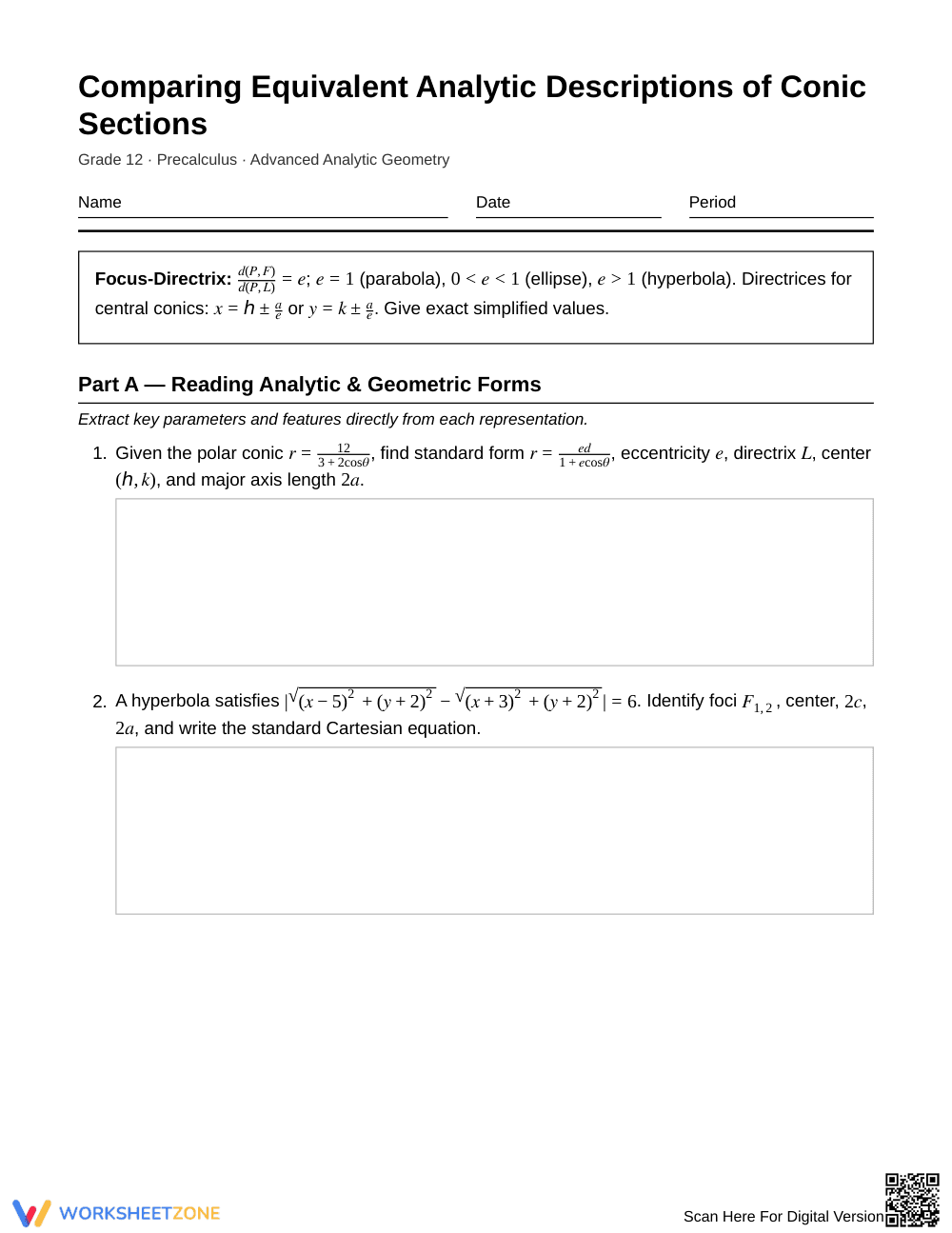
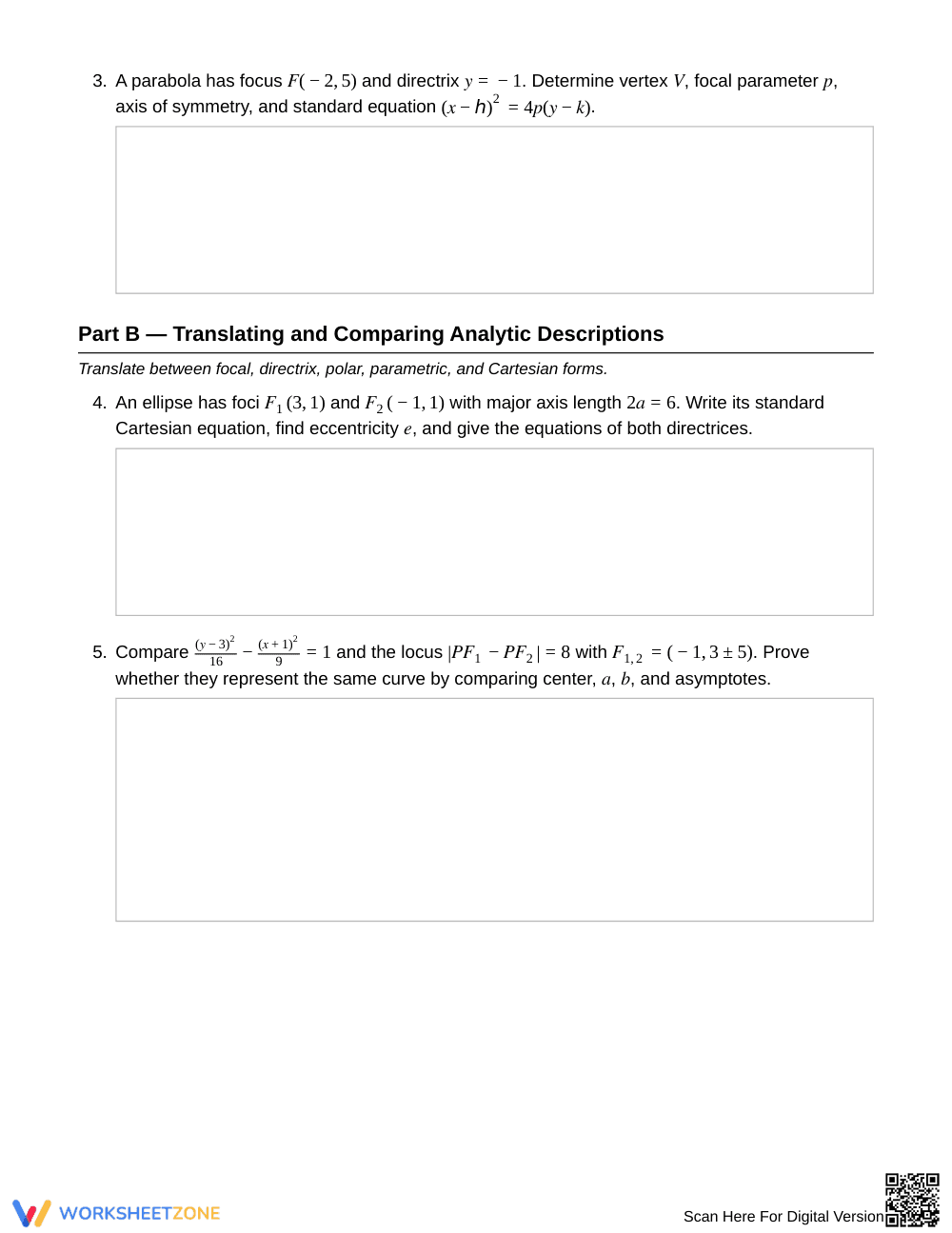
This advanced Precalculus worksheet equips Grade 12 students to translate, compare, and verify equivalent algebraic and geometric descriptions of conic sections. Learners analyze Cartesian, polar, focal-directrix, parametric, and bifocal distance equations to deepen their conceptual mastery of parabolas, ellipses, and hyperbolas through rigorous multi-step problem solving.
At a Glance
- Grade: 12 · Subject: Precalculus
- Standard: Advanced Mathematics — Connect Cartesian, polar, parametric, and geometric locus descriptions of conic sections
- Skill Focus: Compare Equivalent Analytic Descriptions
- Format: 5 pages · 12 problems · Answer key included · PDF
- Best For: Advanced analytic geometry units and exam review
- Time: 45–60 minutes
What's Inside
The 5-page student activity contains 12 rigorous analytical problems distributed across three distinct instructional tiers. Students work directly with eccentricity formulas, locus definitions, parametric forms, and polar directrix models supported by a concise reference header. A full 3-page step-by-step answer key provides complete derivations, graphical parameters, and formal mathematical proofs.
Skill Progression
- Guided Practice (Part A, 3 problems): Students extract fundamental geometric parameters (foci, directrices, eccentricity, vertices, and axes) directly from single representations given in polar, bifocal absolute value, and standard Cartesian formats with direct structural scaffolding.
- Supported Practice (Part B, 6 problems): Learners translate between distinct mathematical representations, converting parametric curves to Cartesian standard form, deriving equations from focal-directrix ratios, and verifying whether distinct analytical forms generate identical loci.
- Independent Practice (Part C, 3 problems): High-level analytical tasks require students to evaluate geometric claims, identify student errors regarding directrix formulas, apply the Triangle Inequality to prove focal constraints, and justify non-extraneous locus simplifications.
This structured progression reflects the gradual-release model, advancing students from foundational parameter extraction to independent theoretical proof and comparative analysis.
Standards Alignment
This resource aligns with advanced high school analytic geometry standards requiring students to derive equations of conic sections given foci, directrices, or eccentricity, and translate between polar, parametric, and Cartesian coordinate systems. Both standard concepts can be copied directly into lesson plans, IEP goals, or district curriculum mapping tools.
How to Use It
Deploy this worksheet after direct instruction on polar conics and locus definitions to consolidate unit learning. For formative assessment, examine student work on Part B to observe whether learners correctly determine linear eccentricity before attempting directrix equations. Students typically complete all 12 tasks within 45 to 60 minutes during dedicated workshop periods or paired problem-solving sessions.
Who It's For
Designed for Grade 12 Precalculus, Honors Geometry, or AP Calculus preparation courses, this set offers high-level challenge for advanced learners. Teachers can differentiate by providing coordinate grid paper or assigning Part A for targeted intervention while utilizing Part C for accelerated math competition enrichment.
According to Fisher & Frey (2014), structured instructional progressions that bridge procedural manipulation and conceptual justification significantly improve student retention in advanced STEM coursework. This 12-task Precalculus resource operationalizes that research by guiding Grade 12 learners through comparative analysis of conic sections across polar, parametric, bifocal, and Cartesian representations. By requiring students to identify parameter relationships and evaluate theoretical constraints, the worksheet builds deep geometric intuition necessary for college-level multivariable calculus and linear algebra. The 5-page printable document features complete derivations across a 3-page verified key, providing educators with an adaptable resource for high school classrooms.


