




























Views
Downloads




Complete Acids, Bases & pH Worksheet | Grade 11 Chemistry

Paste this activity's link or code into your existing LMS (Google Classroom, Canvas, Teams, Schoology, Moodle, etc.).
Students can open and work on the activity right away, with no student login required.
You'll still be able to track student progress and results from your teacher account.
This Grade 11 chemistry worksheet provides rigorous, quantitative practice calculating pH, pOH, and ion concentrations in aqueous solutions. Students distinguish solute concentration from acid strength, solve multi-step neutralization problems, and critically analyze common equilibrium fallacies to build enduring physical chemistry mastery.
At a Glance
- Grade: 11 · Subject: Chemistry
- Standard: Solution Chemistry — Calculate pH, pOH, and ion concentrations in dynamic aqueous systems
- Skill Focus: Acids, Bases, and pH Meaning
- Format: 5 pages · 12 problems · Answer key included · PDF
- Best For: Honors chemistry aqueous equilibrium problem sets
- Time: 45–60 minutes
What's Inside
The 5-page worksheet includes 12 comprehensive problems split into conceptual analysis, quantitative mathematical calculations, and critical verification prompts. A reference equation header supplies the ion-product constant of water, logarithmic transformations, and significant figure guidelines. A full 4-page answer key provides step-by-step mathematical setups, molarity calculations, and stoichiometric explanations.
Skill Progression
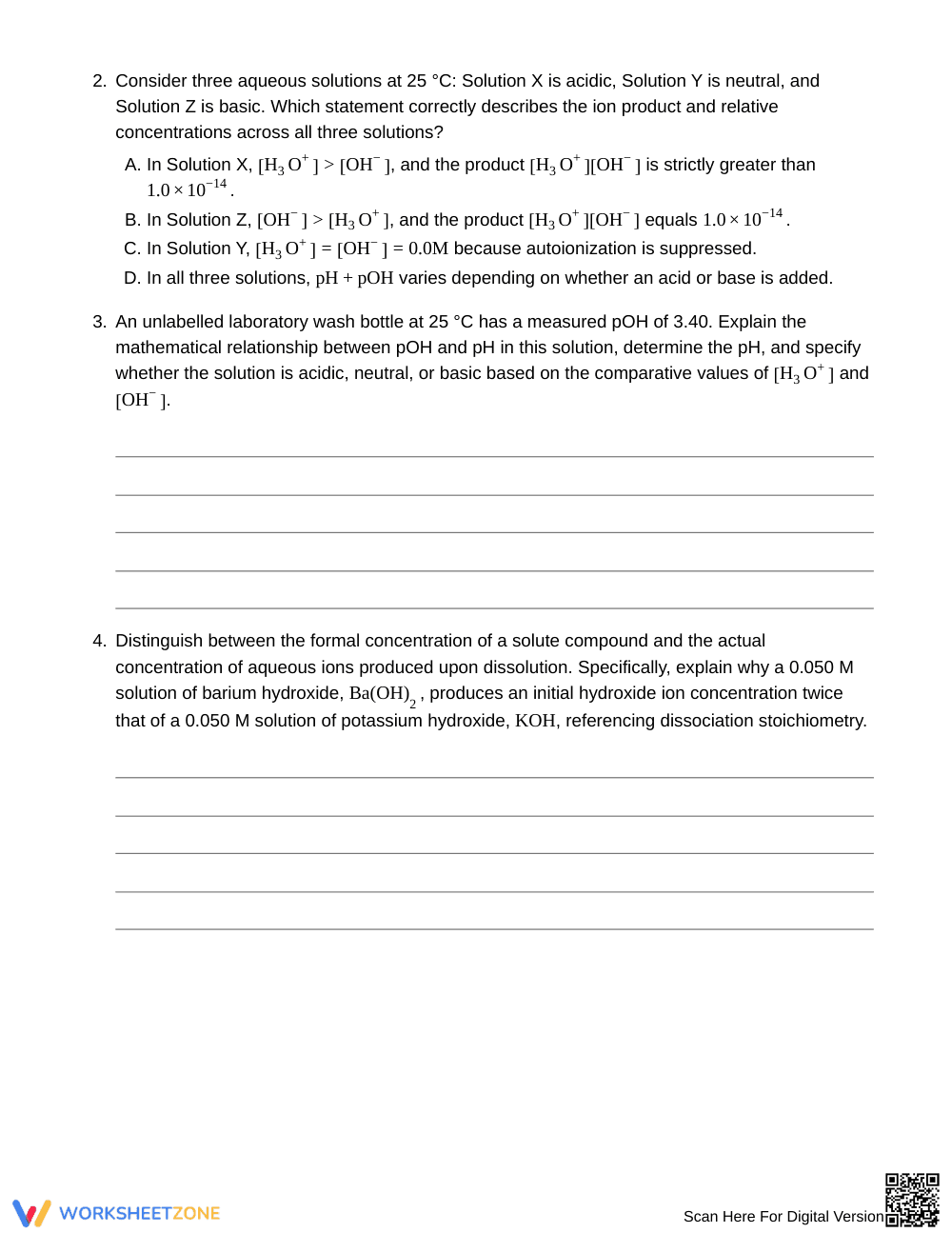
- Guided practice (Problems 1–4): Conceptual questions prompt students to differentiate solute concentration from acid strength, evaluate ion products across neutral and basic solutions, and apply polyprotic dissociation ratios.
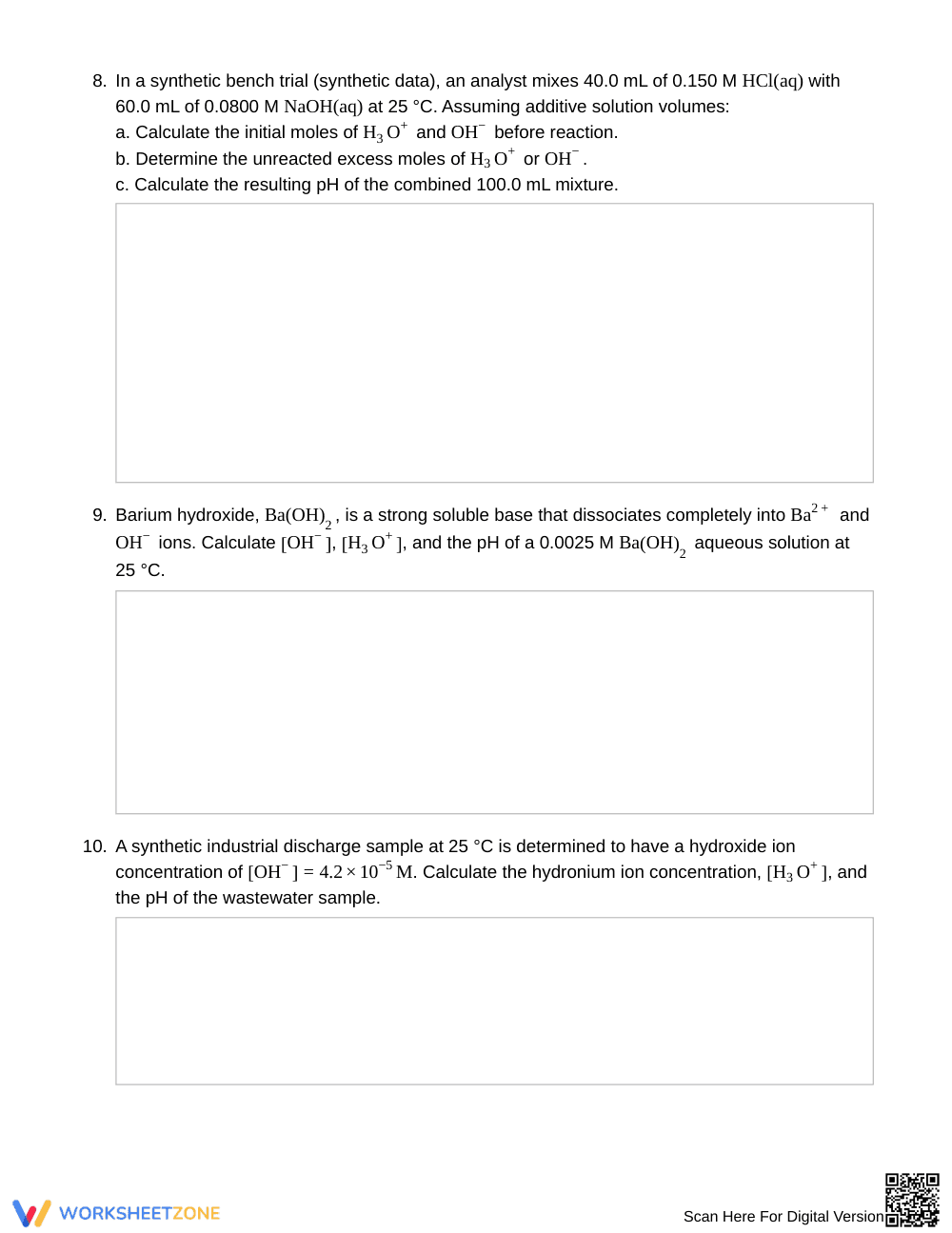
- Supported practice (Problems 5–10): Multi-step numerical calculations challenge learners to compute hydronium concentrations, solve unreacted excess-moles neutralization scenarios, and calculate required solute masses from target pH values.
- Independent practice (Problems 11–12): Advanced verification prompts require students to identify computational breakdowns in extreme acid dilutions and contrast instantaneous acidity against stoichiometric neutralization capacity.
This deliberate sequence follows a gradual-release framework that transitions students from fundamental chemical definitions to rigorous equilibrium problem-solving.
Standards Alignment
Aligned with high school chemistry core competencies for solution chemistry and equilibrium, this lesson requires students to model acid-base dissociation and calculate logarithmic pH and pOH relationships. Supporting objectives address limiting reactant stoichiometry and strong versus weak electrolyte behavior. Both standard codes can be copied directly into lesson plans, IEP goals, or district curriculum mapping tools.
How to Use It
Deploy this worksheet after direct instruction on the logarithmic pH scale and autoionization equilibrium. Use Part A during collaborative group practice, circulating to check that students do not confuse strong acids with concentrated solutions. Assign Parts B and C for independent practice or homework. Expected completion time is 45 to 60 minutes.
Who It's For
This resource is designed for Grade 11 chemistry and AP Chemistry students preparing for equilibrium assessments. Scaffolding notes and logarithmic rules support developing math learners, while the conceptual verification questions provide enrichment for advanced thinkers. Pair this resource with an aqueous acid-base titration laboratory experiment.
According to Fisher & Frey (2014), structured quantitative problem sets that move deliberately from conceptual definitions to complex multi-step calculations significantly improve student retention of analytical chemistry principles. This 12-task chemistry worksheet systematically develops student proficiency with aqueous equilibrium, hydronium ion calculations, and logarithmic pH relationships. By evaluating extreme dilution scenarios and distinguishing stoichiometric neutralization yields from instantaneous hydronium ion concentrations, learners confront persistent misconceptions in acid-base chemistry before formal laboratory titration analysis. The detailed reference equations and logarithmic significant figure rules provide essential scaffolding that supports procedural fluency alongside conceptual reasoning. Teachers can rely on this resource during rigorous unit reviews, guided equilibrium inquiry, or summative assessments. The complete four-page answer key provides fully worked algebraic derivations that make grading efficient while establishing transparent feedback benchmarks for all eleventh-grade chemistry students.


