
































Complete Acid-Base Strength Worksheet | Grade 11 Chemistry

Paste this activity's link or code into your existing LMS (Google Classroom, Canvas, Teams, Schoology, Moodle, etc.).
Students can open and work on the activity right away, with no student login required.
You'll still be able to track student progress and results from your teacher account.
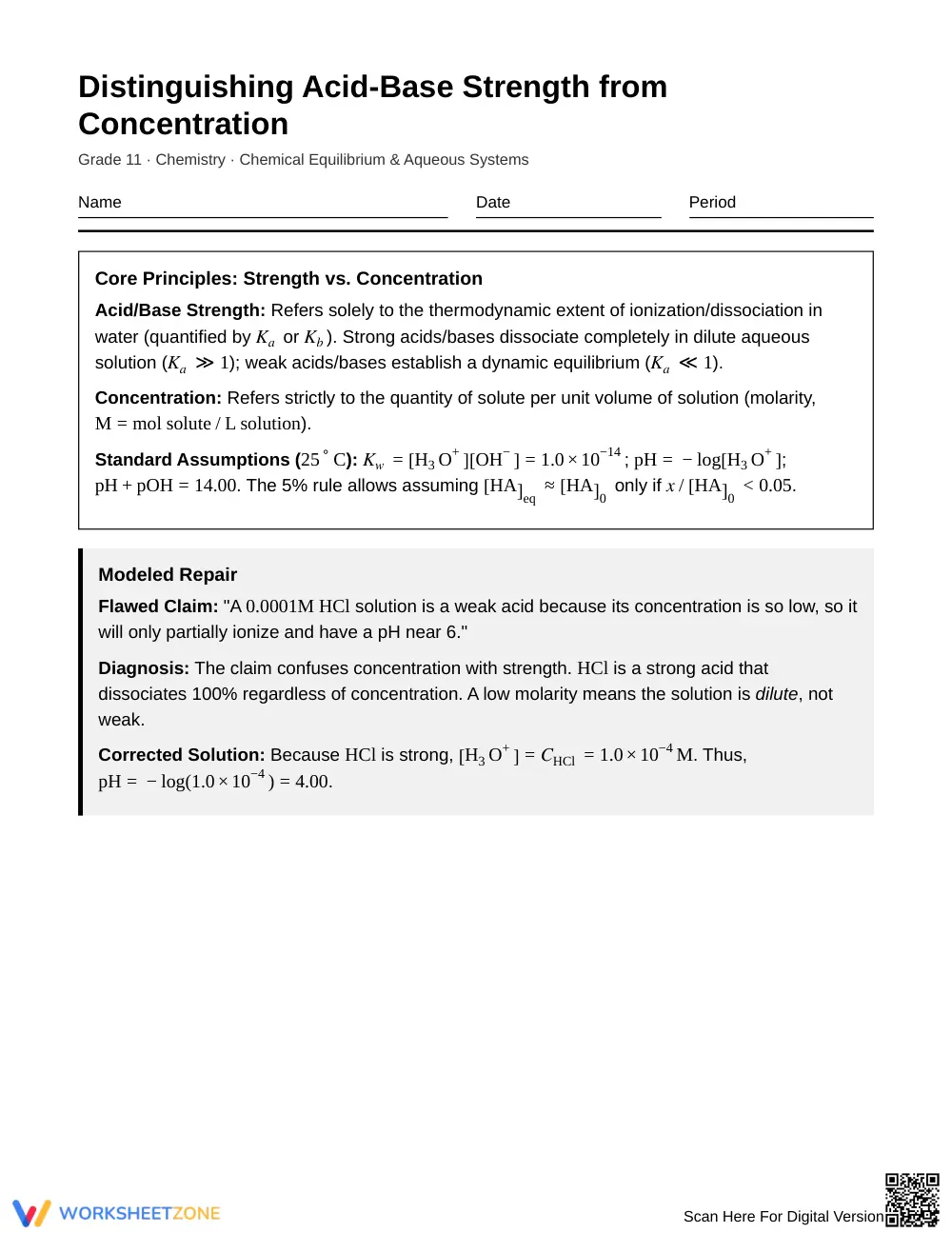
This Grade 11 chemistry worksheet dismantles the common misconception that concentrated acids are strong and dilute acids are weak. Through 12 structured tasks, students diagnose flawed claims, calculate hydronium ion concentrations, and analyze equilibrium constants, establishing a clear boundary between thermodynamic dissociation and solution molarity.
At a Glance
- Grade: 11 · Subject: Chemistry
- Standard:
Equilibrium & Solutions— Distinguish acid dissociation extent from solution molarity using equilibrium constants- Skill Focus: Correct Strong-Means-Concentrated Claims
- Format: 5 pages · 12 problems · Answer key included · PDF
- Best For: Post-lecture concept repair and quantitative practice
- Time: 45–60 minutes
What's Inside
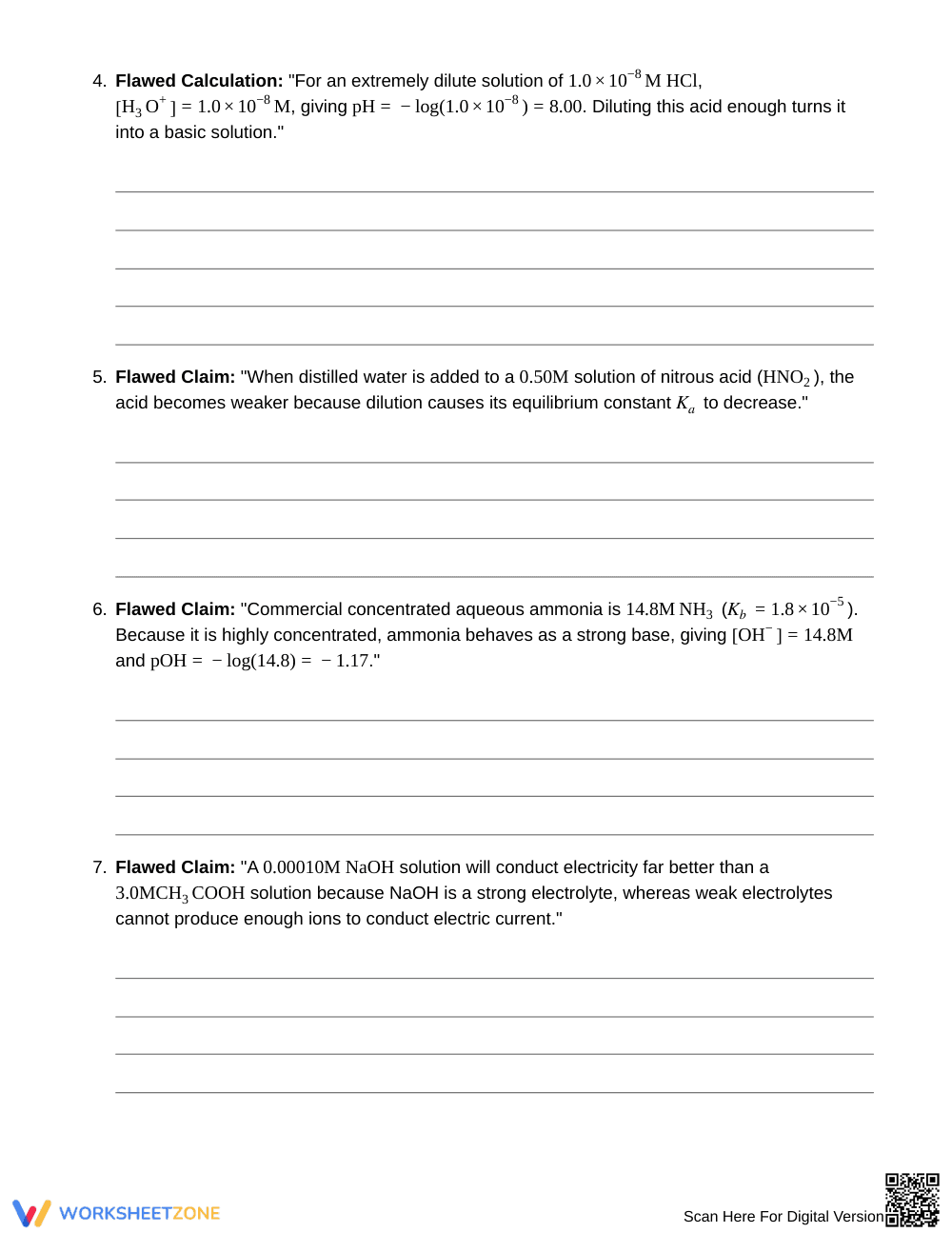
This 5-page resource includes a reference box, a modeled repair example, 8 conceptual error-analysis items, and 4 quantitative transfer problems. Students apply ICE tables, determine percent ionization, calculate titration equivalence volumes, and classify unknown solutions using pH and electrical conductivity. A 4-page answer key provides complete calculations and conceptual justifications.
Skill Progression
- Guided Practice: Students review core dissociation principles and study a modeled error repair contrasting 0.0001 M HCl with weak acids.
- Supported Practice: Part A offers 8 flawed claims on titrations, dilutions, and conductivity for students to diagnose and correct.
- Independent Practice: Part B delivers 4 multi-part quantitative problems requiring ICE tables and 4-sample laboratory data classification.
This progression employs a gradual-release model, moving students from guided error recognition to independent calculation.
Standards Alignment
This resource aligns with high school chemistry topics in chemical equilibrium, solution stoichiometry, and acid-base behavior. Students evaluate dissociation constants and demonstrate that neutralization stoichiometry operates independently of acid strength. Both standard codes can be copied directly into lesson plans, IEP goals, or district curriculum mapping tools.
How to Use It
Use this worksheet after direct instruction on acid dissociation constants and pH. First, assign Part A as collaborative warm-up stations where student pairs debate the flawed statements. Next, assign Part B for independent problem-solving. During class, monitor whether students assume weak acids require less titrant at equivalence. Completion takes 45 to 60 minutes.
Who It's For
This worksheet serves Grade 11 chemistry and honors students mastering aqueous equilibrium. Scaffold struggling learners with the 5% approximation rule guidelines, while challenging advanced students to explain conductivity differences between concentrated weak acids and dilute strong acids. Pair this activity with a wet-lab titration experiment.
Addressing the persistent misconception that strong acids are simply concentrated solutions requires explicit cognitive conflict and structured repair. Research synthesized by Fisher & Frey (2014) demonstrates that systematic error analysis combined with a gradual release of responsibility substantially enhances conceptual retention and analytical transfer in secondary science education. When learners critically evaluate authentic flawed claims—differentiating the thermodynamic extent of acid dissociation quantified by equilibrium constants from physical solution molarity—they successfully replace intuitive misunderstandings with scientifically sound chemical principles. This five-page Grade 11 chemistry resource delivers twelve focused problems guiding students from qualitative diagnosis to rigorous multi-step quantitative calculations. By contrasting monoprotic weak acids with dilute strong acids using calculated hydronium ion concentrations, percent ionization trends, and measured electrical conductivity data, high school students develop an integrated conceptual framework of aqueous equilibrium that ensures sustained academic achievement across advanced chemistry coursework.


