




























Views
Downloads

Printable Comparing Numbers Worksheet | Grade 2 Aligned

Paste this activity's link or code into your existing LMS (Google Classroom, Canvas, Teams, Schoology, Moodle, etc.).
Students can open and work on the activity right away, with no student login required.
You'll still be able to track student progress and results from your teacher account.
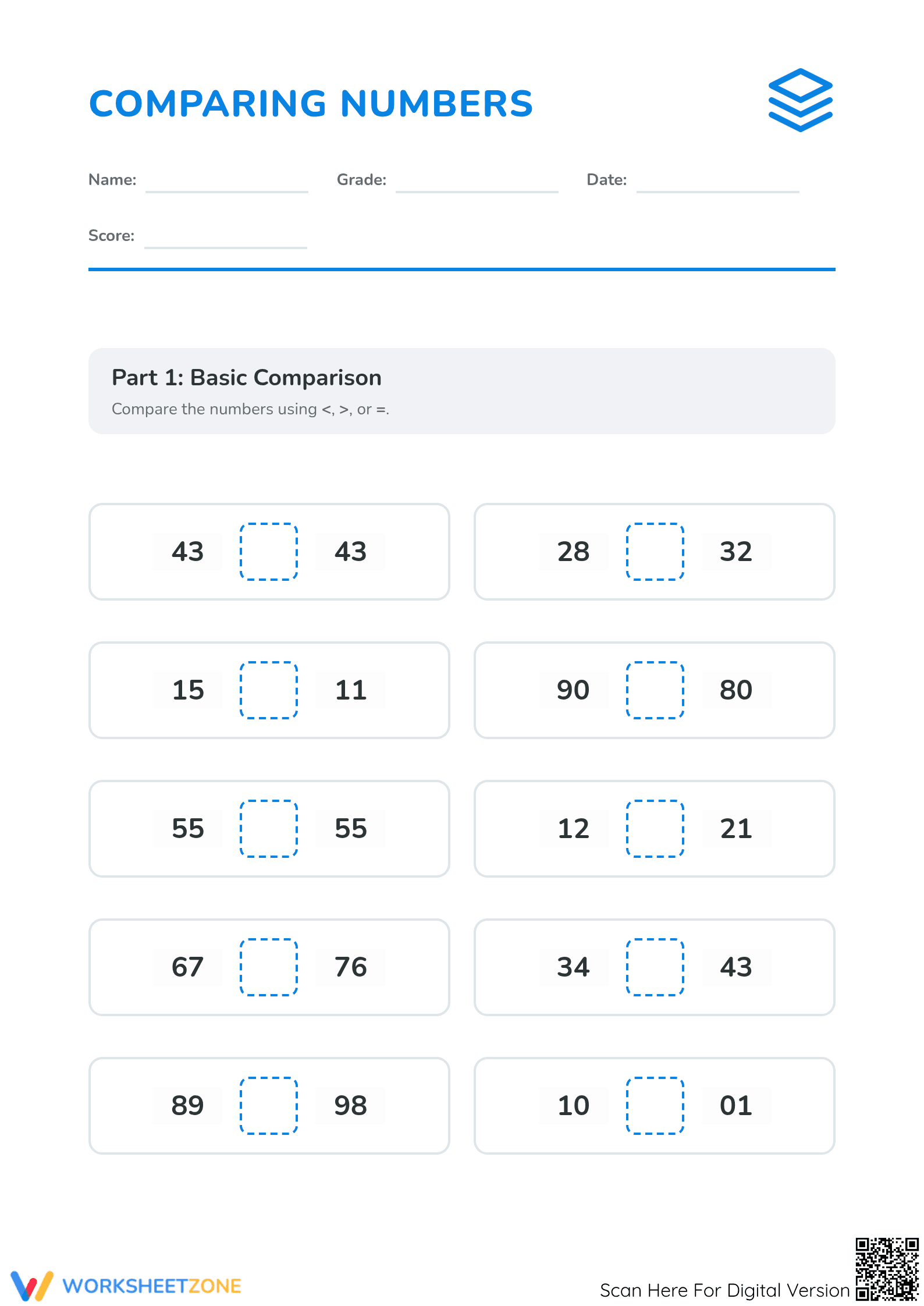
This comprehensive math resource focuses on the fundamental skill of comparing whole numbers using mathematical symbols. Students build fluency with "greater than," "less than," and "equal to" designations across 20 distinct problems. By evaluating two-digit and three-digit values, learners strengthen their underlying number sense and prepare for more complex arithmetic operations.
At a Glance
- Grade: 2 · Subject: Math
- Standard:
2.NBT.A.4— Compare two three-digit numbers using symbols to record the results of comparisons- Skill Focus: Number Comparison (<, >, =)
- Format: 2 pages · 20 problems · Answer key included · PDF
- Best For: Independent practice and quick skill checks
- Time: 15–20 minutes
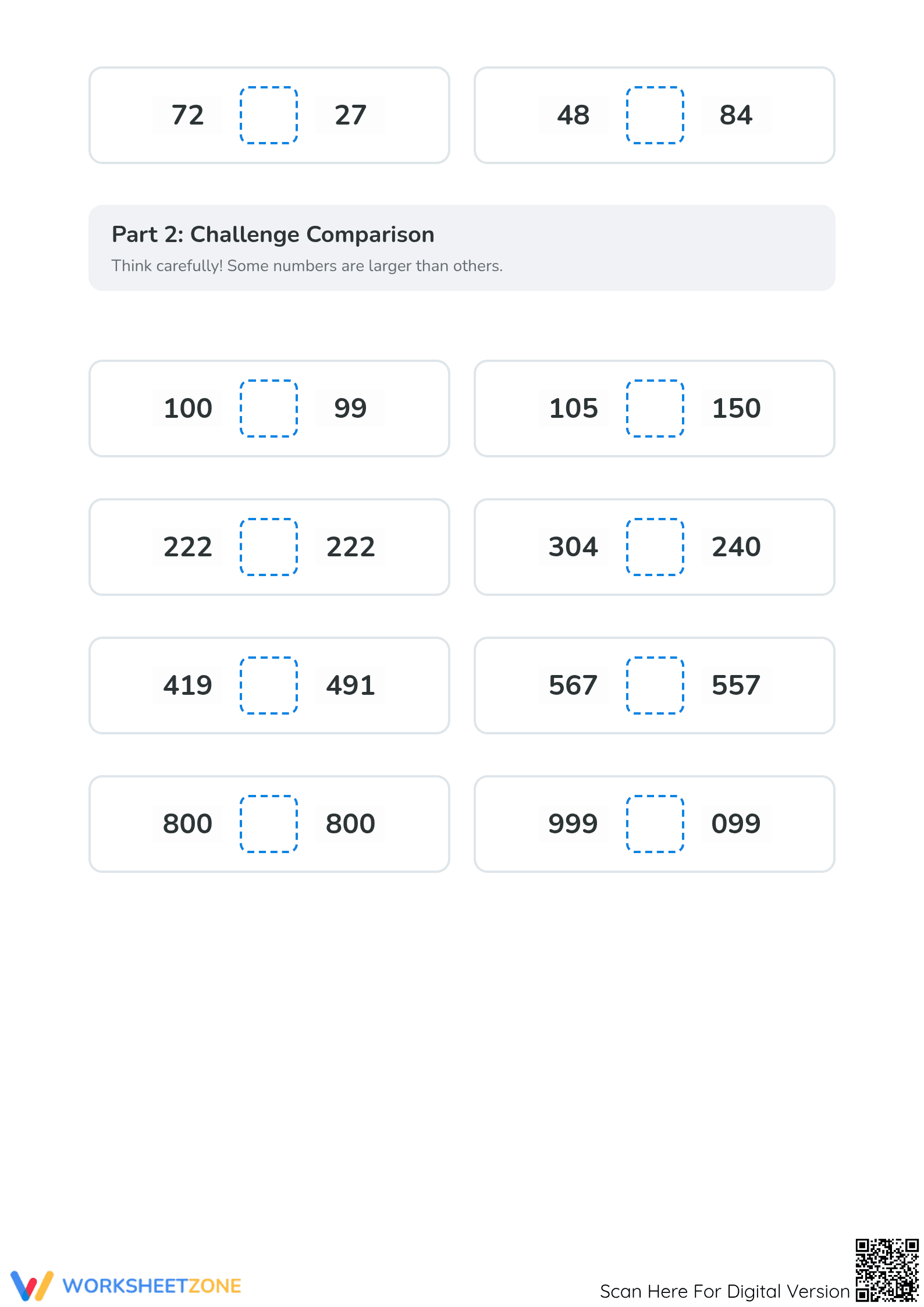
The download contains two clearly organized pages designed for maximum legibility. Part 1 features ten basic comparison tasks involving two-digit numbers, providing a solid review of tens and ones place value. Part 2 introduces a "Challenge Comparison" section with ten additional problems that incorporate three-digit numbers. A full-sized answer key is included to facilitate rapid grading or student self-correction.
- Guided Practice: The worksheet begins with familiar two-digit pairs like 43 and 43, allowing students to establish a rhythm with the equality symbol before moving to inequalities.
- Supported Practice: Mid-level tasks require students to distinguish between similar digits in different positions, such as comparing 67 and 76, which reinforces the importance of place value.
- Independent Practice: The challenge section removes scaffolds, requiring students to compare hundreds, tens, and ones across three-digit integers to demonstrate true mastery of numerical magnitude.
This activity is directly aligned to the Common Core State Standard 2.NBT.A.4: "Compare two three-digit numbers based on meanings of the hundreds, tens, and ones digits, using >, =, and < symbols to record the results of comparisons." By engaging with both equal and unequal pairs, students demonstrate a functional understanding of the base-ten system. This standard code can be copied directly into lesson plans or IEP goals.
Use this worksheet as a focused exit ticket following a lesson on place value comparison to gauge student understanding. Alternatively, assign it as a morning work activity to keep comparison skills sharp during spiraled review. For formative assessment, observe if students consistently compare the largest place value first. Completion typically takes 15 to 20 minutes.
This resource is ideal for second-grade students mastering the standard curriculum, as well as third-grade learners requiring intervention on foundational number sense. The clear formatting supports students with visual processing needs, and the inclusion of a challenge section provides natural differentiation for advanced students. It serves as an essential tool for building mathematical confidence.
The development of fluent number comparison skills is a critical predictor of later success in algebraic thinking and complex computation. According to the NAEP framework, a deep understanding of place value relationships allows students to move beyond rote memorization toward a conceptual grasp of magnitude. This worksheet targets standard 2.NBT.A.4 by requiring learners to evaluate written numerals and apply comparison symbols accurately. Research suggests that frequent, low-stakes practice with numerical inequalities helps cement the relationship between digits and their relative values, reducing common errors in rounding and estimation. By providing 20 structured opportunities to apply these symbols, this resource ensures that students transition from basic counting to a more sophisticated analysis of the number system. This evidence-based approach aligns with current best practices in mathematics instruction, offering a printable solution that is both standards-aligned and classroom-ready for immediate instructional use in the elementary setting.


