


























Views
Downloads
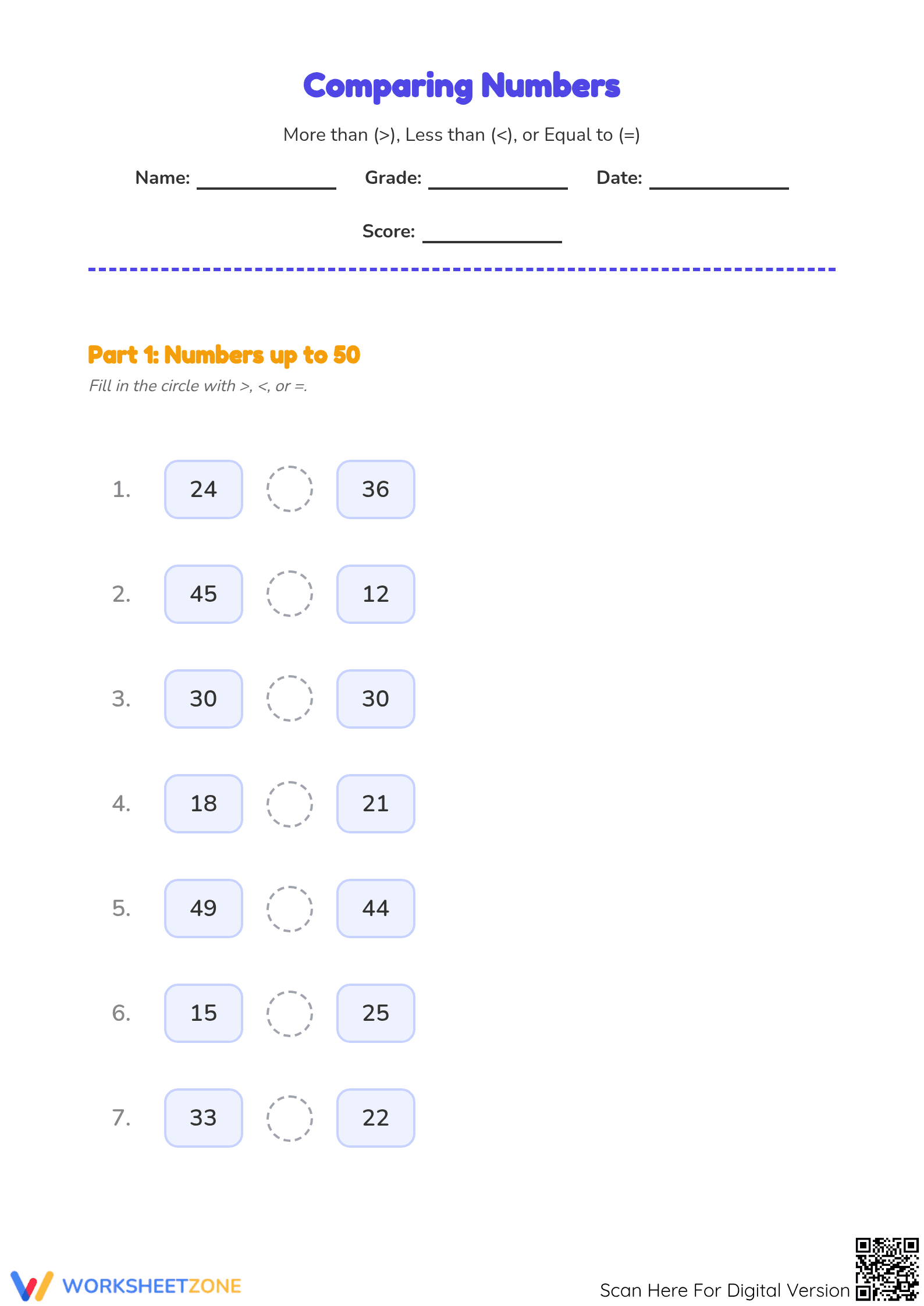



Printable Comparing Numbers Worksheet | Grade 2 Math
Paste this activity's link or code into your existing LMS (Google Classroom, Canvas, Teams, Schoology, Moodle, etc.).
Students can open and work on the activity right away, with no student login required.
You'll still be able to track student progress and results from your teacher account.
This worksheet provides focused practice for Grade 2 students on comparing numbers. Through a series of carefully scaffolded exercises, learners will build fluency in using the greater than (>), less than (<), and equal to (=) symbols to compare numbers up to 1,000, reinforcing core place value understanding and number sense.
At a Glance
- Grade: 2 (scaffolded for 1-3) · Subject: Math
- Standard:
CCSS.MATH.CONTENT.2.NBT.A.4— Compare two three-digit numbers using >, =, and < symbols.- Skill Focus: Comparing Multi-Digit Numbers
- Format: 4 pages · 40 problems · Answer key included · PDF
- Best For: Independent practice, skill reinforcement, or homework
- Time: 15–25 minutes
What's Inside
This resource contains a four-page PDF worksheet designed for clear, straightforward practice. The first page focuses on numbers up to 10, the second up to 100, and the final two pages challenge students with numbers up to 1,000. Each page features 10 comparison problems. A complete four-page answer key is also included, allowing for quick grading or student self-checking.
A Structured Path to Mastery
The worksheet follows a gradual-release model:
- Guided Practice: Page one uses single and double-digit numbers (e.g., 7 vs 9), ensuring students grasp the core concept of the symbols.
- Supported Practice: Page two transitions to two-digit numbers, requiring students to apply place value understanding on a larger scale.
- Independent Practice: The final two pages present the grade-level task: comparing three-digit numbers. These problems require students to analyze hundreds, tens, and ones places, demonstrating mastery.
This structure makes it an effective tool for reinforcing a lesson on number comparison.
Standards-Aligned for Your Classroom
This worksheet is directly aligned with the Common Core State Standard for Grade 2 Mathematics:
CCSS.MATH.CONTENT.2.NBT.A.4: Compare two three-digit numbers based on meanings of the hundreds, tens, and ones digits, using >, =, and < symbols to record the results of comparisons.
While focused on the Grade 2 standard, its scaffolded nature also supports foundational skills from Grade 1 (1.NBT.B.3) and can be used for review in Grade 3. Both standard codes can be copied directly into lesson plans, IEP goals, or district curriculum mapping tools.
How to Use This Worksheet
This resource works well as independent practice after a mini-lesson on number comparison, taking about 15-20 minutes. It can also be assigned as homework to reinforce the skill.
For a quick formative assessment, observe students as they work on page three. This can help identify who needs small-group re-teaching before they move on to more complex numbers.
Who It's For
This worksheet is designed primarily for first and second-grade students learning the fundamentals of number comparison. The clean layout and lack of distracting clipart make it suitable for older students in Grade 3 or 4 who require intervention on this foundational skill. It pairs well with a classroom anchor chart displaying the >, <, and = symbols with clear examples.
Foundational skills in number sense, such as comparing multi-digit numbers, are critical for future success in mathematics. This worksheet directly addresses CCSS.MATH.CONTENT.2.NBT.A.4, which requires students to compare three-digit numbers using appropriate symbols. Research consistently highlights the importance of procedural fluency built upon conceptual understanding. According to the RAND AIRS (2024) report on elementary mathematics, repeated, structured practice is a key component in moving students from conceptual knowledge to automaticity. By providing 40 problems scaffolded from simple to complex, this resource supports that transition. It gives students the necessary repetition to internalize the process of comparing numbers based on place value, a skill essential for operations, rounding, and eventually, work with fractions and decimals.


