


























Views
Downloads




Printable Comparing Numbers Worksheet | Grade 1 Math
Paste this activity's link or code into your existing LMS (Google Classroom, Canvas, Teams, Schoology, Moodle, etc.).
Students can open and work on the activity right away, with no student login required.
You'll still be able to track student progress and results from your teacher account.
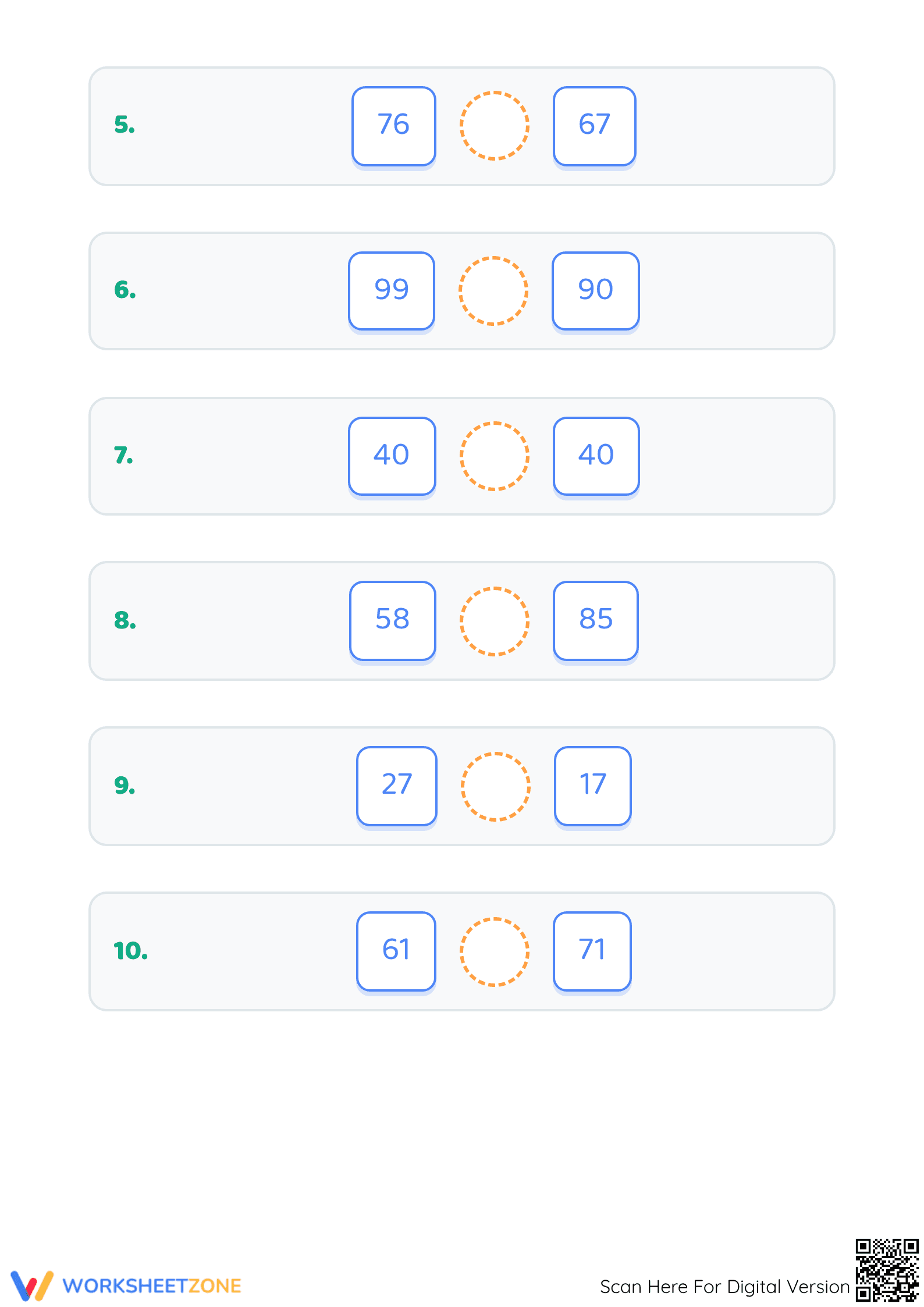
This complete worksheet packet helps first-grade students master comparing and ordering numbers within 100. Through 50 structured problems, learners will practice using inequality symbols and sequencing numbers in both ascending and descending order, building a strong foundation in place value and number sense.
At a Glance
- Grade: 1 · Subject: Math
- Standard:
CCSS.MATH.CONTENT.1.NBT.B.3— Compare two-digit numbers using symbols and place value understanding.- Skill Focus: Comparing and ordering numbers to 100
- Format: 4 pages · 50 problems · Answer key included · PDF
- Best For: Independent practice, math centers, or homework
- Time: 20–30 minutes
What's Inside
Inside this five-page PDF, you'll find four student worksheets and a full one-page answer key. The tasks are varied to maintain engagement, including direct comparisons, ordering sets of numbers from least to greatest, and ordering sets from greatest to least. The clean layout ensures students can focus on the math.
A Clear Path to Mastery
This resource uses a gradual-release model to build student confidence from comparison to ordering. The structure scaffolds learning effectively.
- Guided Practice: The first two pages contain 24 direct comparison problems, helping students build fluency with the greater than, less than, and equal to symbols.
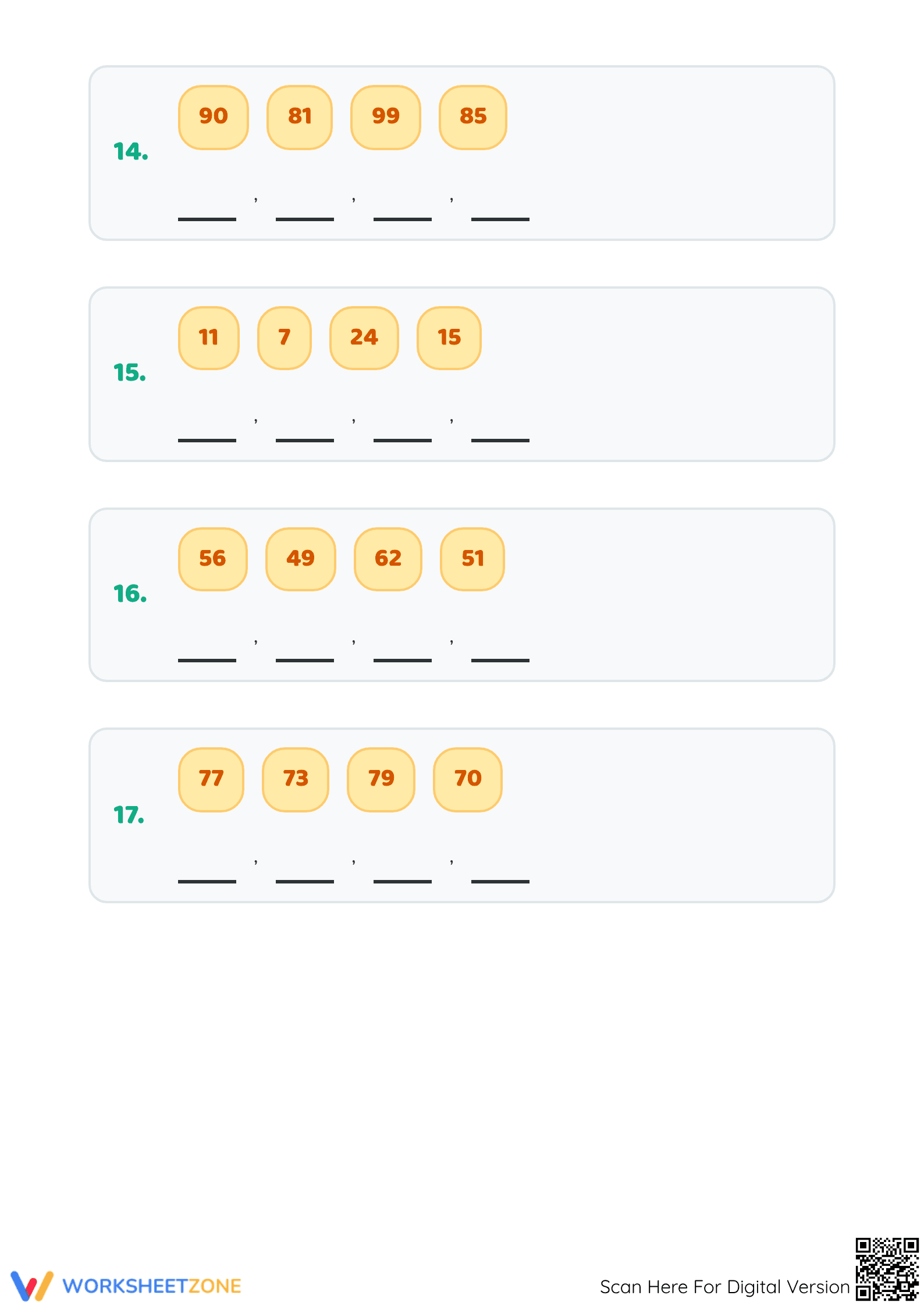
- Supported Practice: Students then progress to ordering sets of numbers. Tasks are separated by ascending and descending order to provide focused practice on each sequencing skill across 12 problem sets.
- Independent Practice: The final worksheet integrates both skills, challenging students to apply their knowledge in a mixed review. This progression ensures students build from a solid foundation toward mastery.
Aligned for Impact
This resource is directly aligned with Common Core standard CCSS.MATH.CONTENT.1.NBT.B.3, where students compare two-digit numbers using place value and symbols. The tasks also support foundational skills for second grade. The standard code can be copied directly into lesson plans, IEP goals, or district curriculum mapping tools.
Classroom Implementation
This worksheet is perfect for use after a lesson on place value and number comparison. Assign it as independent practice, or use it as a focused activity in a math center. For a quick formative assessment, observe which students can compare numbers abstractly versus those who still need visual aids. Most students will complete the packet in 20-30 minutes.
Built for First Graders
This packet is designed for first-grade students learning to compare and order numbers. It can also serve as a review for second graders at the beginning of the year or as a challenge for advanced kindergarteners. Pair it with a 100s chart to support students who need a visual aid.
Mastery of number comparison is a critical checkpoint for early elementary learners, directly supporting future success in multi-digit operations and fractions. This worksheet provides targeted practice aligned with standard CCSS.MATH.CONTENT.1.NBT.B.3, focusing on the development of number sense through place value understanding. Research consistently shows that procedural fluency, built through structured practice like this, is a key component of mathematical proficiency. A major analysis by RAND AIRS (2024) emphasized the importance of high-quality instructional materials that give students sufficient opportunities to practice foundational skills. By offering 50 problems that progress from simple comparison to complex ordering, this resource provides the deliberate practice needed to move students toward automaticity. The ability to fluently compare and order two-digit numbers is a prerequisite for the more advanced numerical reasoning required in later grades.


