


























Views
Downloads
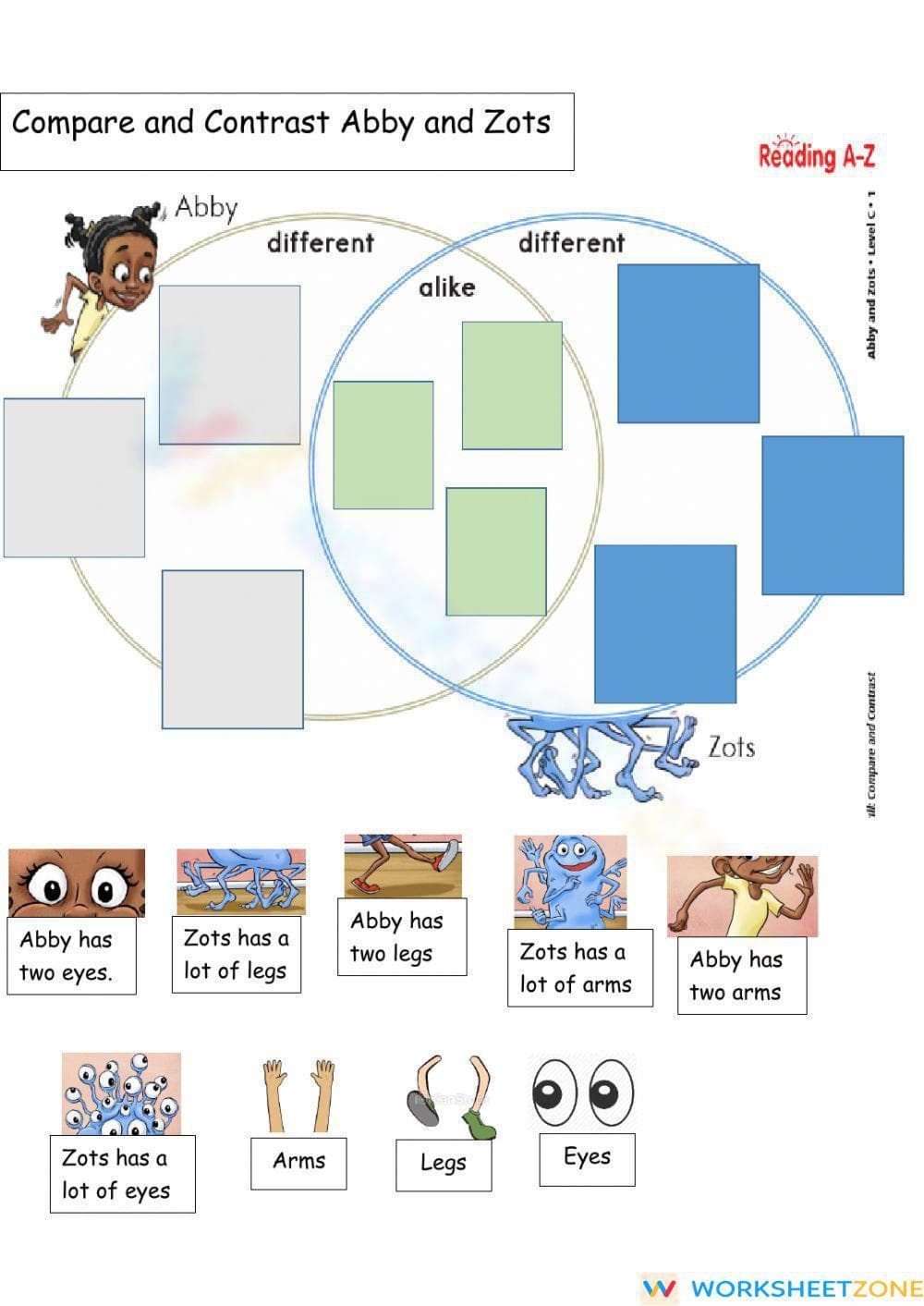

Compare and Contrast Abby and Zots | Printable ELA Worksheet
Paste this activity's link or code into your existing LMS (Google Classroom, Canvas, Teams, Schoology, Moodle, etc.).
Students can open and work on the activity right away, with no student login required.
You'll still be able to track student progress and results from your teacher account.
This character analysis resource focuses on the foundational skill of comparing and contrasting using the popular Abby and Zots characters. Students will examine specific physical traits and actions to determine what makes these characters unique and what they share in common. This interactive Venn diagram activity transforms abstract reading concepts into concrete visual comparisons.
At a Glance
- Grade: Grade 1 · Subject: English Language Arts
- Standard:
CCSS.ELA-LITERACY.RL.1.9— Compare and contrast the adventures and experiences of characters in stories- Skill Focus: Character Comparison and Contrast
- Format: 1 page · 6 tasks · Answer key included · PDF
- Best For: Early literacy centers and reading groups
- Time: 15–20 minutes
The PDF download includes a single, high-quality worksheet featuring a large Venn diagram and a set of descriptive character cards. Students work with six specific trait cards—such as 'Abby has two eyes' and 'Zots has a lot of eyes'—to categorize them into the 'Different' or 'Alike' sections of the diagram. A clear answer key is included for quick teacher verification.
This resource is designed for a three-step zero-prep workflow. First, print the single-page document (30 seconds). Second, distribute the sheets to students with scissors and glue (30 seconds). Third, review the completed diagrams using the answer key (under 1 minute). Total teacher preparation time is less than two minutes, making it ideal for emergency sub plans or busy literacy block transitions.
The primary alignment for this resource is CCSS.ELA-LITERACY.RL.1.9, which requires students to compare and contrast the adventures and experiences of characters in stories. By identifying physical differences and similarities, students build the prerequisite skills needed to analyze more complex character motivations. Both standard codes can be copied directly into lesson plans, IEP goals, or district curriculum mapping tools.
Use this worksheet during the 'We Do' phase of a lesson on character traits to model Venn diagram usage. It also serves as an excellent formative-assessment tool during small-group reading rotations; observe if students can justify their placements using visual evidence. Expect most students to complete the sorting and gluing within a fifteen to twenty minute window.
This activity is perfectly suited for Kindergarten and first-grade students who are just beginning to explore literary analysis. It includes visual scaffolds like pictures on the trait cards to support English Language Learners and students with IEP accommodations. Pair this worksheet with the original Abby and Zots reading passage or a character anchor chart to reinforce the concept of characterization.
Aligned to CCSS.ELA-LITERACY.RL.1.9, this worksheet targets the essential foundational skill of comparing and contrasting character traits between two distinct subjects in a narrative. By engaging with visual cues and descriptive text, students develop the cognitive ability to identify similarities and differences, a core component of reading comprehension. Research from Fisher & Frey (2014) emphasizes that visual organizers like Venn diagrams significantly enhance a student's capacity to categorize information and synthesize complex story elements. This resource provides a structured environment for young learners to practice evidence-based reasoning by matching physical attributes and behaviors to specific characters. This method supports early literacy development and prepares students for higher-order literary analysis in subsequent grades. Teachers can effectively use this tool as a formative assessment to monitor a student's progress in distinguishing character details, ensuring they meet rigorous state and national standards. This worksheet serves as a vital bridge between literal identification and analytical thinking.


