


























Views
Downloads
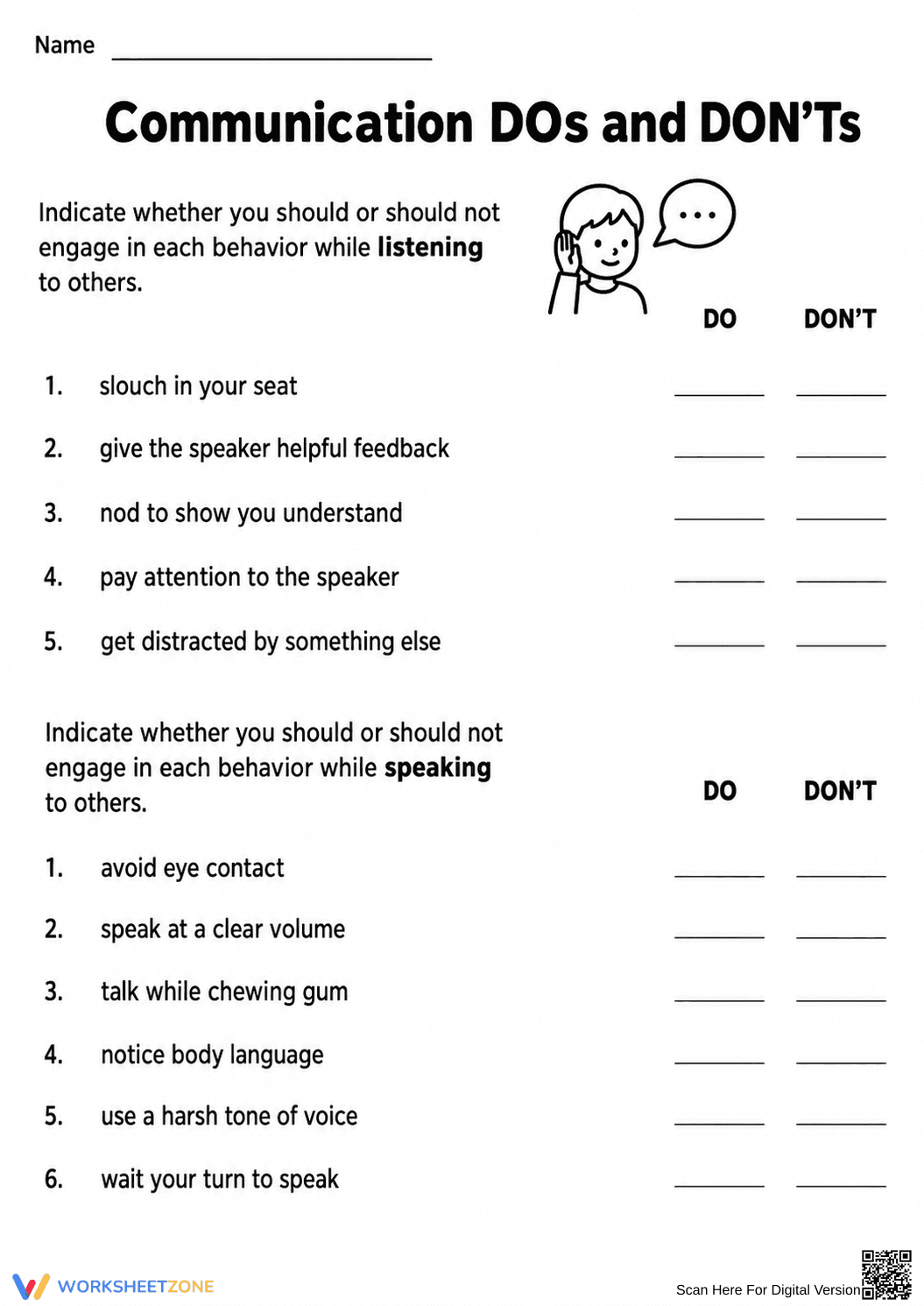

Grade 3 Communication Skills — Printable No-Prep Worksheet
Paste this activity's link or code into your existing LMS (Google Classroom, Canvas, Teams, Schoology, Moodle, etc.).
Students can open and work on the activity right away, with no student login required.
You'll still be able to track student progress and results from your teacher account.
This communication skills worksheet helps students identify appropriate behaviors for active listening and respectful speaking. By categorizing common actions as "DOs" or "DON'Ts," learners build the social awareness needed for effective classroom discussions and positive peer interactions.
At a Glance
- Grade: 3 · Subject: Social Skills
- Standard:
CCSS.ELA-LITERACY.SL.3.1.B— Follow agreed-upon rules for discussions- Skill Focus: Active listening and speaking behaviors
- Format: 1 page · 11 problems · Answer key included · PDF
- Best For: Morning meetings and social-emotional learning
- Time: 10–15 minutes
This single-page resource features two sections targeting different communication aspects. The first lists five listening behaviors; the second outlines six speaking behaviors. For each of the 11 items, students evaluate the action—like slouching or making eye contact—and check the DO or DON'T column. A complete answer key is provided to ensure accurate grading and facilitate class discussions.
Zero-Prep Workflow
This worksheet is designed for immediate classroom implementation.
- Print (1 minute): Simply download the PDF and print a class set. No cutting, laminating, or special materials are required.
- Distribute (1 minute): Hand out the worksheets during morning meeting, advisory, or at the start of a collaborative group project.
- Review (3 minutes): Use the included answer key to quickly check student responses or guide a whole-class review session.
With a total teacher prep time of under two minutes, this resource is highly effective for busy educators and makes an excellent addition to any emergency substitute plan.
Standards Alignment
This activity is directly aligned with CCSS.ELA-LITERACY.SL.3.1.B, which requires students to follow agreed-upon rules for discussions, such as listening to others and speaking one at a time. It also supports broader social-emotional learning objectives related to relationship skills and social awareness. Both standard codes can be copied directly into lesson plans, IEP goals, or district curriculum mapping tools.
How to Use It
Introduce this worksheet before starting a major group project or literature circle to establish clear behavioral expectations. Alternatively, use it as a reflective activity after a classroom conflict to reinforce positive communication habits. As students complete the 11 items, observe their responses as a formative assessment to identify individuals who might need additional coaching on reading body language or maintaining appropriate voice volume. The entire activity typically takes 10 to 15 minutes to complete.
Who It's For
This resource is ideal for second through fifth-grade students developing their interpersonal skills. It is particularly beneficial for neurodivergent learners or students with IEP goals focused on pragmatic language and social interactions, as it provides explicit, concrete examples of abstract social rules. Pair this worksheet with a visual anchor chart displaying active listening strategies to reinforce the concepts throughout the school year.
Mastering foundational communication habits is critical for academic success and peer collaboration. This resource targets the specific skills outlined in CCSS.ELA-LITERACY.SL.3.1.B, helping students learn to follow agreed-upon rules for discussions by explicitly identifying positive and negative listening and speaking behaviors. According to Fisher & Frey (2014), explicit instruction in collaborative discussion frameworks significantly increases student engagement and comprehension during peer-to-peer learning activities. When students can accurately distinguish between productive actions, such as making eye contact, and disruptive actions, such as slouching or interrupting, they are better equipped to participate in meaningful academic discourse. By categorizing these concrete examples, educators can establish a safe, respectful classroom environment that encourages active participation. This targeted practice ensures that learners internalize the social expectations necessary for both academic group work and everyday interpersonal relationships.


