


























Views
Downloads

Essential Common and Proper Nouns Sorting Worksheet | Gr. 2
Paste this activity's link or code into your existing LMS (Google Classroom, Canvas, Teams, Schoology, Moodle, etc.).
Students can open and work on the activity right away, with no student login required.
You'll still be able to track student progress and results from your teacher account.
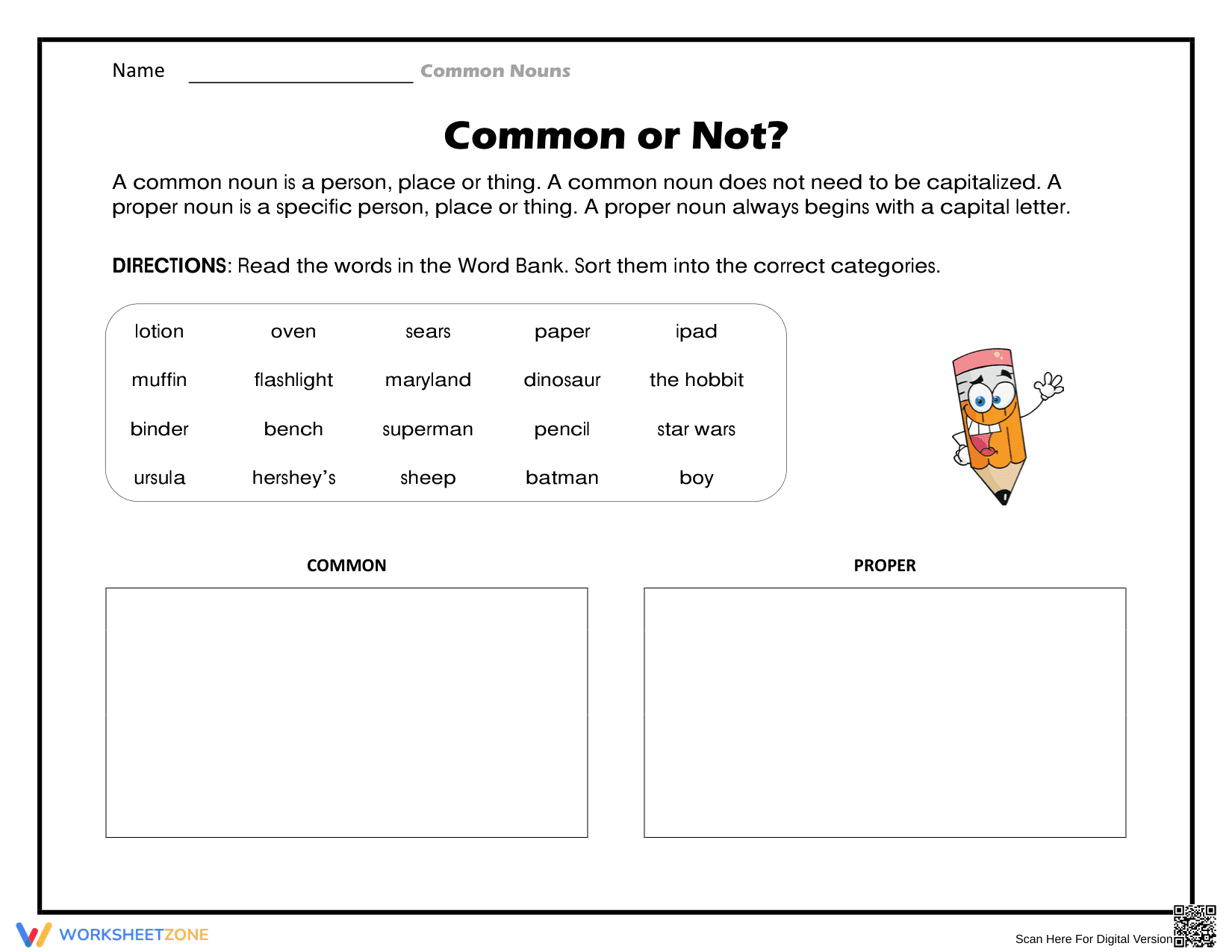
This "Common or Not?" worksheet provides a direct and effective way for students to master the distinction between common and proper nouns. By sorting twenty specific examples from a word bank into two clear categories, learners strengthen their understanding of capitalization rules and noun classification, ensuring they can identify specific names versus general entities in their writing.
At a Glance
- Grade: 2 · Subject: English Language Arts
- Standard:
CCSS.ELA-LITERACY.L.1.1.B— Use common, proper, and possessive nouns accurately in sentences and speech- Skill Focus: Common vs. Proper Noun Classification
- Format: 1 page · 20 problems · Answer key included · PDF
- Best For: Independent grammar practice or assessment
- Time: 10–15 minutes
The resource features a comprehensive word bank containing a mix of general items and specific named entities, such as "muffin," "Maryland," "Ursula," and "bench." Students are provided with two large sorting boxes labeled "Common" and "Proper." The single-page layout is clean and includes a concise definition of both noun types at the top to support independent work and self-correction during the task.
This worksheet is designed for an immediate, zero-prep classroom workflow that saves teachers valuable time. First, print the single-page PDF (30 seconds). Second, distribute to students for a quick morning work activity or a literacy center rotation (1 minute). Third, review the completed sorts using the included answer key for instant feedback (1 minute). Total preparation time is under two minutes, making it an ideal choice for emergency sub plans or last-minute grammar reinforcements.
This activity is aligned with `CCSS.ELA-LITERACY.L.1.1.B`, which requires students to use common, proper, and possessive nouns. By focusing on the capitalization distinction between words like "batman" and "boy," students demonstrate their command of the conventions of standard English grammar. This standard code can be copied directly into lesson plans, IEP goals, or district curriculum mapping tools to track student progress.
Use this worksheet as a "ticket-to-leave" formative assessment after a direct instruction lesson on capitalization. Observe if students correctly capitalize the "Proper" column words even if they were lowercase in the word bank. Alternatively, place it in a grammar center where students can work in pairs to justify their sorting choices. This provides an excellent opportunity for peer-to-peer learning and oral language practice regarding grammatical rules.
The worksheet is primarily intended for second-grade students but is also highly effective for first-grade enrichment or third-grade review. It supports struggling writers by providing a word bank that reduces the cognitive load of generating examples, allowing them to focus entirely on the classification skill. It pairs naturally with a noun-themed anchor chart or a short reading passage where students can highlight nouns before sorting.
Grammar instruction is most effective when integrated into a structured literacy framework that emphasizes the relationship between parts of speech and sentence mechanics. According to Fisher & Frey (2014), the gradual release of responsibility model is supported by providing clear, scaffolded practice like this sorting activity before asking students to apply the skill in open-ended writing. This worksheet bridges the gap between identification and application by forcing students to evaluate the specificity of each noun. Standardized assessments often require students to correct capitalization errors, and this resource builds the foundational awareness needed for such tasks. By engaging with twenty varied examples, students internalize the pattern that specific names require capital letters while general categories do not. This fundamental ELA skill, explicitly linked to CCSS.ELA-LITERACY.L.1.1.B, is essential for developing clear and professional communication habits in early elementary learners.


