


























Views
Plays

Restrictive Clauses Worksheet | Essential Grade 6 Ready
Paste this activity's link or code into your existing LMS (Google Classroom, Canvas, Teams, Schoology, Moodle, etc.).
Students can open and work on the activity right away, with no student login required.
You'll still be able to track student progress and results from your teacher account.
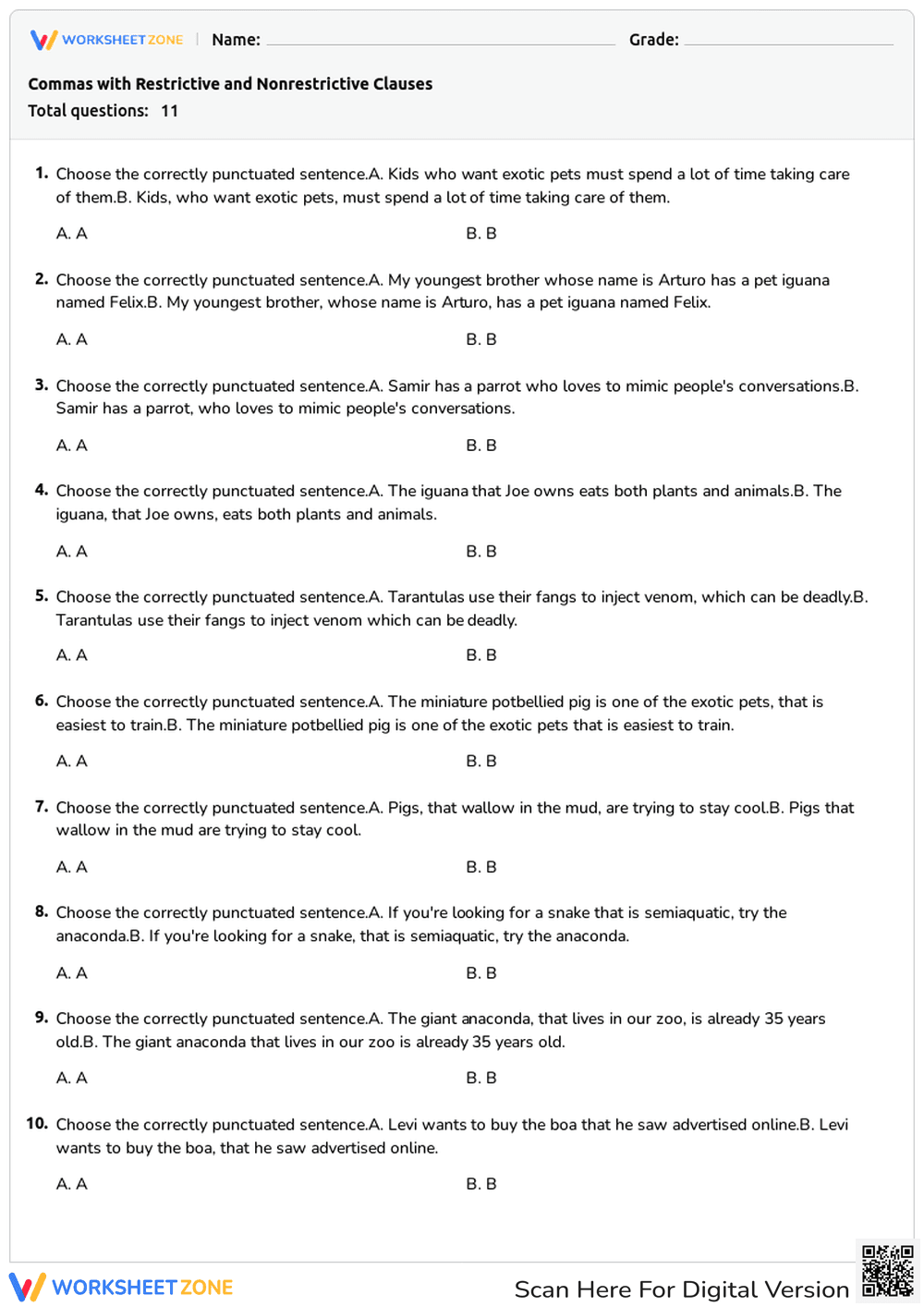
This Grade 6 grammar worksheet provides targeted practice in identifying and punctuating restrictive and nonrestrictive clauses. Students analyze 11 distinct sentences to determine if information is essential to the meaning or parenthetical, applying comma rules to ensure clarity. By mastering these punctuation conventions, learners improve their writing precision and reading comprehension of complex texts.
At a Glance
- Grade: 6 · Subject: ELA
- Standard:
CCSS.ELA-LITERACY.L.6.2.A— Use punctuation to set off nonrestrictive or parenthetical elements- Skill Focus: Restrictive vs. Nonrestrictive Clauses
- Format: 2 pages · 11 problems · Answer key included · PDF
- Best For: Grammar warm-ups and formative assessment
- Time: 15–20 minutes
The worksheet features 11 multiple-choice questions designed to test student recognition of comma placement. Each item presents two variations of the same sentence, challenging the student to select the version that correctly uses commas with relative clauses. The layout is clean and distraction-free, providing ample white space for student focus. A comprehensive answer key is provided to facilitate self-correction or quick teacher grading.
The zero-prep design of this resource ensures it fits into any instructional block without added stress. First, print the two-page PDF (30 seconds). Second, distribute the 11-question set to students for independent or partner work (1 minute). Finally, use the integrated answer key to review responses as a whole group or for rapid grading (under 1 minute).
This resource is directly aligned with CCSS.ELA-LITERACY.L.6.2.A, which requires students to use punctuation (commas, parentheses, dashes) to set off nonrestrictive or parenthetical elements. It also supports the broader goal of L.6.1, demonstrating command of the conventions of standard English grammar and usage when writing. Both standard codes can be copied directly into lesson plans, IEP goals, or district curriculum mapping tools.
Use this worksheet as a formative assessment after a direct instruction lesson on relative clauses. Circulate to observe if students over-use commas with "that" clauses. It also serves as an excellent exit ticket to gauge mastery before moving on to more complex sentence structures. Expected completion time is 15 to 20 minutes.
This resource is designed for middle school students, particularly those in Grade 6, but is also suitable for older students requiring remediation in punctuation. It is an effective tool for English Language Learners (ELLs) who are learning the nuances of English sentence structure. Pair this worksheet with a mentor text passage where students can highlight examples of nonrestrictive clauses in professional writing.
According to the RAND AIRS 2024 report on secondary literacy, explicit instruction in syntactic variety and punctuation is a critical predictor of college-readiness in writing. This worksheet targets CCSS.ELA-LITERACY.L.6.2.A by requiring students to distinguish between essential information (restrictive) and parenthetical information (nonrestrictive). By isolating the specific mechanical skill of comma placement within complex sentences, the resource reduces cognitive load, allowing students to focus on the semantic difference between clauses. Research from Fisher & Frey (2014) suggests that targeted practice with immediate feedback—facilitated here by the included answer key—accelerates the transition from guided to independent mastery of grammatical conventions. Educators can utilize these 11 tasks to identify specific misconceptions regarding relative pronouns like "which" and "that," ensuring students develop the precision necessary for advanced academic composition and standardized testing environments.


