


























Views
Downloads
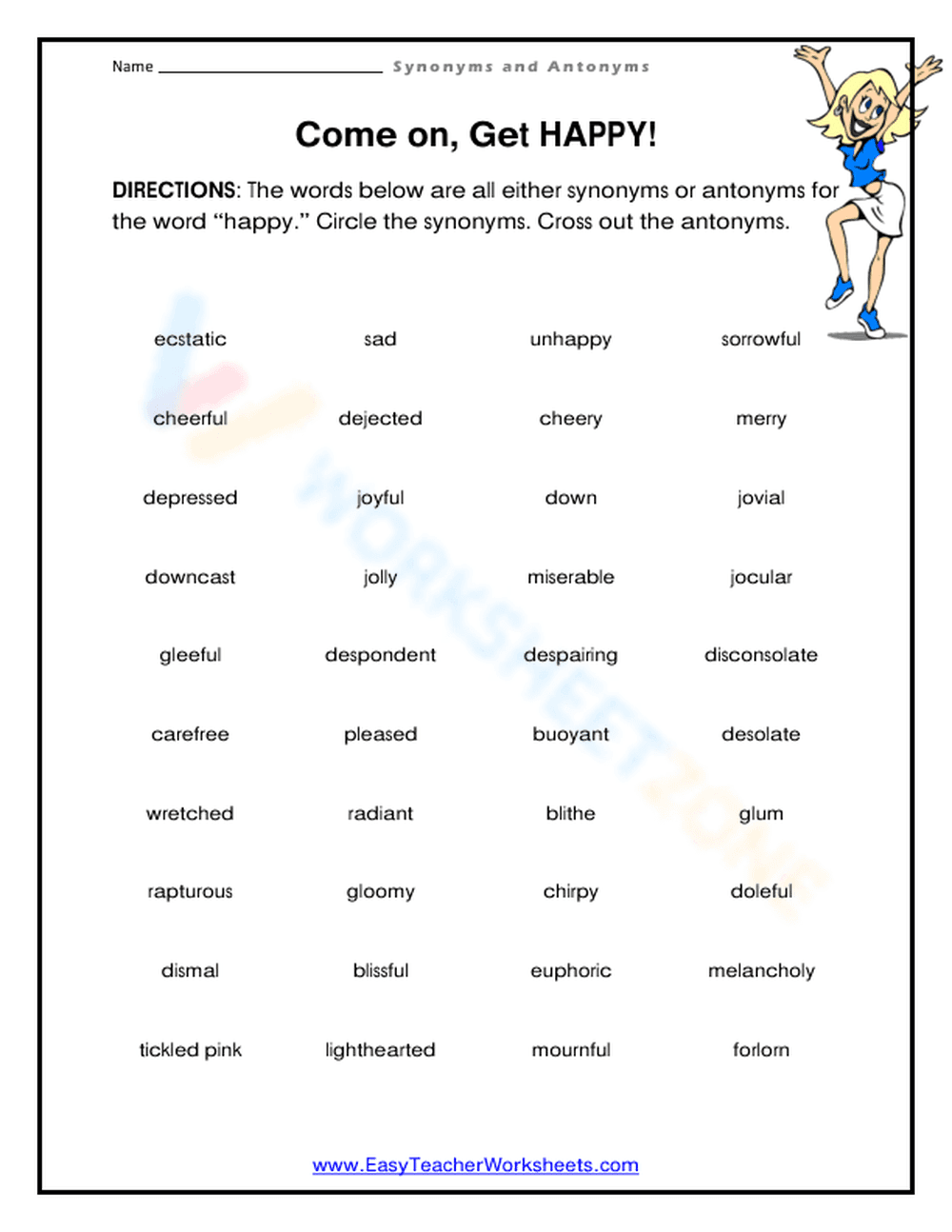

Essential Synonyms and Antonyms Worksheet | Grade 4 ELA
Paste this activity's link or code into your existing LMS (Google Classroom, Canvas, Teams, Schoology, Moodle, etc.).
Students can open and work on the activity right away, with no student login required.
You'll still be able to track student progress and results from your teacher account.
Build vocabulary and emotional intelligence with this targeted Grade 4 English Language Arts worksheet. By identifying synonyms and antonyms for the word "happy," students develop a nuanced understanding of descriptive language. This resource helps learners distinguish between intensities of emotion, which is a critical step toward improved reading comprehension and expressive writing.
At a Glance
- Grade: 4 · Subject: ELA
- Standard:
CCSS.ELA-LITERACY.L.4.5.c— Relate words to their opposites and words with similar meanings- Skill Focus: Synonyms and Antonyms (Emotion Words)
- Format: 1 page · 40 problems · Answer key included · PDF
- Best For: Vocabulary building and morning work
- Time: 15–20 minutes
What's Inside
This one-page printable features a high-density word bank containing 40 different terms. Each word is specifically related to the concept of happiness, either as a direct synonym or an antonym. The worksheet provides clear directions for circling synonyms and crossing out antonyms, ensuring students can work independently. A full answer key is provided to facilitate rapid grading or student self-correction.
Skill Progression
- Guided Practice: The activity begins with high-frequency words like "sad" and "cheerful" to establish core concepts of opposing meanings.
- Supported Practice: Students encounter moderate-level vocabulary such as "downcast" and "joyful," requiring careful thought about specific emotional states.
- Independent Practice: The final challenge includes advanced academic terms like "disconsolate" and "euphoric," pushing students to apply knowledge to complex vocabulary.
This increasing difficulty naturally supports the gradual-release model, allowing for a structured transition from teacher-led modeling to independent mastery.
Standards Alignment
The primary focus is CCSS.ELA-LITERACY.L.4.5.c, requiring students to demonstrate understanding of words by relating them to their opposites (antonyms) and to words with similar meanings (synonyms). By working through 40 variations of the word "happy," students explore nuances in language and semantic relationships. Both standard codes can be copied directly into lesson plans, IEP goals, or district curriculum mapping tools.
How to Use It
Use this worksheet as a formative assessment during a grammar unit on word relationships. It serves as an excellent bell-ringer after students have been introduced to the definitions of synonyms and antonyms. Teachers should observe students as they work, noting those who struggle with higher-tier vocabulary words like "melancholy." Completion typically takes 15 to 20 minutes depending on the student's reading speed.
Who It's For
This resource is ideal for Grade 4 students, though it works well for Grade 3 learners ready for vocabulary extension. It provides natural support for English Language Learners by grouping related emotional terms together in a predictable format. This worksheet pairs well with a classroom "emotion wheel" or an anchor chart focusing on descriptive adjectives and shades of meaning.
Instructional strategies focused on word relationships, specifically synonyms and antonyms, are fundamental for expanding a student's lexical range. This worksheet aligns with CCSS.ELA-LITERACY.L.4.5.c by requiring students to actively distinguish between similar and opposite meanings for the core concept of "happy." Research in the NAEP (2024) indicates that students who possess a deep understanding of word relationships exhibit significantly higher reading comprehension scores, as they are better equipped to interpret nuances in text. By categorizing 40 distinct emotion-based terms, this activity reinforces the cognitive patterns necessary for sophisticated language processing. Systematic practice with these semantic connections helps bridge the gap between basic vocabulary and academic literacy. This tool provides a structured environment for students to engage with "tier two" words, ensuring they can accurately identify and apply descriptive language in both academic and creative writing contexts.


