


























Views
Downloads

Printable Color Matching Worksheet | Kindergarten ELA
Paste this activity's link or code into your existing LMS (Google Classroom, Canvas, Teams, Schoology, Moodle, etc.).
Students can open and work on the activity right away, with no student login required.
You'll still be able to track student progress and results from your teacher account.
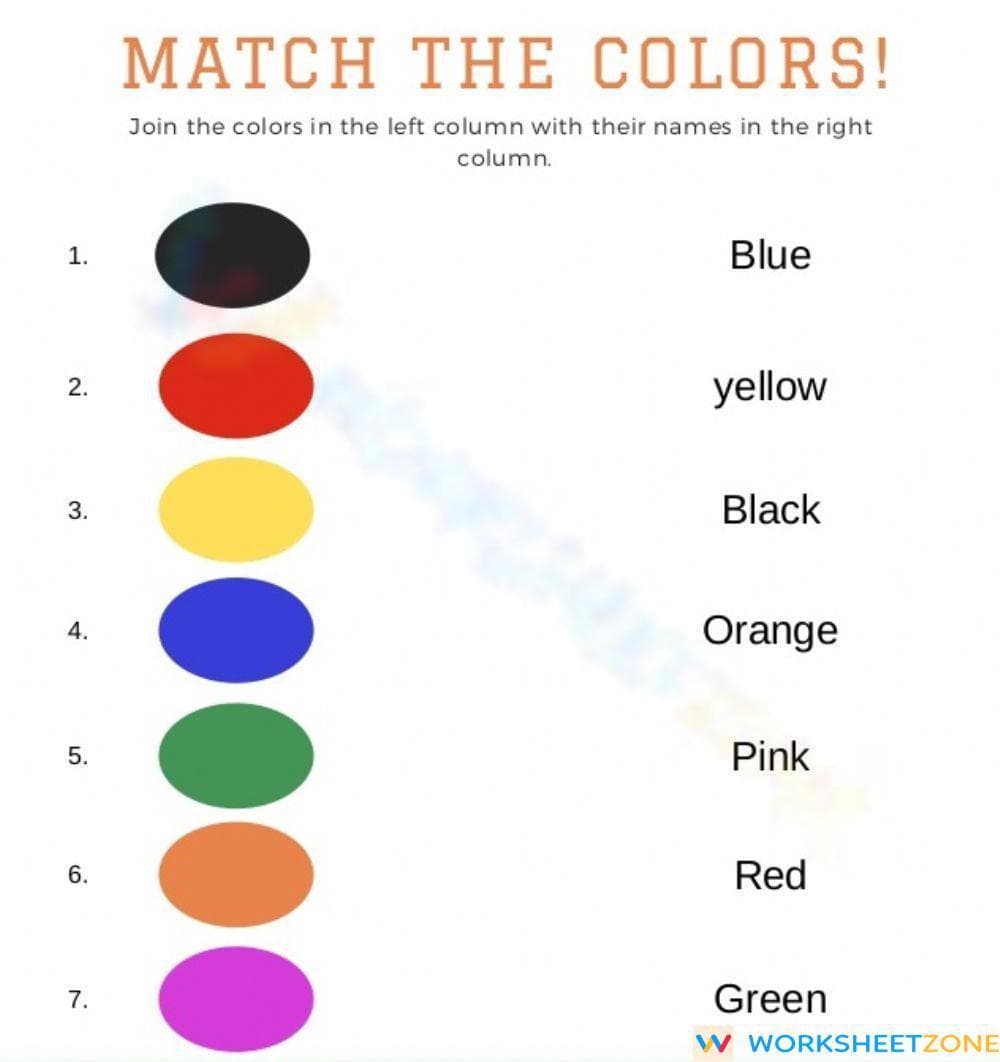
This Kindergarten color matching worksheet helps young learners master basic vocabulary through visual identification. Students connect seven vibrant color ovals to their corresponding printed names, reinforcing the relationship between visual stimuli and written language. By engaging with these essential high-frequency words, children build the foundational literacy skills necessary for early reading success.
At a Glance
- Grade: Kindergarten · Subject: English Language Arts
- Standard:
CCSS.ELA-LITERACY.L.K.5.A— Sort common objects into categories to gain a sense of the concepts represented- Skill Focus: Color word recognition and visual matching
- Format: 1 page · 7 problems · Answer key included · PDF
- Best For: Independent morning work or vocabulary center practice
- Time: 5–10 minutes
What's Inside
This printable PDF contains one focused activity page featuring seven distinct color icons (black, red, yellow, blue, green, orange, and pink). The layout uses a clean, two-column matching format designed to reduce cognitive load for early learners. Large fonts and clear borders ensure the task remains accessible for students developing fine motor skills and letter recognition.
Zero-Prep Workflow
This essential resource requires zero teacher preparation. Simply print the single-page document (30 seconds), distribute it to your students (30 seconds), and facilitate a quick group review of the results (1 minute). With a total prep time under two minutes, it serves as an ideal sub-plan filler, transition activity, or immediate formative assessment tool during a colors unit.
Standards Alignment
The primary focus of this task is CCSS.ELA-LITERACY.L.K.5.A, which requires students to sort common objects into categories to gain a sense of the concepts they represent. It also supports CCSS.ELA-LITERACY.RF.K.3, reinforcing phonics and word recognition through repeated exposure to color labels. Both standard codes can be copied directly into lesson plans, IEP goals, or district curriculum mapping tools.
How to Use It
Use this worksheet as a "Quick Check" after a group read-aloud focused on rainbow themes or color identification. During the activity, observe if students can identify the colors by sight before looking at the words, which provides a valuable data point on their visual-to-verbal processing. Most students will complete the seven matching items within five to ten minutes.
Who It's For
This resource is designed for Preschool, Kindergarten, and Grade 1 students who are beginning to recognize environmental print. It is particularly effective for English Language Learners (ELL) and students with IEPs requiring visual supports. For differentiation, pair this sheet with real-world manipulatives like colored blocks or an anchor chart displaying the color names in large, bold print.
According to the NAEP 2024 framework for early literacy, the ability to map visual concepts to written labels is a critical precursor to reading fluency. This color matching activity, aligned to CCSS.ELA-LITERACY.L.K.5.A, directly addresses that need by providing structured practice in word-concept association. Research from Fisher & Frey (2014) emphasizes that "gradual release" activities, such as this guided matching task, allow students to move from modeled recognition to independent mastery of high-frequency vocabulary. By focusing on seven distinct color categories, the worksheet helps students build a mental schema for descriptive language, which is essential for both informational and narrative text comprehension in later grades. Educators can use this data-driven approach to identify students who may need additional support in letter-sound correspondence or basic conceptual sorting. This printable resource ensures that every child has access to essential, evidence-based vocabulary practice that aligns with national standards and proven instructional methodologies.


