


























Views
Downloads
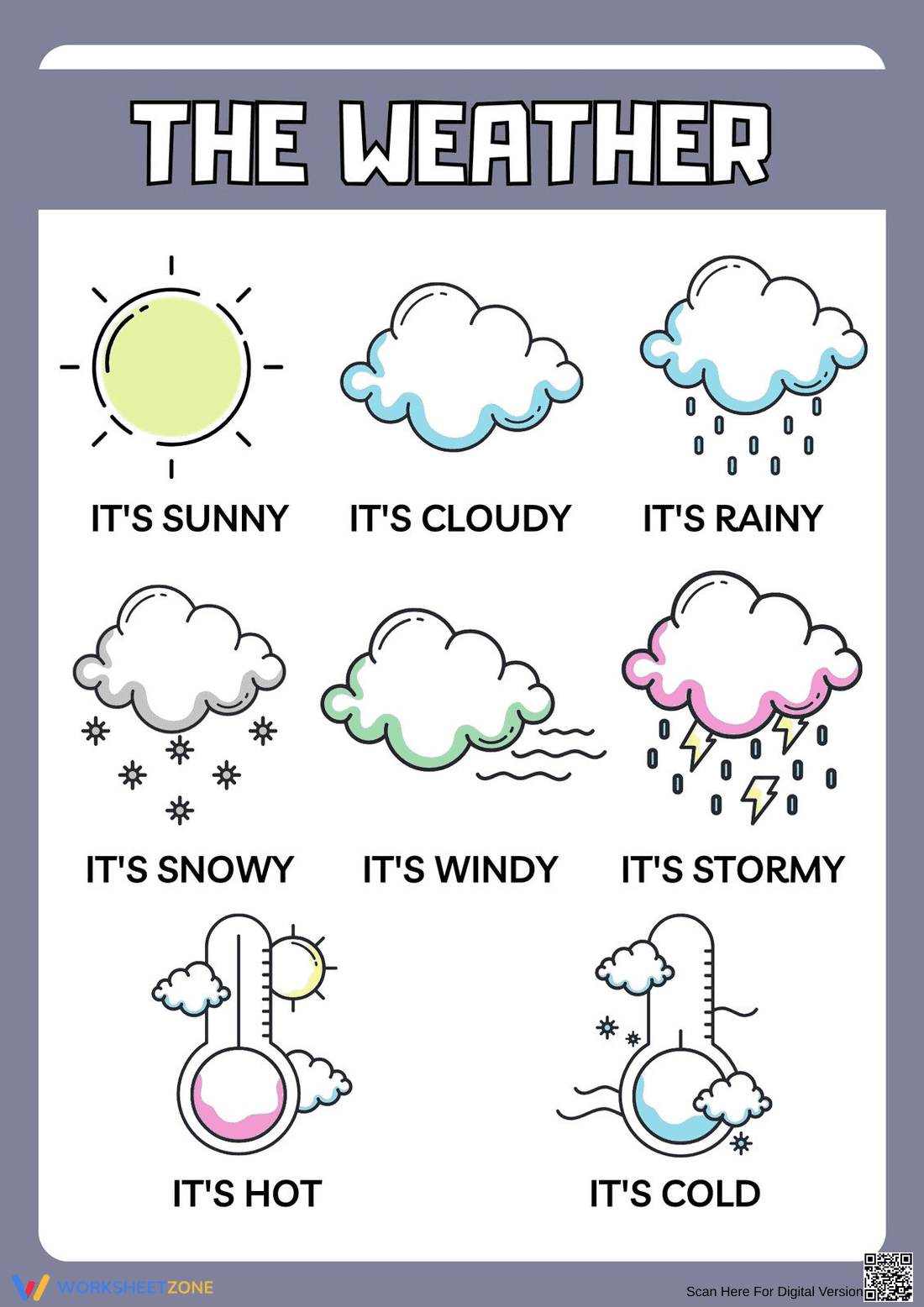

Weather Picture Dictionary | Grade K-1 Printable
Paste this activity's link or code into your existing LMS (Google Classroom, Canvas, Teams, Schoology, Moodle, etc.).
Students can open and work on the activity right away, with no student login required.
You'll still be able to track student progress and results from your teacher account.
This Grade K-1 weather picture dictionary provides young learners with 8 essential vocabulary terms paired with clear, engaging illustrations. By connecting visual cues to written phrases like "It's sunny" and "It's stormy," students build the foundational language skills necessary to describe the world around them during daily calendar routines or science observations.
At a Glance
- Grade: Kindergarten · Subject: ELA / ESL
- Standard:
CCSS.ELA-LITERACY.L.K.5.A— Sort common objects into categories to gain a sense of the concepts- Skill Focus: Weather vocabulary association
- Format: 2 pages · 8 terms · Reference sheet · PDF
- Best For: Daily morning meetings and ESL support
- Time: 5–10 minutes
The resource includes two distinct versions: a vibrant, full-color page for digital display or classroom posters, and a black-and-white version perfect for student notebooks or coloring activities. Each page features 8 distinct weather conditions, including temperature indicators (hot and cold) and atmospheric states (windy, snowy, rainy), using simple "It is" sentence structures.
The zero-prep workflow for this resource is designed for immediate classroom integration. First, print the desired version (30 seconds). Next, distribute the sheets to students to keep in their writing folders or science journals (1 minute). Finally, review the 8 terms as a whole group using the "point and repeat" method (5 minutes). Total teacher preparation time is under 2 minutes, making it an ideal addition to emergency sub plans.
This worksheet aligns with CCSS.ELA-LITERACY.L.K.5.A, focusing on sorting common objects into categories to gain a sense of the concepts the categories represent. It also supports CCSS.ELA-LITERACY.L.1.6 by helping students use words and phrases acquired through conversations and reading. Both standard codes can be copied directly into lesson plans, IEP goals, or district curriculum mapping tools.
Use this dictionary during your morning meeting to help students identify the current weather. It serves as an excellent formative assessment tool; simply ask students to point to the picture that matches the window's view. Expected completion for a matching or coloring activity is 10 to 15 minutes, depending on the student's fine motor skills and the specific instructional goal.
This resource is ideal for Kindergarten and 1st-grade students, as well as English Language Learners (ELL) who require visual scaffolding. It pairs naturally with a daily weather chart or a primary science unit on seasons and atmospheric changes. The clear font and simple graphics ensure accessibility for early readers who are just beginning to decode simple sentences.
Research from Fisher & Frey (2014) emphasizes the importance of visual supports in vocabulary acquisition, particularly for early readers and second-language learners. By providing a picture dictionary format, this resource reduces the cognitive load required to process new linguistic labels. The inclusion of 8 specific weather terms allows for a manageable yet comprehensive introduction to environmental descriptions. According to the RAND AIRS 2024 report on instructional materials, high-quality visual aids significantly improve retention rates for foundational Tier 1 vocabulary. This worksheet provides the necessary scaffolding to move students from simple recognition to active production of weather-related phrases. By aligning with CCSS.ELA-LITERACY.L.K.5.A, the tool ensures that students are not just memorizing words but are categorizing environmental concepts effectively. This structured approach to language development is essential for building the background knowledge required for later reading comprehension and scientific inquiry in elementary education.


