


























Views
Downloads
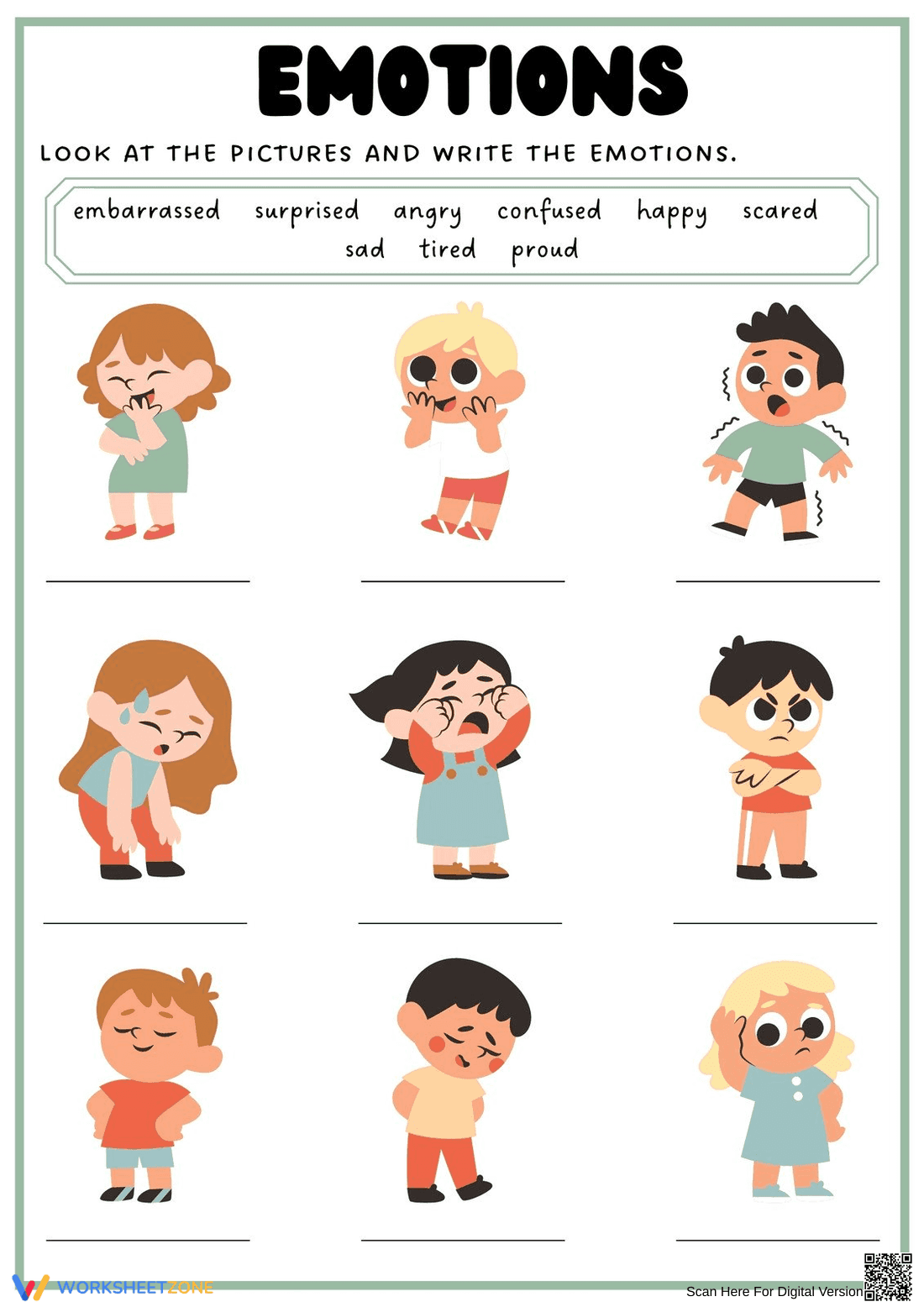

Essential Identifying Emotions Worksheet for K-1
Paste this activity's link or code into your existing LMS (Google Classroom, Canvas, Teams, Schoology, Moodle, etc.).
Students can open and work on the activity right away, with no student login required.
You'll still be able to track student progress and results from your teacher account.
This Grade K-1 emotions worksheet helps students identify and label nine distinct feelings using visual cues and a word bank. By connecting facial expressions to specific vocabulary, learners build essential social-emotional awareness and language skills. It provides a clear, structured way for young students to practice emotional literacy and descriptive writing.
At a Glance
- Grade: K-1 · Subject: ELA / SEL
- Standard:
CCSS.ELA-LITERACY.L.K.5.C— Identify real-life connections between words and their use- Skill Focus: Identifying and labeling emotions
- Format: 1 page · 9 problems · Answer key included · PDF
- Best For: Morning work or SEL lessons
- Time: 10–15 minutes
What's Inside
This single-page PDF features nine high-quality illustrations of children expressing various emotional states. A clear word bank at the top includes terms like "embarrassed," "surprised," and "proud." Students observe the character's body language and facial expressions, then select the correct word to write on the provided line. The layout is clean and distraction-free for early learners.
Zero-Prep Workflow
- Print: Generate copies in less than 30 seconds for your entire class.
- Distribute: Hand out the sheets and spend 1 minute reviewing the word bank terms.
- Review: Spend 5 minutes discussing the visual cues for each emotion to check for understanding.
The total teacher preparation time is less than 2 minutes, making it an ideal choice for substitute folders or transition periods.
Standards Alignment
This worksheet aligns with `CCSS.ELA-LITERACY.L.K.5.C`, which requires students to identify real-life connections between words and their use, specifically regarding feelings. It also supports `CCSS.ELA-LITERACY.L.1.5`, focusing on word relationships and nuances in word meanings. Both standard codes can be copied directly into lesson plans, IEP goals, or district curriculum mapping tools.
How to Use It
Use this worksheet as a formative assessment during a Social-Emotional Learning (SEL) unit to gauge student understanding of non-verbal cues. Alternatively, assign it as a vocabulary-building activity during ELA centers. Observe if students can distinguish between similar emotions like "sad" and "tired" based on the visual evidence. Completion typically takes 10 to 15 minutes.
Who It's For
This resource is tailored for Kindergarten and 1st-grade students developing their emotional vocabulary. It is particularly effective for English Language Learners (ELLs) who benefit from the direct pairing of images and text. Pair this worksheet with a read-aloud about feelings or an "Emotions" anchor chart to reinforce the concepts.
According to research by Fisher & Frey (2014) on the gradual release of responsibility, visual scaffolds like the illustrations in this worksheet are critical for early literacy development. By providing a word bank alongside clear pictorial representations, the resource reduces cognitive load, allowing students to focus on the semantic connection between the feeling and the written word. This alignment with CCSS.ELA-LITERACY.L.K.5.C ensures that students are not just memorizing words but are identifying real-life connections between language and human experience. The 9-task structure provides sufficient repetition for mastery without overwhelming young learners. Such evidence-based design supports both general education students and those requiring Tier 2 interventions in social-emotional development. This worksheet serves as a reliable tool for building the foundational vocabulary necessary for more complex reading comprehension and interpersonal communication in later elementary grades.


