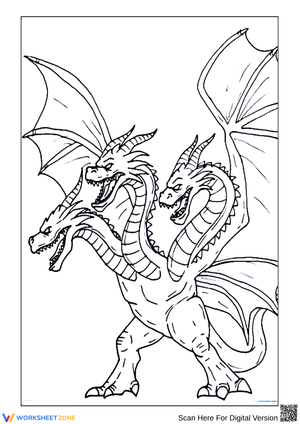
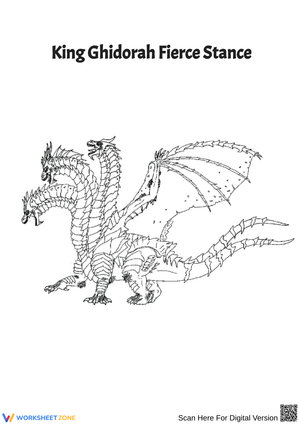
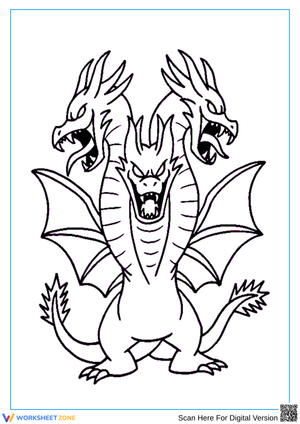
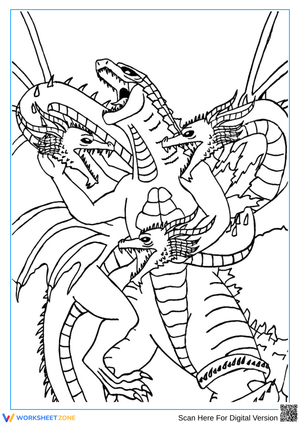
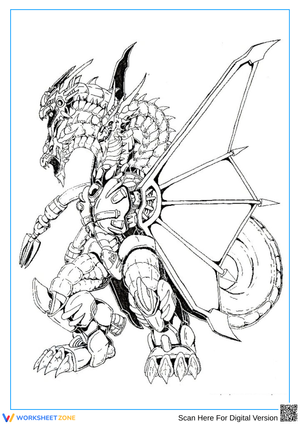
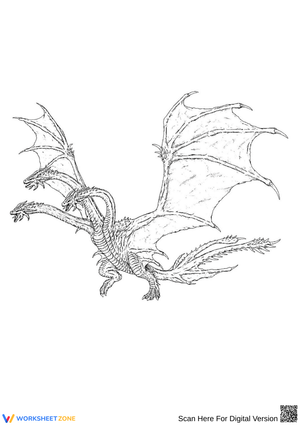
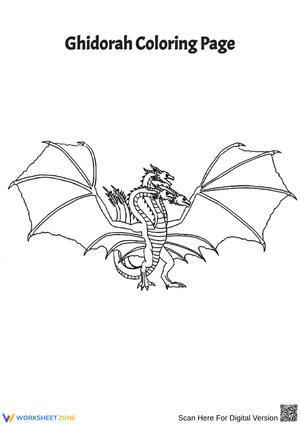
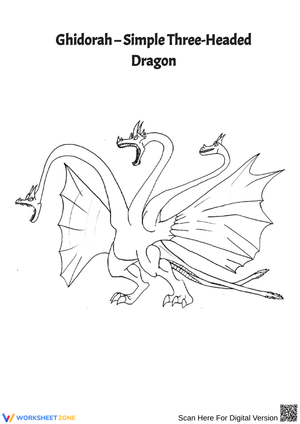
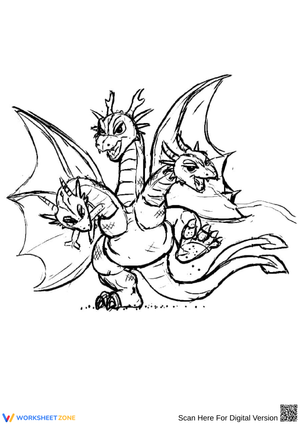
King Ghidorah stands out from every other kaiju with a golden, scaly body, two spiked tails, and a huge pair of leathery wings. The real challenge for colorists is the three snarling dragon heads, each with its own jaw, teeth, and neck frills that need separate shading. Most King Ghidorah coloring pages show him mid-roar or blasting his signature gravity beams, giving young artists plenty of jagged scales and dramatic lines to fill in with gold, amber, and deep yellow tones.
What You'll Find in the Collection
The set of Ghidorah printables ranges from simple full-body roaring poses to close-up head shots that zoom in on a single snarling face. Several sheets place him in classic battle scenes against Godzilla, with both kaiju locked in combat under a crumbling city skyline, while others pair him with Mothra for a three-way monster clash. There are also solo flying poses that highlight his wingspan and twin tails stretched out across the page.
Coloring Tips and Printing Setup
For the scales, layer yellow first, then add orange and brown in the crevices so the body looks textured instead of flat. Gravity beams look best in electric blue, purple, or magenta with white highlights left uncolored for glow. Each design fits standard US letter paper, and printing on cardstock keeps the outlines crisp under crayon, marker, or colored pencil without the paper buckling or tearing during longer coloring sessions.
Frequently Asked Questions
1. Which colors work best for the heads and beams?
Gold, yellow, and burnt orange bring out the scaly texture across the body and three necks, while a darker brown or black in the mouths and claws adds contrast. For the signature gravity beams, blue, violet, or hot pink create an energetic glow effect. Leaving thin white gaps between beam layers makes the light look like it is radiating outward from each mouth.
2. Are these pages better for kids or older fans?
Both groups are covered. Simple single-head or standing poses with bold, thick lines work well for younger kids still building coloring control. Detailed full-body designs with battle backgrounds, wing patterns, and layered tails appeal more to teens and adult kaiju fans who want a longer, more involved project. Parents can pick based on a child's age and patience for fine detail.
3. What is a surprising fact about King Ghidorah's origin?
King Ghidorah first appeared in the 1964 Toho film Ghidorah, the Three-Headed Monster, but his design traces back much further. He was inspired by Yamata no Orochi, an ancient Japanese dragon myth that originally had eight heads. Filmmakers trimmed that number down to three for the screen, giving today's coloring pages their instantly recognizable triple-headed silhouette.












 Interactive Worksheet Maker
 Quiz Maker
 Word Search Maker
 Crossword Puzzle Maker
 Word Scramble Generator
 Sentence Scramble Generator
 Handwriting Worksheet Generator
 Name Tracing Generator
 Fill In The Blank Generator