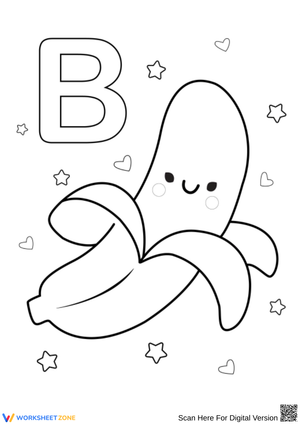
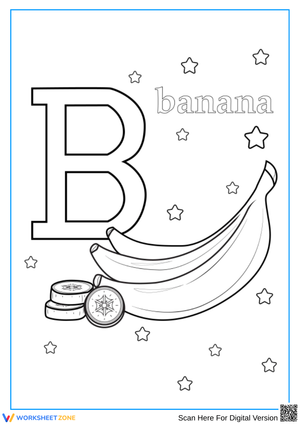
What You'll Find in This Banana Collection
This set of banana coloring pages covers more ground than a single peeled fruit. You'll find cartoon bananas with smiling faces, realistic bunches still attached at the stem, single peeled bananas showing the inner fruit, banana splits with scoops of ice cream, and mixed fruit bowl scenes pairing bananas with apples or grapes. Each design uses bold, closed outlines so color stays contained. Whether a printable shows one curved banana or a full hand of six, the line art stays clean enough for both crayon and marker use.
Which Design Fits Which Age or Skill Level
Toddlers and preschoolers do best with a single thick-outline banana that has almost no interior detail, since the wide curve is forgiving for small hands still learning to stay inside lines. Early elementary kids can handle a bunch of three or four bananas with peel-crease lines. Teens and adults get the most out of denser pages: fruit-bowl scenes, banana splits, or bananas rendered with realistic stem and tip shading that rewards colored pencils and layered blending.
Coloring Techniques Using Ripeness Stages
Real bananas shift color as they ripen, and that gives coloring pages a built-in shading guide. Green marks an unripe banana, solid yellow shows peak ripeness, and yellow with brown speckles signals an overripe one headed toward banana bread. Try coloring one banana in a bunch green and the rest yellow to mimic a produce-aisle photo. For peel texture, add thin darker-yellow lines along the natural ridges, and leave a small white highlight strip to suggest the peel's shine under light.
Frequently Asked Questions
1. What supplies work best for these coloring sheets?
Crayons are the easiest choice for toddlers because they resist tearing the paper and forgive uneven pressure. Markers give bold, saturated color that suits simple single-banana printables but can bleed through thin paper, so standard 24 to 32 lb printer paper or cardstock works better than lightweight copy paper. Colored pencils are best for detailed bunch or fruit-bowl designs, since they allow layering yellow, green, and brown to mimic real ripeness shading.
2. Can banana coloring pages support a fruit or healthy-eating activity?
Yes. Because bananas are a familiar, well-known source of potassium, magnesium, and vitamin B6, these printables pair naturally with a snack-time chat about healthy fruit choices or a simple nutrition-themed coloring station. Parents can hand a child a banana-split page after fruit tasting, while teachers can use bunch or fruit-bowl designs during a classroom fruit unit without needing any extra materials beyond crayons or pencils.
3. What is a surprising fact tied to these coloring pages?
Bananas are technically a berry, not a tree fruit, and they grow on giant herb plants in clusters called hands, with each individual banana called a finger. Nearly every banana sold in US stores is the Cavendish variety, yet the FAO recognizes almost 1,000 banana varieties worldwide, originating in Southeast Asia. That range makes bunch and fruit-bowl printables a fun way to imagine less common shapes and colors.












 Interactive Worksheet Maker
 Quiz Maker
 Word Search Maker
 Crossword Puzzle Maker
 Word Scramble Generator
 Sentence Scramble Generator
 Handwriting Worksheet Generator
 Name Tracing Generator
 Fill In The Blank Generator