


























Views
Downloads


Printable Pattern Tracing Worksheet: K Handwriting
Paste this activity's link or code into your existing LMS (Google Classroom, Canvas, Teams, Schoology, Moodle, etc.).
Students can open and work on the activity right away, with no student login required.
You'll still be able to track student progress and results from your teacher account.
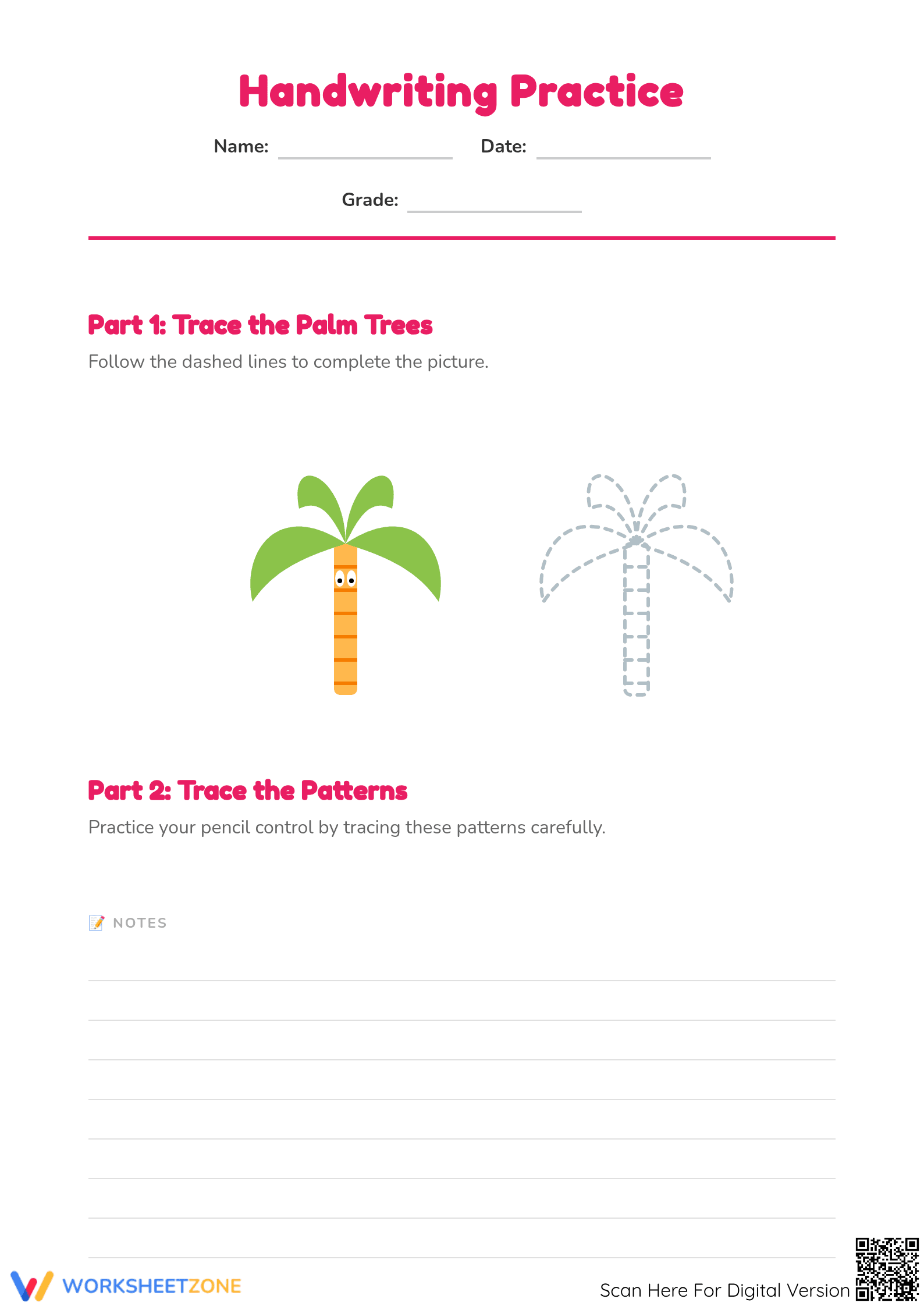
This Kindergarten pattern tracing worksheet builds essential fine motor skills through engaging visual tasks. Students trace palm tree outlines and complex geometric paths to develop the pencil control necessary for neat letter formation. This resource provides an immediate, high-success activity for early learners starting their handwriting journey.
At a Glance
- Grade: Kindergarten · Subject: Handwriting
- Standard:
CCSS.ELA-LITERACY.L.K.1.A— Print many upper- and lowercase letters using proper pencil grip and posture- Skill Focus: Developing Fine Motor Control & Geometric Pattern Recognition
- Format: 2 pages · 4 tasks · Printable · PDF
- Best For: Independent morning work stations or handwriting centers
- Time: 10–15 minutes of quiet focused practice
What's Inside
This two-page resource features a structured approach to handwriting readiness. Page one introduces a thematic "Trace the Palm Trees" activity, combining creative coloring potential with guided line work. Page two offers three distinct pattern paths—zigzag, square-topped, and scalloped—that challenge students to maintain consistent pencil pressure and directionality across the page.
Zero-Prep Workflow
The zero-prep workflow for this resource is designed for maximum classroom efficiency. First, print the two-page PDF (30 seconds). Second, distribute the sheets to students during your morning transition or center rotation (1 minute). Third, conduct a quick "pencil check" to ensure proper tripod grip as students begin (30 seconds). This entire setup requires less than two minutes of teacher preparation time, making it an ideal choice for busy mornings or unexpected substitute teacher plans.
Standards Alignment
This worksheet aligns with CCSS.ELA-LITERACY.L.K.1.A: "Print many upper- and lowercase letters." While the task focuses on shapes and patterns, these movements are the foundational building blocks for forming vertical, horizontal, and curved letter strokes. Both standard codes can be copied directly into lesson plans, IEP goals, or district curriculum mapping tools.
How to Use It
Use this worksheet as a "warm-up" before a formal letter-writing lesson to loosen students' wrist muscles. Teachers should observe student progress specifically looking for "line-crossing" behavior—where a student lifts the pencil prematurely—to identify those needing extra occupational therapy support. This activity typically takes 12 minutes to complete with high engagement.
Who It's For
This resource is designed for Preschool and Kindergarten students who are beginning to master pencil grip. It is particularly effective for students requiring extra fine motor support or as an independent activity following a direct instruction lesson on line types. Pair this with a textured tracing tray or sand writing for a multi-sensory experience.
The integration of pattern tracing into early childhood curricula is a critical step in developing the cognitive-motor pathways required for fluent literacy. According to RAND AIRS 2024, students who engage in regular fine motor "pre-writing" activities, such as tracing complex patterns like those found in this worksheet, demonstrate significantly higher accuracy in letter formation by the end of the Kindergarten year compared to those who focus solely on letter memorization. This worksheet targets the standard CCSS.ELA-LITERACY.L.K.1.A by reinforcing the muscular memory needed for curved and angular strokes. Fisher & Frey (2014) highlight that gradual release models in handwriting benefit from these types of low-stakes, high-scaffold tracing tasks. By isolating the motor skill from the cognitive load of letter identification, students build the confidence and stamina necessary for longer writing assignments later in the academic cycle.


