


























Views
Downloads
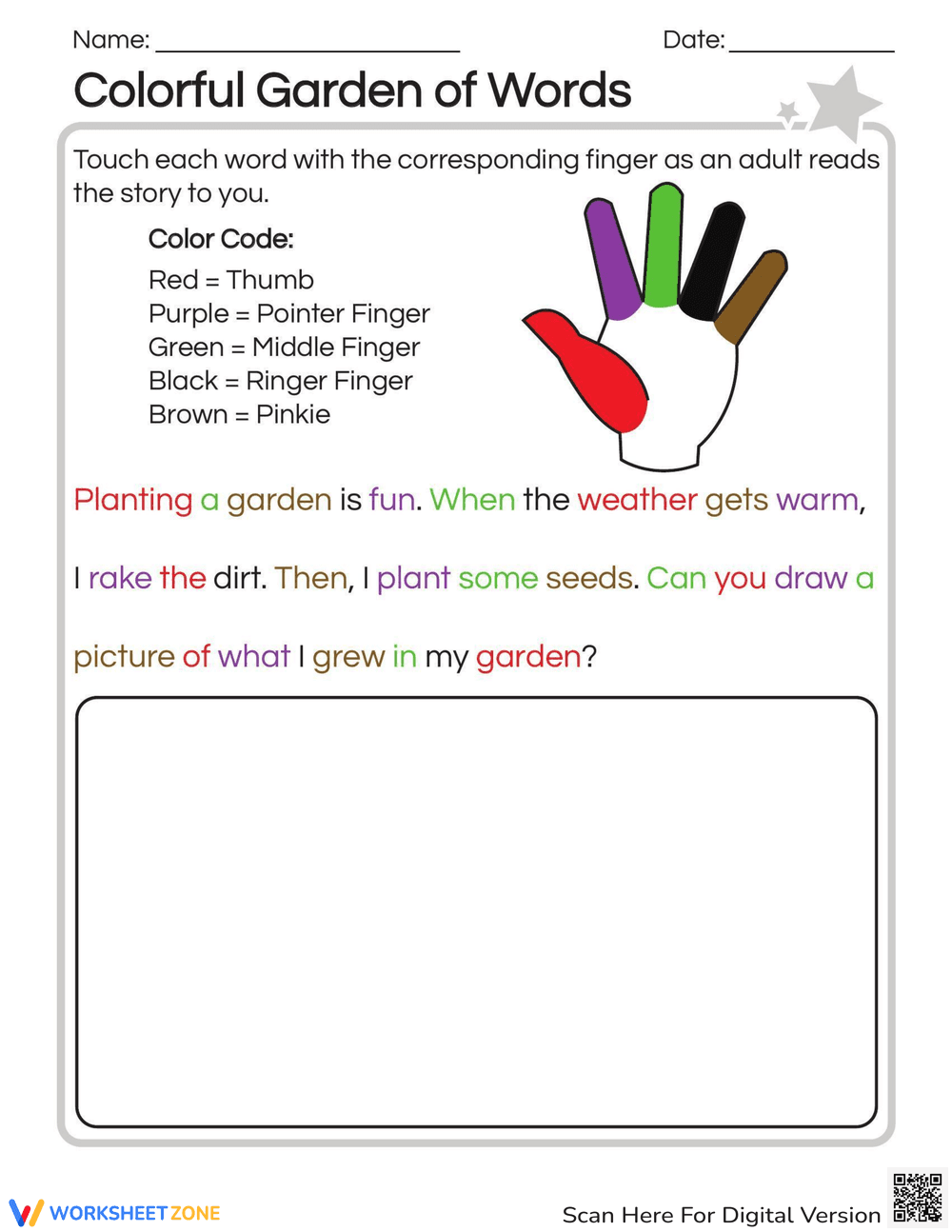

Printable Garden of Words Worksheet | Grade 1–2
Paste this activity's link or code into your existing LMS (Google Classroom, Canvas, Teams, Schoology, Moodle, etc.).
Students can open and work on the activity right away, with no student login required.
You'll still be able to track student progress and results from your teacher account.
This printable garden-themed worksheet builds early literacy skills by guiding Grade 1 and Grade 2 students through finger tracking, word spacing recognition, and left-to-right directionality — all within a colorful, engaging garden context that keeps young learners focused and motivated.
At a Glance
- Grade: 1–2 · Subject: English Language Arts / Early Literacy
- Standard:
RF.K.1.A— Follow words left to right, top to bottom, and page by page- Skill Focus: Finger tracking, word spacing, concepts of print
- Format: 1 page · 4 problems · No answer key · PDF
- Best For: Guided reading warm-up or literacy center
- Time: 10–15 minutes
Inside, students encounter a garden-themed layout featuring simple sentences and illustrated prompts. Tasks ask students to track words with their finger, identify spaces between words, and draw their own garden creation to reinforce print concepts. The single-page format keeps cognitive load low while the visual theme sustains engagement across the full activity.
Skill Progression
- Guided practice: Teacher-led finger tracking along 2 modeled sentences — students follow the pointer word by word, left to right.
- Supported practice: Students independently track 1 sentence with a finger while a partner checks directionality — light peer scaffold.
- Independent practice: Students draw their own garden scene and label it, applying word-spacing awareness without prompting.
This sequence mirrors a gradual-release model (I Do, We Do, You Do), moving students from full support to independent application within a single sitting.
Standards Alignment
Primary standard: RF.K.1.A — Students follow words from left to right, top to bottom, and page by page. Supporting concept: word boundaries and spacing as visual cues for early readers, addressed through the spacing identification tasks. Both standard codes can be copied directly into lesson plans, IEP goals, or district curriculum mapping tools.
How to Use It
Use before direct instruction as a print-concept warm-up: distribute the sheet and observe which students self-correct tracking direction — a quick formative check requiring no additional materials. Alternatively, assign during a literacy center rotation after a shared reading lesson; students complete all 4 tasks in 10–15 minutes. Watch for students who skip spaces when labeling their drawing — this signals a gap in word-boundary awareness worth noting for small-group follow-up.
Who It's For
Best suited for Grade 1 students consolidating foundational print concepts and Grade 2 students who need a brief review before moving to fluency work. Pairs naturally with a big-book shared reading anchor text or a classroom word wall focused on high-frequency words. Students who finish early can extend by writing a second sentence about their garden drawing, adding a natural challenge without a separate worksheet.
Concepts of print remain a critical gateway skill for early readers. Research from NAEP longitudinal data shows students who master directionality and word-boundary awareness in Grades K–2 demonstrate significantly stronger decoding fluency by Grade 3. Standard RF.K.1.A targets the foundational behavior of following print left to right, top to bottom — the prerequisite for all subsequent phonics and word-recognition instruction. Fisher & Frey (2014) identify explicit print-concept modeling within a gradual-release framework as a high-leverage practice for closing early literacy gaps. This 1-page, 4-task worksheet operationalizes that framework in a low-prep, visually motivating format appropriate for Grades 1–2, making it a practical tool for classroom instruction, literacy centers, or targeted small-group intervention aligned to RF.K.1.A.


