


























Views
Downloads
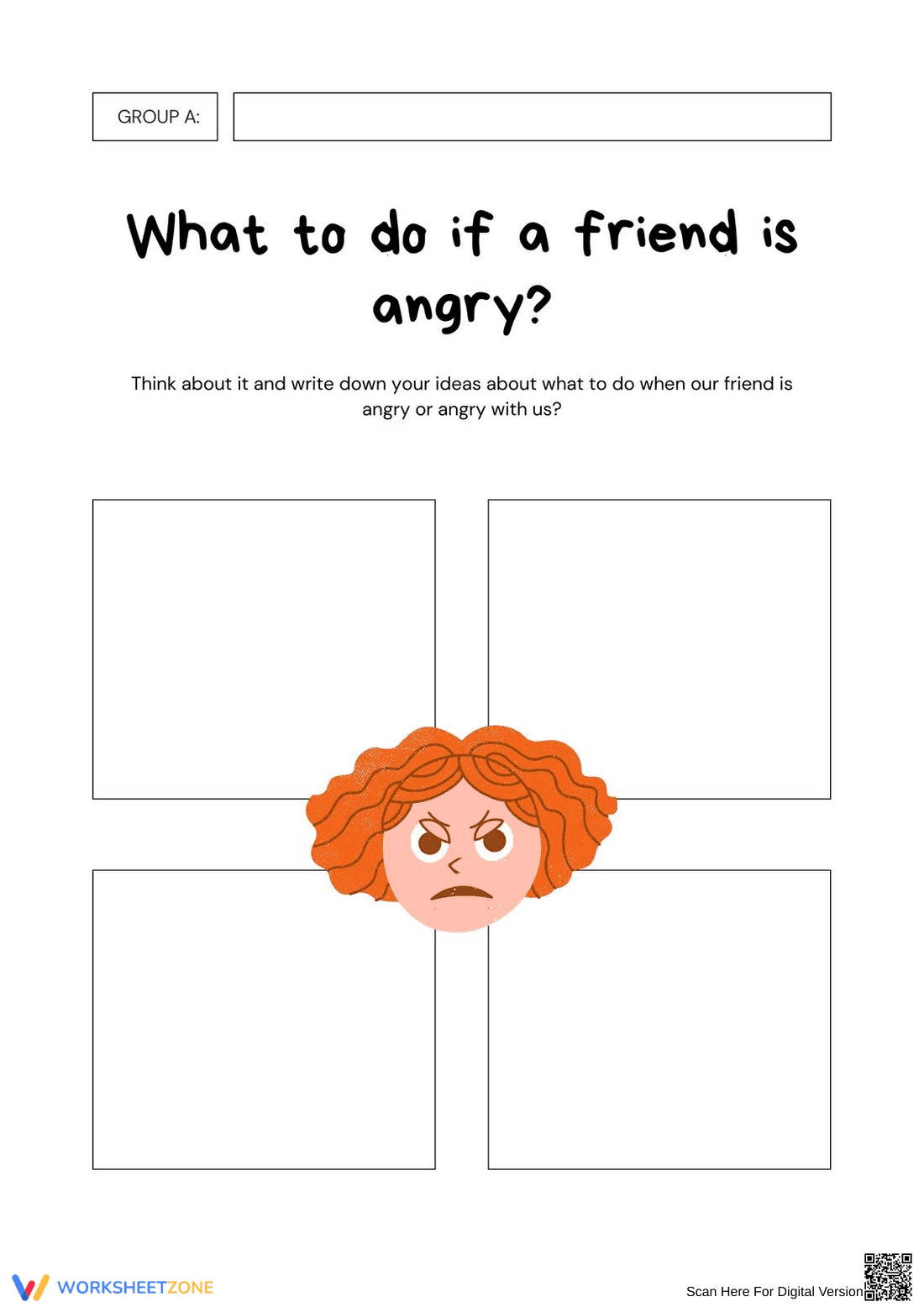

Printable Friend Emotions Worksheet | Grade 2 SEL
Paste this activity's link or code into your existing LMS (Google Classroom, Canvas, Teams, Schoology, Moodle, etc.).
Students can open and work on the activity right away, with no student login required.
You'll still be able to track student progress and results from your teacher account.
This Grade 2 social-emotional learning worksheet prompts students to explore conflict resolution and empathy. By brainstorming actionable steps to take when a friend is angry, young learners develop critical relationship skills while practicing expressive writing. The open-ended format encourages thoughtful reflection on personal experiences and peer interactions.
At a Glance
- Grade: 2 · Subject: SEL
- Standard:
CCSS.ELA-LITERACY.W.2.8— Recall experiences to answer a question- Skill Focus: Conflict resolution and empathy
- Format: 1 page · 4 problems · No answer key · PDF
- Best For: Morning work or SEL blocks
- Time: 15–20 minutes
This single-page resource features a central illustration of an angry character surrounded by four blank response boxes. The clear, direct prompt asks students to think about and write down their ideas regarding what to do when a friend is angry. The spacious boxes accommodate both written sentences and drawn pictures, making it accessible for varying writing abilities. Because the responses are entirely subjective and based on personal emotional intelligence, no answer key is required.
This resource is designed for immediate classroom implementation with a streamlined workflow:
- Print (1 minute): The black-and-white friendly design prints quickly and clearly for an entire class.
- Distribute (1 minute): Hand out the single page during morning meeting or a dedicated social-emotional block.
- Review (3 minutes): Briefly read the prompt aloud and discuss one quick example as a class before independent work.
Total teacher preparation requires under two minutes, making this an excellent, reliable option for emergency sub plans or spontaneous teachable moments following a classroom conflict.
This activity aligns with CCSS.ELA-LITERACY.W.2.8, requiring students to recall information from experiences or gather information from provided sources to answer a question. It also supports core competencies in relationship skills and social awareness. Both standard codes can be copied directly into lesson plans, IEP goals, or district curriculum mapping tools.
Teachers can utilize this worksheet during a dedicated morning meeting focused on friendship and feelings. It serves as an excellent independent reflection activity after reading a picture book about peer conflict. Alternatively, use it as a restorative practice tool for small groups struggling with playground disagreements. While students work for the expected 15 to 20 minutes, teachers can circulate and use formative assessment observation to identify students who might need additional support with emotional regulation or perspective-taking.
This activity is primarily designed for second-grade students developing their social awareness and peer relationship skills. The open-box format provides natural differentiation, allowing emerging writers to draw their solutions while advanced students can write detailed, multi-sentence action plans. It pairs perfectly with classroom anchor charts detailing calming strategies or positive communication habits.
Developing strong peer relationship skills in early elementary school lays the foundation for long-term academic and social success. This resource directly supports CCSS.ELA-LITERACY.W.2.8 by asking students to recall experiences to answer a question about managing interpersonal conflict. According to a comprehensive EdReports 2024 analysis, integrating social-emotional prompts into daily writing tasks significantly improves both emotional vocabulary and classroom climate. When students actively brainstorm solutions to hypothetical social challenges, they build cognitive scripts that can be deployed during real-world disagreements. This targeted practice in empathy and problem-solving reduces behavioral disruptions and fosters a more inclusive learning environment. By providing structured opportunities to reflect on how to support an angry friend, educators equip young learners with the practical tools necessary for healthy emotional regulation and sustained peer connections.


