




























Views
Downloads

Grade K-1 Weather Coloring — Printable No-Prep Worksheet

Paste this activity's link or code into your existing LMS (Google Classroom, Canvas, Teams, Schoology, Moodle, etc.).
Students can open and work on the activity right away, with no student login required.
You'll still be able to track student progress and results from your teacher account.
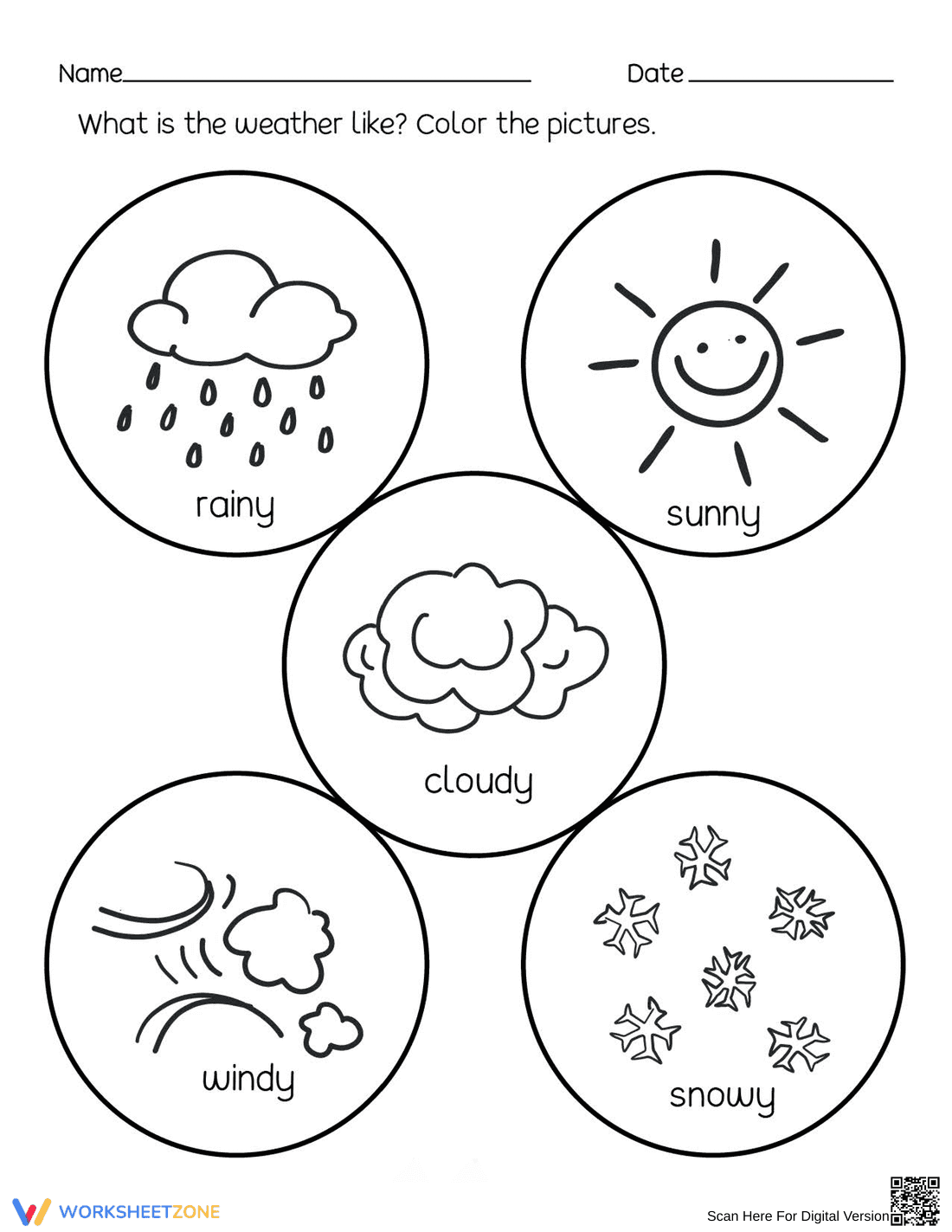
This Kindergarten science worksheet helps young learners identify and describe different weather conditions through a tactile coloring activity. By engaging with visual representations of sunny, rainy, cloudy, windy, and snowy days, students build essential scientific vocabulary while developing the fine motor skills necessary for early academic success. It is a foundational tool for atmospheric observation.
At a Glance
- Grade: Kindergarten · Subject: Science
- Standard:
K-ESS2-1— Use and share observations of local weather conditions to describe patterns over time- Skill Focus: Weather vocabulary and identification
- Format: 1 page · 5 problems · Answer key included · PDF
- Best For: Independent morning work or science centers
- Time: 10–15 minutes
This single-page PDF features five distinct circular illustrations representing common weather patterns: sun, rain, clouds, wind, and snow. Each image is accompanied by a clear, easy-to-read label in a child-friendly font. The structure includes space for the student's name and the date, making it perfect for portfolio collection. A simple answer key is provided for teacher reference.
The workflow for this resource is designed for maximum efficiency in a busy primary classroom. First, print the single-page PDF (30 seconds). Second, distribute the sheets to students during your morning routine or science block (1 minute). Third, review the completed coloring pages to check for vocabulary comprehension and observational accuracy (30 seconds per student). Total teacher prep time is under two minutes, making it an ideal sub plan.
This resource aligns with `K-ESS2-1`, which requires students to use and share observations of local weather conditions. By identifying specific features of different weather types, students begin the process of data collection and pattern recognition. This standard code can be copied directly into lesson plans, IEP goals, or district curriculum mapping tools to ensure compliance with NGSS requirements. The visual prompts serve as a scaffold for students who are still developing their writing abilities.
Use this worksheet as a formative assessment during a unit on Earth's systems. For a more interactive experience, have students look out the classroom window and color the circle that matches the current conditions first. Teachers should observe if students can verbally link the "windy" or "snowy" icons to their own physical experiences. Expected completion time for the entire activity is approximately 12 minutes, allowing for integration into tight instructional blocks.
This activity is designed for Kindergarten and Grade 1 students, including English Language Learners who benefit from the strong visual-to-text pairing. It works well as a standalone activity or when paired with a weather-themed picture book or a daily weather chart. The large, bold lines make it accessible for students working on their grip and coloring control, providing a successful experience for all learners.
According to a ScienceDirect TpT Analysis, tactile activities like coloring significantly improve vocabulary retention in early childhood science education. This Grade 1 weather worksheet for K-ESS2-1 provides a structured environment where students can internalize weather vocabulary through creative engagement. By focusing on the plain-English skill of describing weather conditions, the resource bridges the gap between abstract concepts and daily observations. The inclusion of five distinct weather types ensures that students are exposed to a broad spectrum of meteorological phenomena, supporting the cognitive scaffolding required for more complex Earth science topics in later grades. Research indicates that such visual aids are critical for learners in the pre-operational stage of development. This resource serves as a reliable, research-backed tool for educators looking to simplify their science instruction without sacrificing the depth of standards-based learning objectives in the modern classroom setting.


