


























Views
Plays



Printable Cold War Era Quiz | Grades 9-12
Paste this activity's link or code into your existing LMS (Google Classroom, Canvas, Teams, Schoology, Moodle, etc.).
Students can open and work on the activity right away, with no student login required.
You'll still be able to track student progress and results from your teacher account.
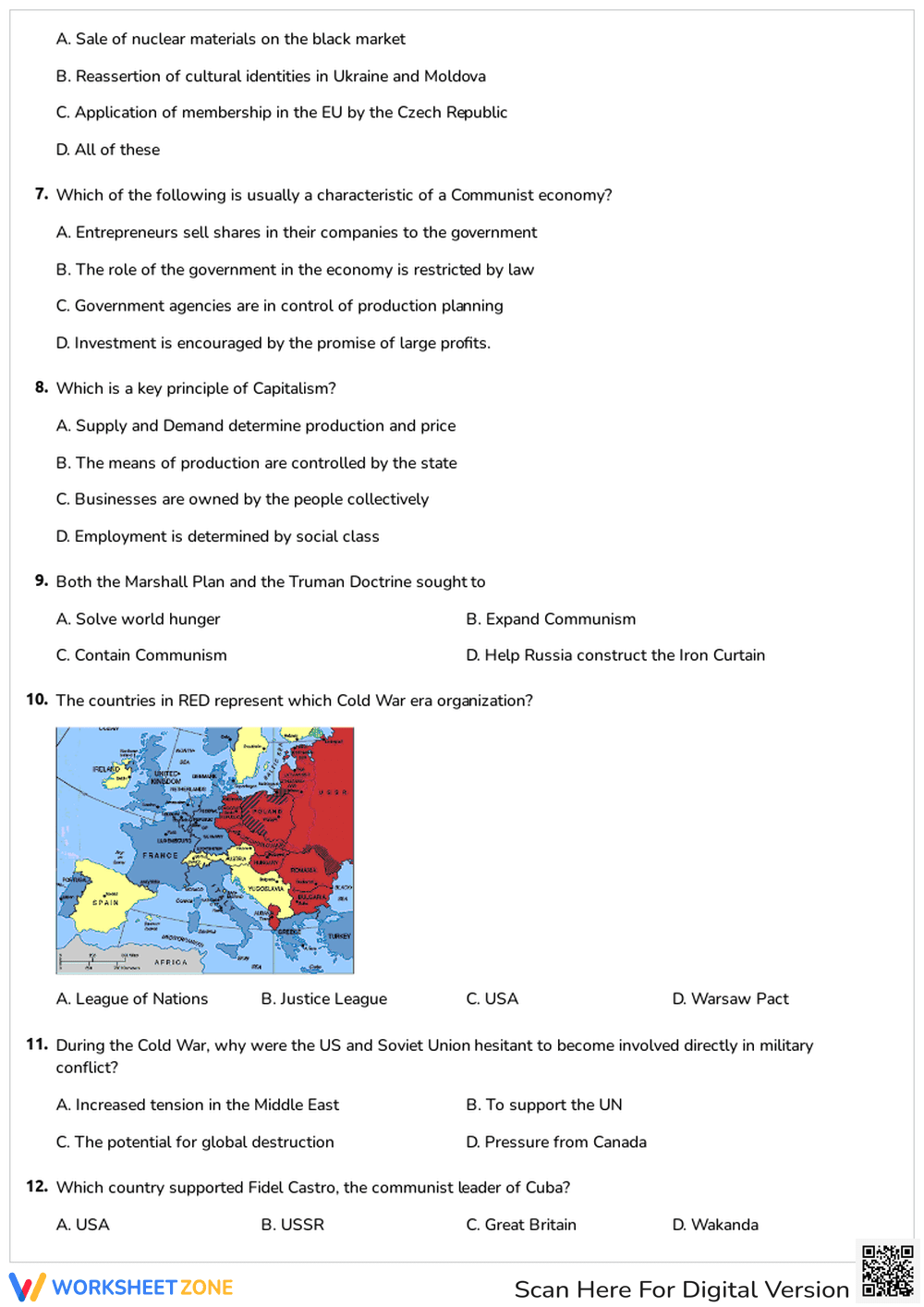
This comprehensive Cold War era worksheet evaluates student understanding of global politics, competing ideologies, and major conflicts between the United States and the Soviet Union. Students will analyze historical events, interpret political cartoons, and read maps to demonstrate their grasp of 20th-century geopolitical dynamics.
At a Glance
- Grade: 9-12 · Subject: Social Studies
- Standard:
CCSS.RH.11-12.7— Integrate and evaluate visual and textual historical sources- Skill Focus: Cold War Conflicts and Ideologies
- Format: 4 pages · 20 problems · Answer key included · PDF
- Best For: End-of-unit assessment or review
- Time: 30–45 minutes
Inside this resource, educators will find a robust 20-question multiple-choice assessment spanning four pages. The task types go beyond simple recall, requiring students to interpret primary source excerpts, analyze political cartoons, and extract data from historical maps. A complete answer key is included to ensure fast and accurate grading for teachers.
Zero-Prep Workflow
- Print (1 minute): Simply download the PDF and print a class set. The clean layout ensures high-quality copies.
- Distribute (1 minute): Hand out the four-page packet. The instructions are self-explanatory, requiring no additional teacher setup.
- Review (5 minutes): Use the included answer key to quickly grade the 20 multiple-choice questions or review them collectively as a class.
This zero-prep workflow makes it an ideal resource for busy teachers or an emergency sub plan, keeping total teacher prep time under two minutes.
Standards Alignment
Aligned to CCSS.RH.11-12.7, this worksheet requires students to integrate and evaluate multiple sources of information presented in diverse formats and media (e.g., visually, quantitatively, as well as in words) in order to address a question or solve a problem. It also supports general historical comprehension of the post-WWII era. Both standard codes can be copied directly into lesson plans, IEP goals, or district curriculum mapping tools.
How to Use It
- Formative Assessment: Deploy this worksheet at the end of a Cold War unit to gauge student mastery of key concepts like the Marshall Plan, the Iron Curtain, and proxy wars. Observe how students tackle the visual source questions to identify if they need more practice with document analysis.
- Substitute Teacher Plan: Because it is entirely self-contained and requires no direct instruction to administer, this quiz is perfect to leave in an emergency sub folder. Students can complete it independently within a standard 45-minute class period.
Who It's For
This resource is designed for high school Social Studies students in grades 9 through 12. It is particularly effective for general education history classes, but the multiple-choice format provides a clear, structured assessment that can be easily accommodated for students with IEPs by reducing the number of answer choices. It pairs perfectly with a direct instruction lesson on the origins of the Cold War or a gallery walk of Cold War primary sources.
Integrating visual literacy into historical assessments is crucial for developing critical thinking in high school social studies. By aligning with CCSS.RH.11-12.7 to integrate and evaluate visual and textual historical sources, this worksheet ensures students are not just memorizing facts, but actively interpreting data. According to a recent ScienceDirect TpT Analysis, resources that combine traditional questioning with multimedia analysis—such as political cartoons and historical maps—significantly improve student engagement and retention of complex historical narratives. This Cold War era assessment leverages these evidence-based practices by requiring students to synthesize information across different formats. The structured multiple-choice design allows educators to efficiently measure comprehension of competing ideologies and global conflicts, providing immediate data to inform subsequent instruction and ensure students are mastering essential historical analysis skills.


