


























Views
Downloads
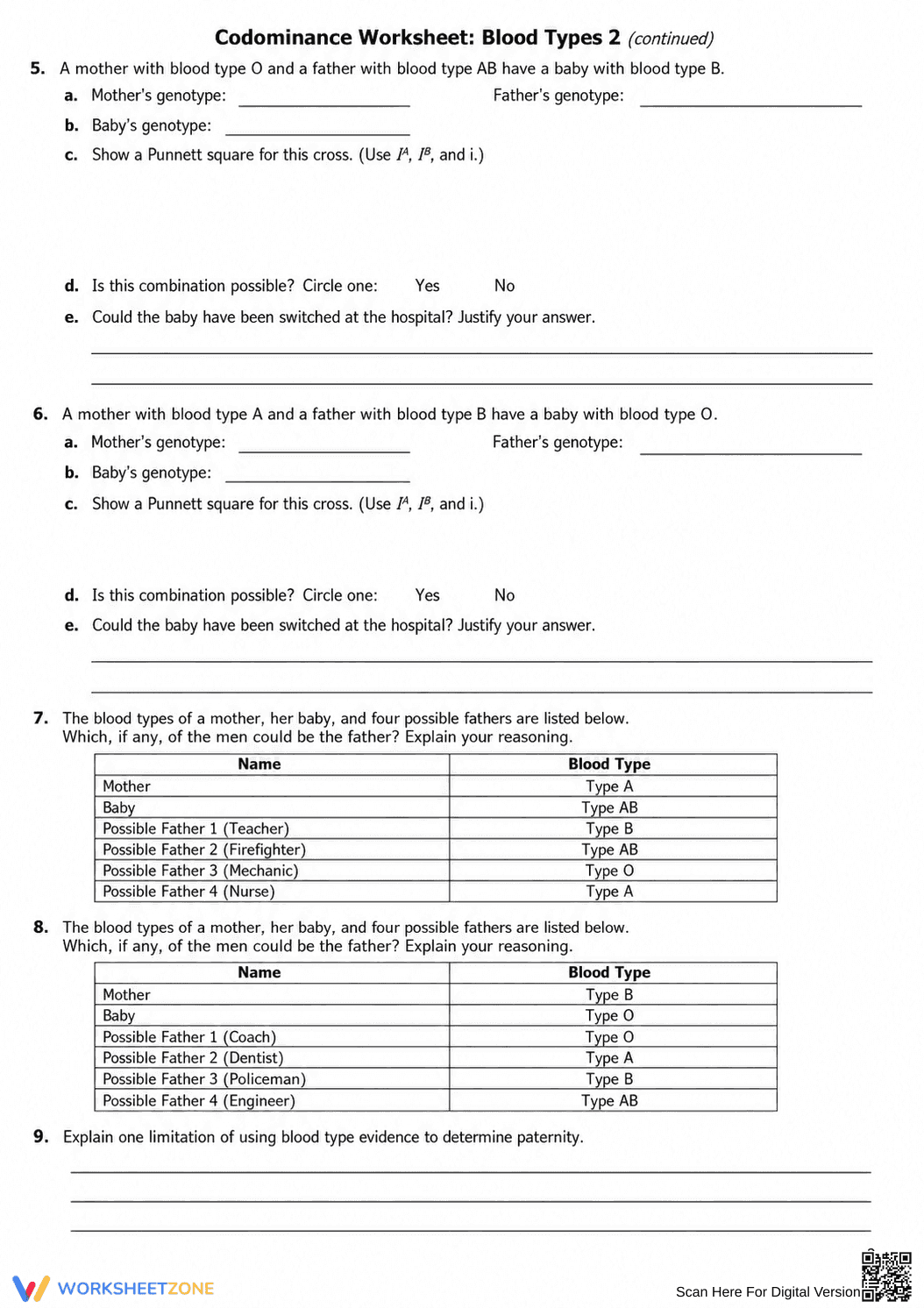

Printable Codominance Worksheet | Grade 9 Biology
Paste this activity's link or code into your existing LMS (Google Classroom, Canvas, Teams, Schoology, Moodle, etc.).
Students can open and work on the activity right away, with no student login required.
You'll still be able to track student progress and results from your teacher account.
This focused genetics worksheet helps students master codominance and multiple alleles through real-world blood type scenarios. By analyzing parent and offspring genotypes, students will construct Punnett squares, evaluate paternity claims, and apply probability to inheritance patterns, solidifying their understanding of complex genetic traits.
At a Glance
- Grade: 9 · Subject: Biology
- Standard:
HS-LS3-3— Apply probability to explain trait variation and distribution- Skill Focus: Codominance and Punnett Squares
- Format: 1 page · 5 problems · Answer key included · PDF
- Best For: Independent practice or homework
- Time: 20–30 minutes
Inside this single-page printable, educators will find five multi-part genetics problems that challenge students to apply their knowledge of the ABO blood group system. The tasks require learners to determine parental genotypes, complete Punnett squares using proper allele notation, and justify their reasoning in written responses. The worksheet features engaging, real-world applications, including hospital mix-up scenarios and paternity testing tables. A complete answer key is provided for quick grading.
Skill Progression
- Guided practice: The first two problems provide structured prompts where students identify genotypes before setting up Punnett squares to solve hospital mix-up scenarios.
- Supported practice: Students transition to analyzing data tables, cross-referencing blood types to eliminate impossible genetic combinations for paternity cases.
- Independent practice: The final task asks students to independently explain the limitations of blood type evidence, demanding higher-order thinking.
This gradual-release approach ensures students build confidence before tackling complex analytical questions.
This resource is strictly aligned to the Next Generation Science Standards, specifically focusing on HS-LS3-3: Apply concepts of statistics and probability to explain the variation and distribution of expressed traits in a population. By calculating the probability of specific blood types in offspring, students directly engage with the mathematical core of this standard. Both standard codes can be copied directly into lesson plans, IEP goals, or district curriculum mapping tools.
Deploy this worksheet following direct instruction on multiple alleles and codominance. It serves as excellent independent practice or a collaborative pair-and-share activity. As a formative assessment tip, circulate while students complete the Punnett squares; check that they correctly use superscript notation before attempting written justifications. Expected completion time is 20 to 30 minutes.
Designed for high school biology students studying non-Mendelian genetics. It provides differentiation for advanced learners focusing on written justifications, while struggling students rely on structured Punnett square setups. Pair this worksheet with an ABO blood group anchor chart to support visual learners.
Mastering complex inheritance patterns like codominance requires students to move beyond basic dominant-recessive relationships and apply statistical reasoning to biological phenomena. This resource directly supports HS-LS3-3 by challenging learners to apply probability to explain trait variation and distribution through the lens of human blood types. According to a ScienceDirect TpT Analysis, instructional materials that embed genetic principles within real-world contexts—such as hospital mix-ups and paternity testing—significantly increase student engagement and conceptual retention compared to abstract problem sets. By requiring students to construct Punnett squares and justify their analytical conclusions in writing, this worksheet bridges the gap between mathematical probability and biological application. The structured progression from basic genotype identification to complex scenario analysis ensures that students develop the robust critical thinking skills necessary for advanced scientific literacy and future coursework in genetics.


