


























Views
Downloads

Printable Codominance Worksheet | Grade 9 Biology
Paste this activity's link or code into your existing LMS (Google Classroom, Canvas, Teams, Schoology, Moodle, etc.).
Students can open and work on the activity right away, with no student login required.
You'll still be able to track student progress and results from your teacher account.
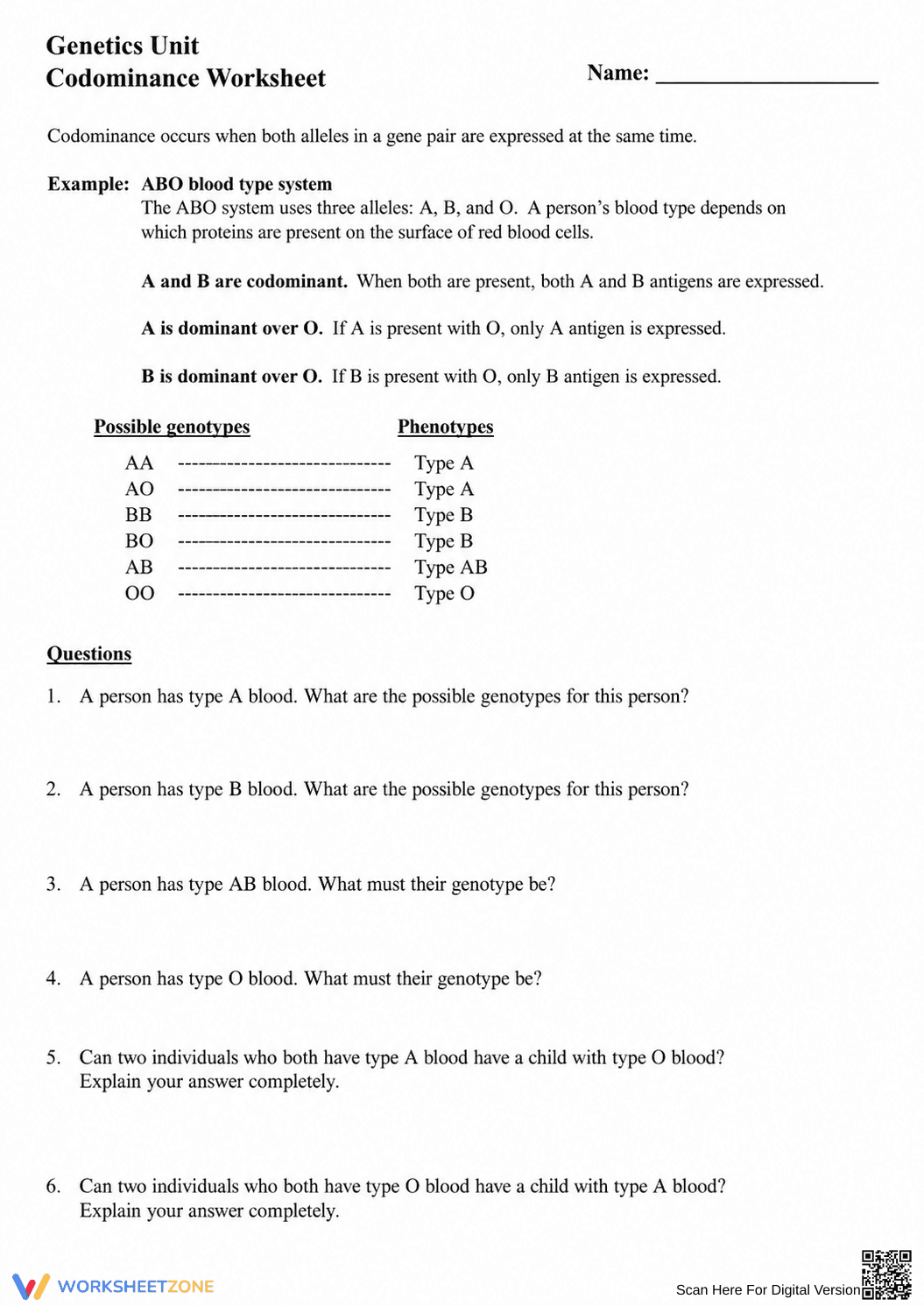
This Grade 9 biology worksheet introduces students to the principles of codominance using the ABO blood type system. By analyzing genotypes and phenotypes, students will predict genetic outcomes and explain trait inheritance. The clear introductory text ensures learners can immediately apply these concepts to real-world genetic scenarios.
At a Glance
- Grade: 9 · Subject: Biology
- Standard:
HS-LS3-3— Apply probability to explain trait variation and distribution- Skill Focus: Codominance and Blood Types
- Format: 1 page · 6 problems · Answer key included · PDF
- Best For: Independent practice or sub plans
- Time: 15–20 minutes
What's Inside
This single-page resource features a concise reading section that defines codominance and outlines the ABO blood type system. It includes a reference table mapping possible genotypes to their corresponding phenotypes. Following the reading, students will tackle six short-answer questions that require them to determine genotypes based on blood types and logically explain the possibility of specific offspring combinations. A complete answer key is provided for quick grading.
Zero-Prep Workflow
- Print (1 minute): Simply print the single-page PDF for your class. No special materials or prior setup are required.
- Distribute (1 minute): Hand out the worksheet. The built-in reading section allows students to begin working immediately without a separate lecture.
- Review (3 minutes): Use the included answer key to quickly check student responses or guide a brief class discussion.
With under two minutes of total teacher prep time, this resource is highly effective for busy days or as a reliable emergency sub plan.
Standards Alignment
Aligned to HS-LS3-3, this activity asks students to apply concepts of statistics and probability to explain the variation and distribution of expressed traits in a population. It also supports foundational middle school genetics standards by reinforcing how sexual reproduction results in genetic variation. Both standard codes can be copied directly into lesson plans, IEP goals, or district curriculum mapping tools.
How to Use It
This worksheet is ideal for use during direct instruction as a guided application activity immediately following a lesson on non-Mendelian genetics. Alternatively, assign it as a formative assessment to gauge student understanding of genotypes and phenotypes before moving on to complex Punnett square problems. As an observation tip, check students' written explanations for questions five and six to ensure they grasp how parental alleles combine. Expected completion time is 15 to 20 minutes.
Who It's For
Designed for high school biology students, this resource is also appropriate for advanced middle school life science classes. The built-in reference table provides natural differentiation for students who need visual support when mapping alleles. It pairs perfectly with introductory Punnett square activities or a broader unit on human genetics.
Aligning instruction to HS-LS3-3 ensures students can apply probability to explain trait variation and distribution in real-world contexts like human blood typing. According to a recent ScienceDirect TpT Analysis, providing students with integrated reading materials and immediate practice in a single document significantly reduces cognitive overload and improves overall task completion rates in secondary science classrooms. By combining the foundational rules of codominance with direct application questions, this worksheet supports deeper conceptual retention and builds essential problem-solving skills. The structured format allows learners to independently navigate complex genetic relationships without requiring extensive prior knowledge. This approach not only reinforces core biological principles but also fosters critical thinking and scientific literacy, ensuring students are well-prepared for more advanced genetic modeling and inheritance predictions in future lessons.


