


























Views
Downloads

Printable Classroom Vocabulary Handwriting | Grade 2-3
Paste this activity's link or code into your existing LMS (Google Classroom, Canvas, Teams, Schoology, Moodle, etc.).
Students can open and work on the activity right away, with no student login required.
You'll still be able to track student progress and results from your teacher account.
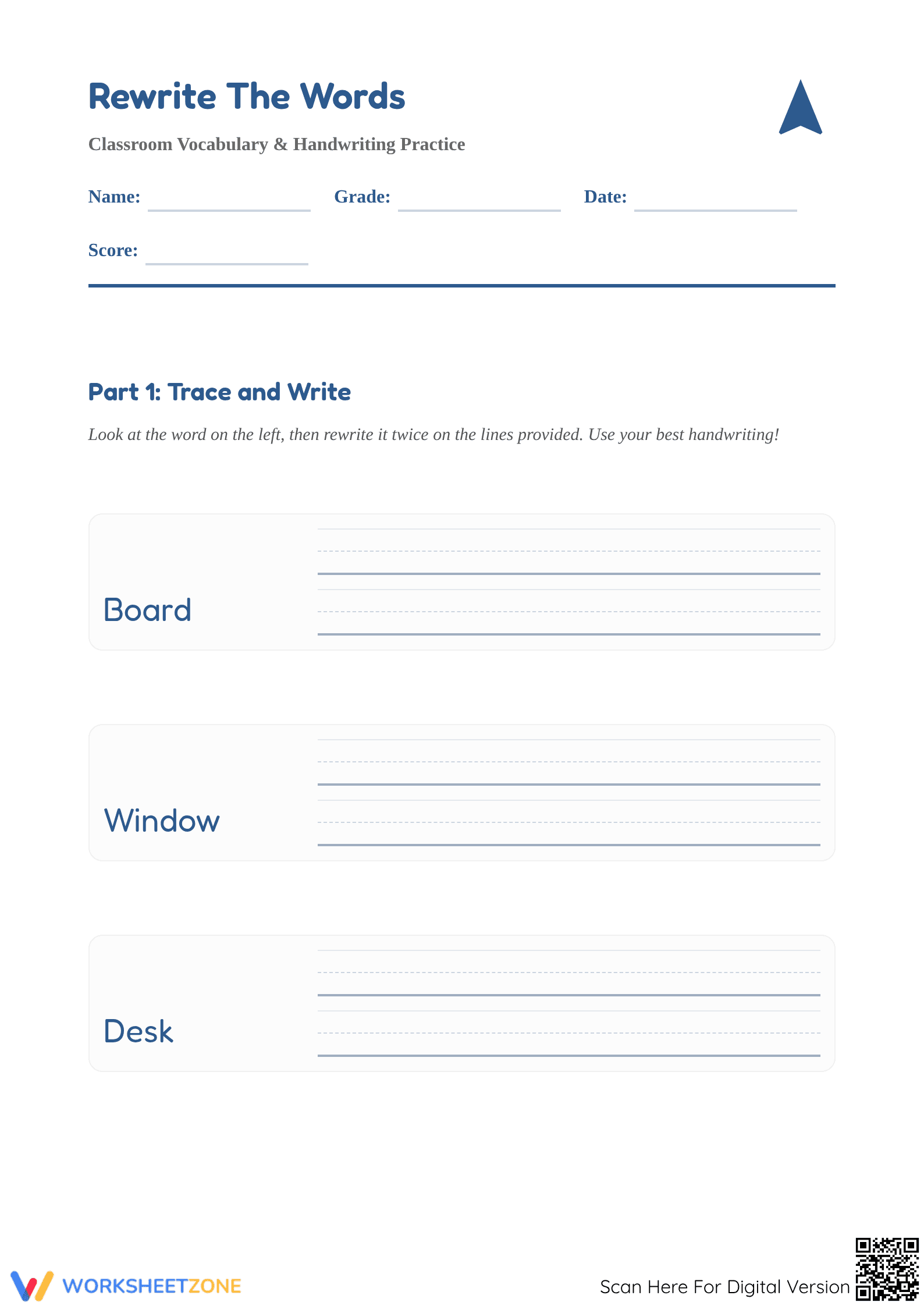
Help students master essential school vocabulary while refining their penmanship with this comprehensive classroom objects handwriting worksheet. This three-page resource bridges the gap between mechanical writing practice and functional language use. Students transition from tracing foundational words to applying their knowledge in context, ensuring they develop both legibility and spelling accuracy simultaneously.
At a Glance
- Grade: 2–3 · Subject: ELA & Handwriting
- Standard:
CCSS.ELA-LITERACY.L.2.2— Demonstrate command of the conventions of standard English spelling and usage- Skill Focus: Classroom Vocabulary & Handwriting
- Format: 3 pages · 14 problems · Answer key included · PDF
- Best For: Independent practice and vocabulary reinforcement
- Time: 20–30 minutes
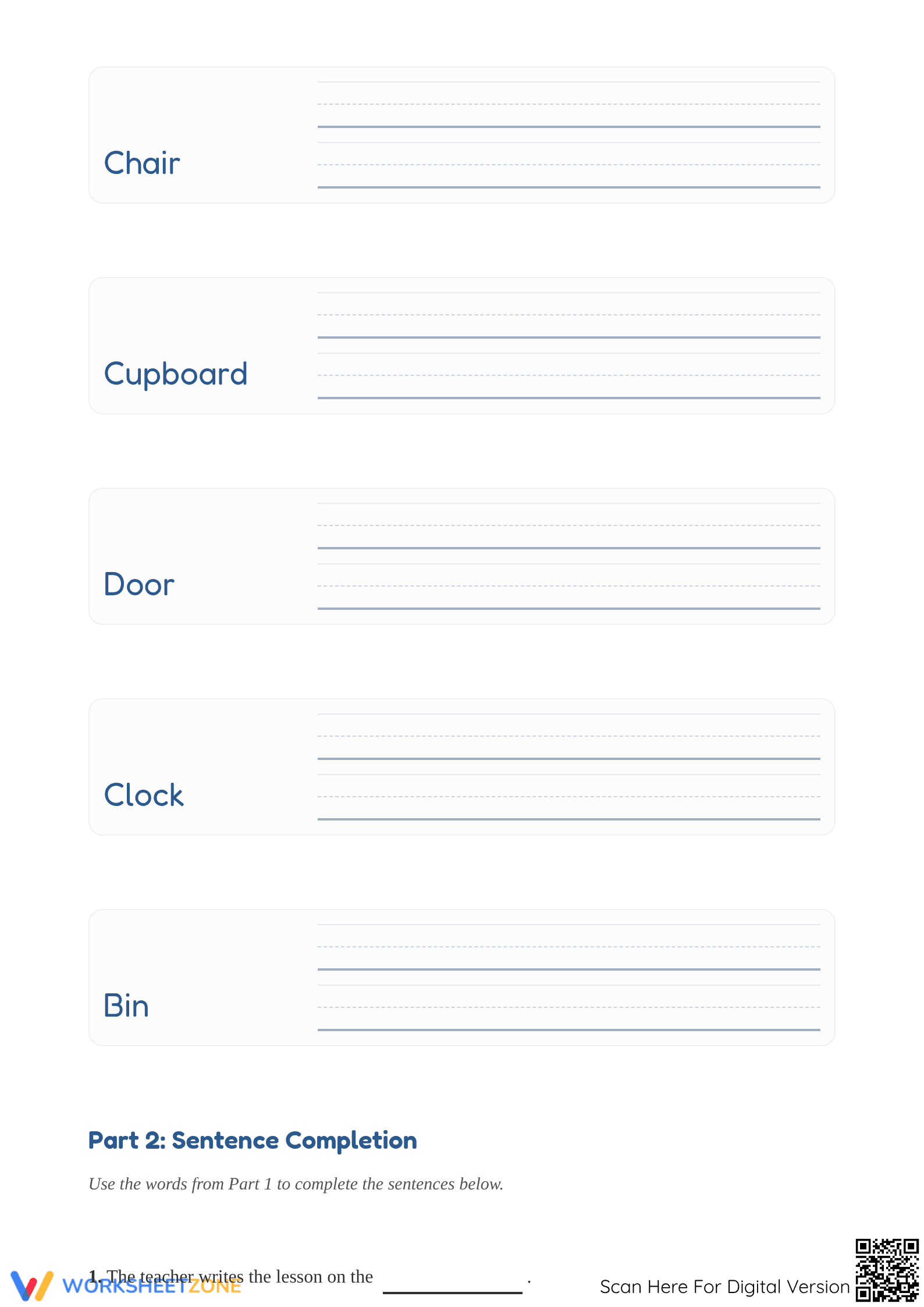
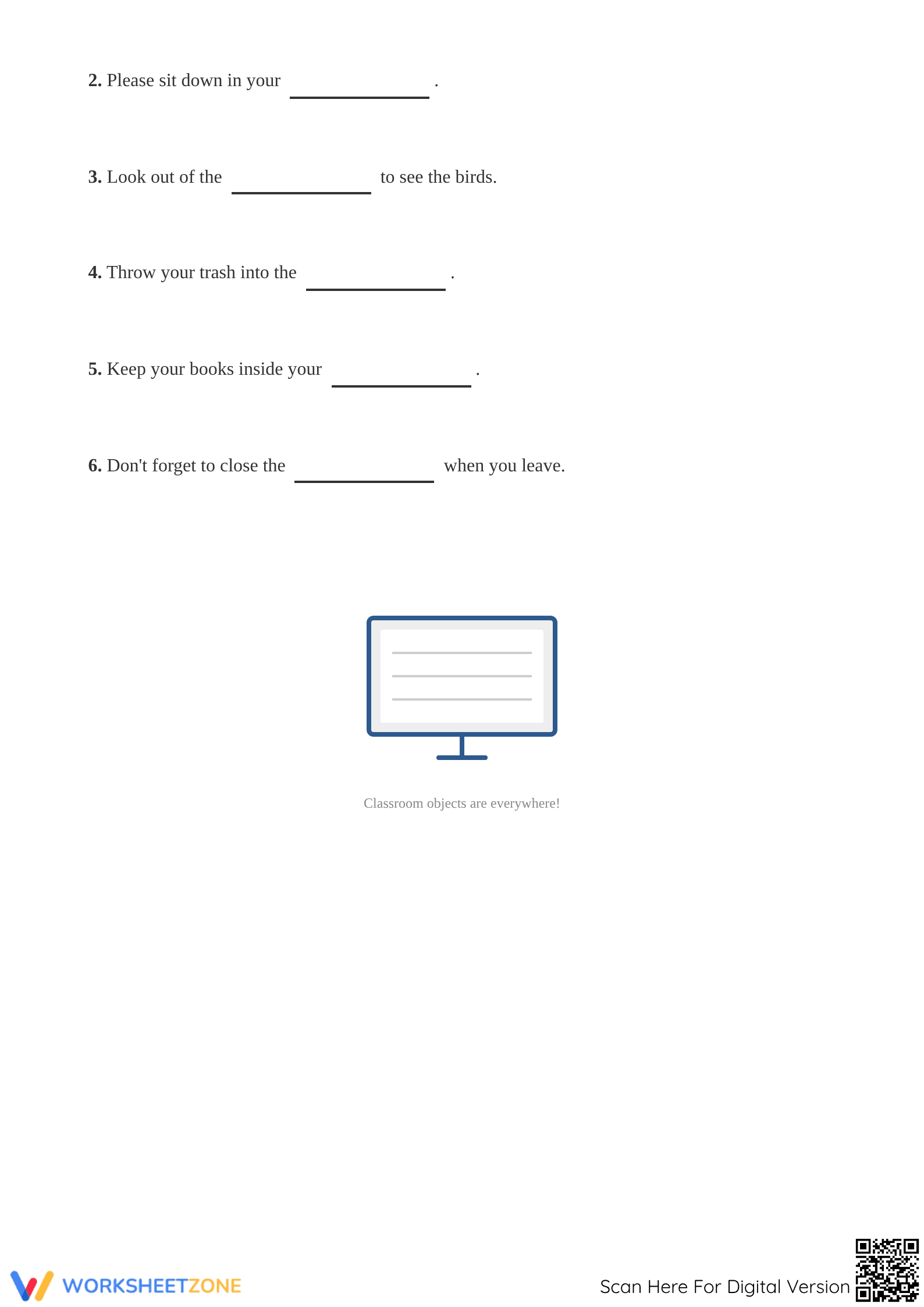
This resource contains two distinct instructional parts spread across three clean, distraction-free pages. Part one focuses on the "Trace and Write" method for eight core classroom terms, including board, window, desk, and chair. Part two challenges students with six sentence-completion exercises that require them to choose the correct object based on semantic clues. A full answer key is included for rapid grading or student self-correction.
Skill Progression
- Guided Practice: Eight tracing tasks allow students to follow dotted-line models for classroom nouns, establishing correct letter formation and spacing.
- Supported Practice: Eight rewrite tasks require students to replicate the words independently on primary-ruled lines without tracing guides.
- Independent Application: Six fill-in-the-blank sentences move beyond rote copying to test comprehension and vocabulary retrieval in a contextual setting.
This gradual-release model follows the proven "I Do, We Do, You Do" instructional framework, moving students from scaffolded repetition to independent mastery.
Standards Alignment
This worksheet is primarily aligned with CCSS.ELA-LITERACY.L.2.2: "Demonstrate command of the conventions of standard English capitalization, punctuation, and spelling when writing." By focusing on high-frequency classroom nouns, it also supports CCSS.ELA-LITERACY.L.2.4 regarding vocabulary acquisition and use. Both standard codes can be copied directly into lesson plans, IEP goals, or district curriculum mapping tools.
How to Use It
Distribute this worksheet as a quiet morning work activity or as a focused handwriting station during your ELA block. For the best results, use it after a "labels" walk around the room where students identify the physical objects. Teachers should observe the sentence completion portion to identify students who struggle with context clues or letter reversals. Expect most second and third graders to complete the packet within 25 minutes.
Who It's For
This packet is ideal for second and third-grade students who need to improve legibility or reinforce spelling patterns. It serves as an excellent resource for English Language Learners (ELLs) who are building foundational school-based vocabulary. Pair this worksheet with a classroom scavenger hunt or a picture dictionary to provide additional visual support for students who are below grade level in reading comprehension.
Educational research highlights that handwriting practice is most effective when paired with meaningful vocabulary rather than isolated letter repetition. According to a RAND AIRS 2024 analysis, students who engage in integrated writing and language tasks show a 22% higher retention rate for new vocabulary compared to those using traditional copy-work. This worksheet utilizes 14 specific tasks to reinforce CCSS.ELA-LITERACY.L.2.2 standards, ensuring that mechanical skills and semantic understanding grow together. By grounding penmanship in the immediate environment of the classroom, the resource reduces cognitive load and allows students to focus on the fine motor demands of writing. Educators can rely on this structured approach to provide the 20 to 30 minutes of daily writing practice recommended by current literacy frameworks for primary-grade success.


