




























Views
Downloads

Classroom Job Interest Survey | Grade 3 Essential

Paste this activity's link or code into your existing LMS (Google Classroom, Canvas, Teams, Schoology, Moodle, etc.).
Students can open and work on the activity right away, with no student login required.
You'll still be able to track student progress and results from your teacher account.
This Classroom Job Interest Survey helps Grade 3 students identify roles they are passionate about within the school community. By selecting preferred tasks and reflecting on their strengths, students build a sense of ownership and responsibility. This activity streamlines classroom management while fostering a collaborative environment where every student contributes to daily success.
At a Glance
- Grade: 3 · Subject: ELA / Classroom Management
- Standard:
CCSS.ELA-LITERACY.SL.3.1— Follow agreed-upon rules for discussions and carry out assigned roles- Skill Focus: Responsibility and Self-Reflection
- Format: 1 page · 13 tasks · Survey format · PDF
- Best For: Back-to-school community building and management
- Time: 15–20 minutes
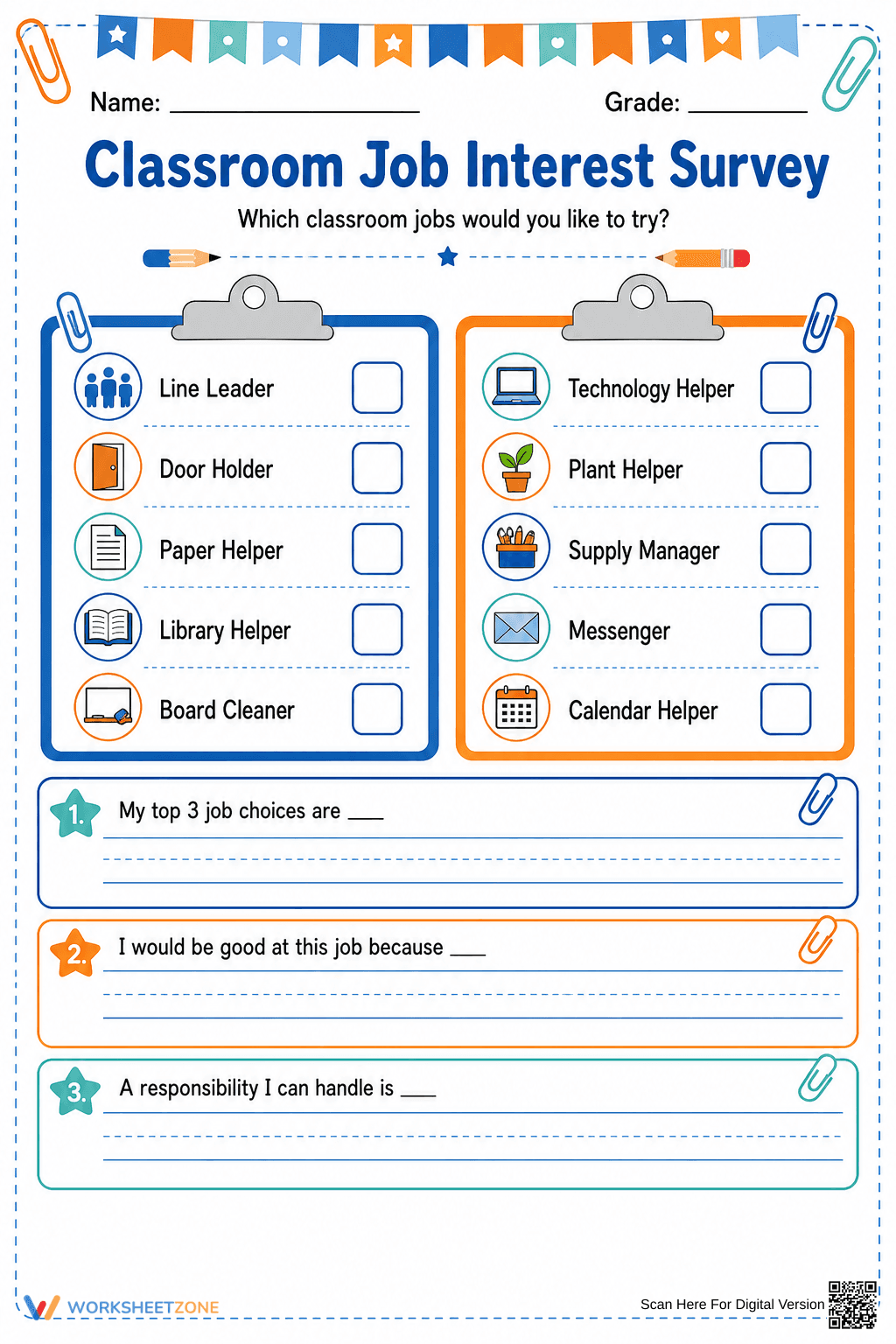
This single-page PDF features a clean, high-contrast layout with 10 specific classroom job options, including Line Leader, Technology Helper, and Supply Manager. Each job is accompanied by a visual icon to support diverse learners. Below the checklist, three structured response panels provide writing lines for students to rank their top choices and justify their suitability for specific responsibilities.
Zero-Prep Workflow:
- Print: Select the single-page PDF and print enough copies for your roster (30 seconds).
- Distribute: Hand out the surveys during your morning meeting or social-emotional learning block (1 minute).
- Review: Collect the completed forms to assign roles that align with student interests and strengths (5 minutes).
This zero-prep workflow ensures a smooth transition into new classroom routines without requiring teacher-led instruction or complex setup.
Standards Alignment
This worksheet aligns with `CCSS.ELA-LITERACY.SL.3.1`, which requires students to engage effectively in collaborative discussions and carry out assigned roles. By reflecting on their potential contributions to the classroom, students prepare for the practical application of these social-emotional standards. This standard code can be copied directly into lesson plans, IEP goals, or district curriculum mapping tools.
How to Use It
Use this survey during the first week of school to establish a democratic classroom culture. It serves as a formative assessment of student writing and self-perception. Observe how students justify their choices to identify leadership potential or areas where students may need more confidence. Completion typically takes 15 to 20 minutes depending on the depth of student reflection.
Who It's For
This resource is designed for general education students in Grades 2 through 5, but the visual icons make it highly accessible for English Language Learners and students with IEPs. It pairs naturally with a "Classroom Jobs" anchor chart or a direct instruction lesson on community roles and civic responsibility.
Effective classroom management relies on student agency and the clear definition of roles within the learning environment. According to Fisher & Frey (2014), providing students with opportunities to assume responsibility through assigned roles fosters a sense of belonging and increases engagement in the academic community. This worksheet facilitates that process by aligning with CCSS.ELA-LITERACY.SL.3.1, allowing students to articulate their interests and demonstrate readiness for specific tasks. Research from the RAND AIRS 2024 report suggests that social-emotional learning tools, such as interest inventories, are critical for developing the self-awareness necessary for collaborative success. By using this survey, educators can ensure that classroom jobs are not merely chores but are meaningful opportunities for students to practice real-world accountability. The structured format supports the gradual release of responsibility, moving from teacher-led organization to student-led maintenance of the classroom ecosystem, which is a hallmark of high-performing elementary environments.


