


























Views
Downloads

Essential Animal Classification Worksheet | Grade 2
Paste this activity's link or code into your existing LMS (Google Classroom, Canvas, Teams, Schoology, Moodle, etc.).
Students can open and work on the activity right away, with no student login required.
You'll still be able to track student progress and results from your teacher account.
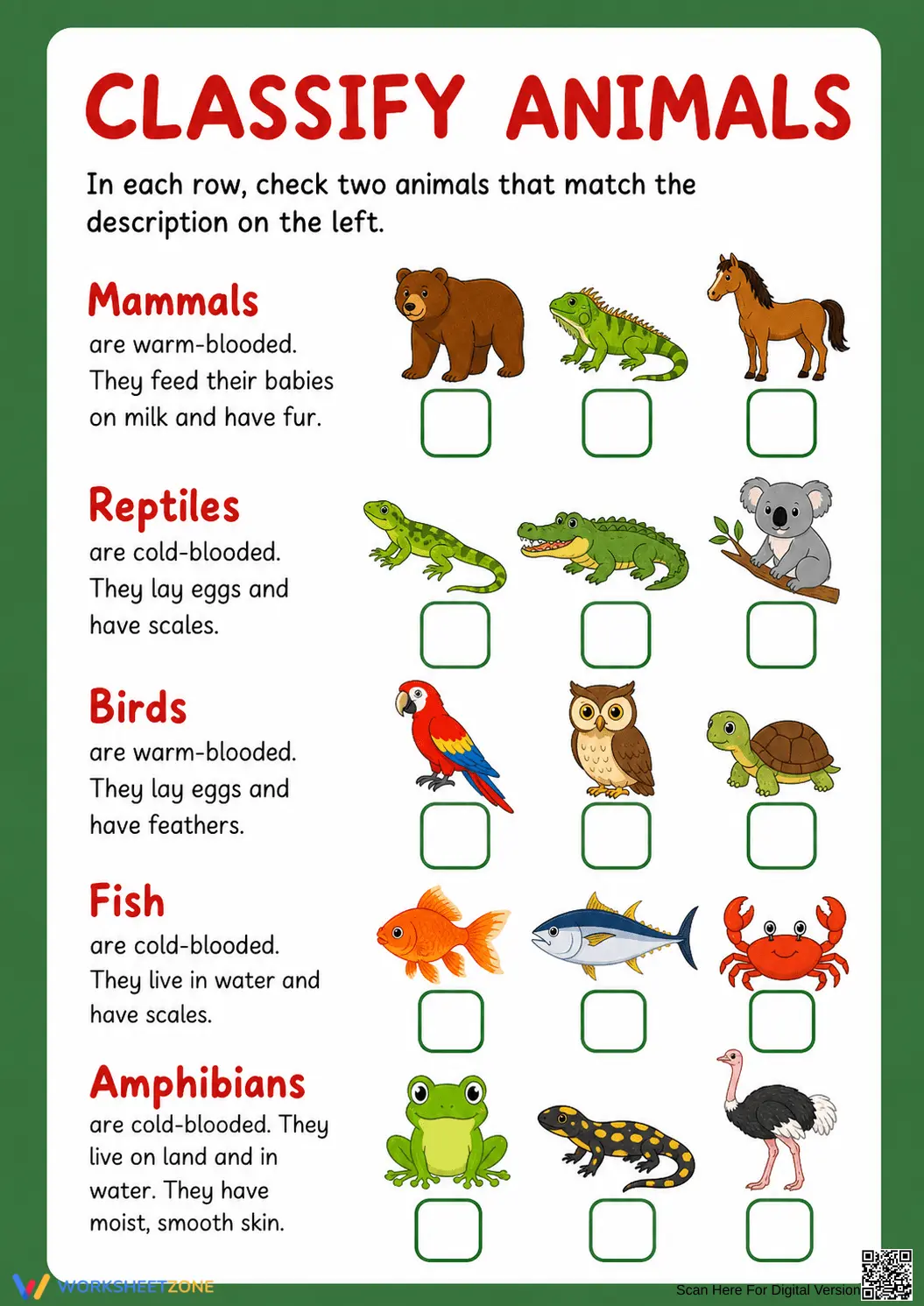
This Grade 2 science worksheet helps students master animal classification by identifying specific traits of mammals, reptiles, birds, fish, and amphibians. Students analyze descriptive text and select visual examples that match each category. It provides a clear, structured way to reinforce biological concepts through observation and evidence-based selection.
At a Glance
- Grade: 2 · Subject: Science
- Standard:
2-LS4-1— Make observations of animals to compare the diversity of life- Skill Focus: Vertebrate classification and traits
- Format: 1 page · 10 problems · Answer key included · PDF
- Best For: Independent practice or science centers
- Time: 15–20 minutes
The worksheet features five distinct sections, each dedicated to a major vertebrate group. Every section includes a concise definition of the group's characteristics, such as being warm-blooded or having scales. Students are presented with three high-quality animal illustrations per row and must identify the two that belong to the specified class. This 1-page PDF includes a clear layout and an answer key for quick grading.
Zero-Prep Workflow
- Print: Generate the single-page PDF for your entire class in under one minute.
- Distribute: Hand out the sheets as a science warm-up, exit ticket, or independent center activity.
- Review: Use the included answer key to facilitate a 5-minute group discussion on animal traits.
This streamlined process ensures total teacher preparation time remains under 2 minutes, making it an ideal component for emergency sub-plans.
Standards Alignment
This activity aligns with `2-LS4-1`, requiring students to make observations of animals to compare diversity. By identifying specific traits like fur, feathers, or moist skin, students engage in the foundational work of biological categorization. Both standard codes can be copied directly into lesson plans, IEP goals, or district curriculum mapping tools.
How to Use It
Use this worksheet during the "Explain" phase of a 5E lesson cycle to verify student understanding of vertebrate groups. It works effectively as a formative assessment after a direct instruction session on animal life cycles. Teachers should observe if students can distinguish between reptiles and amphibians, as the "scales vs. smooth skin" distinction is a frequent point of confusion.
Who It's For
This resource is tailored for second-grade students but remains accessible for Grade 1 and Grade 3 learners needing review. It supports English Language Learners through visual cues and paired text. Pair this worksheet with a living things anchor chart or a short informational passage about animal habitats to deepen the learning experience.
According to the RAND AIRS 2024 report, high-quality visual aids in early science education significantly improve the retention of complex classification systems. This worksheet utilizes the 2-LS4-1 standard to bridge the gap between abstract biological definitions and concrete visual identification. By requiring students to select two correct examples from a set of three, the task increases cognitive demand compared to simple matching exercises. Research from Fisher & Frey (2014) emphasizes that such structured observation tasks are essential for developing the academic vocabulary necessary for later success in life sciences. This resource provides 10 specific opportunities for students to practice evidence-based reasoning, ensuring they can articulate why a bear is a mammal while a chameleon is not. It serves as a reliable tool for measuring student progress toward mastery of elementary biological standards and supporting scientific literacy.


