


























Views
Downloads

Printable Money Comparison Worksheet | Grade 2 Math
Paste this activity's link or code into your existing LMS (Google Classroom, Canvas, Teams, Schoology, Moodle, etc.).
Students can open and work on the activity right away, with no student login required.
You'll still be able to track student progress and results from your teacher account.
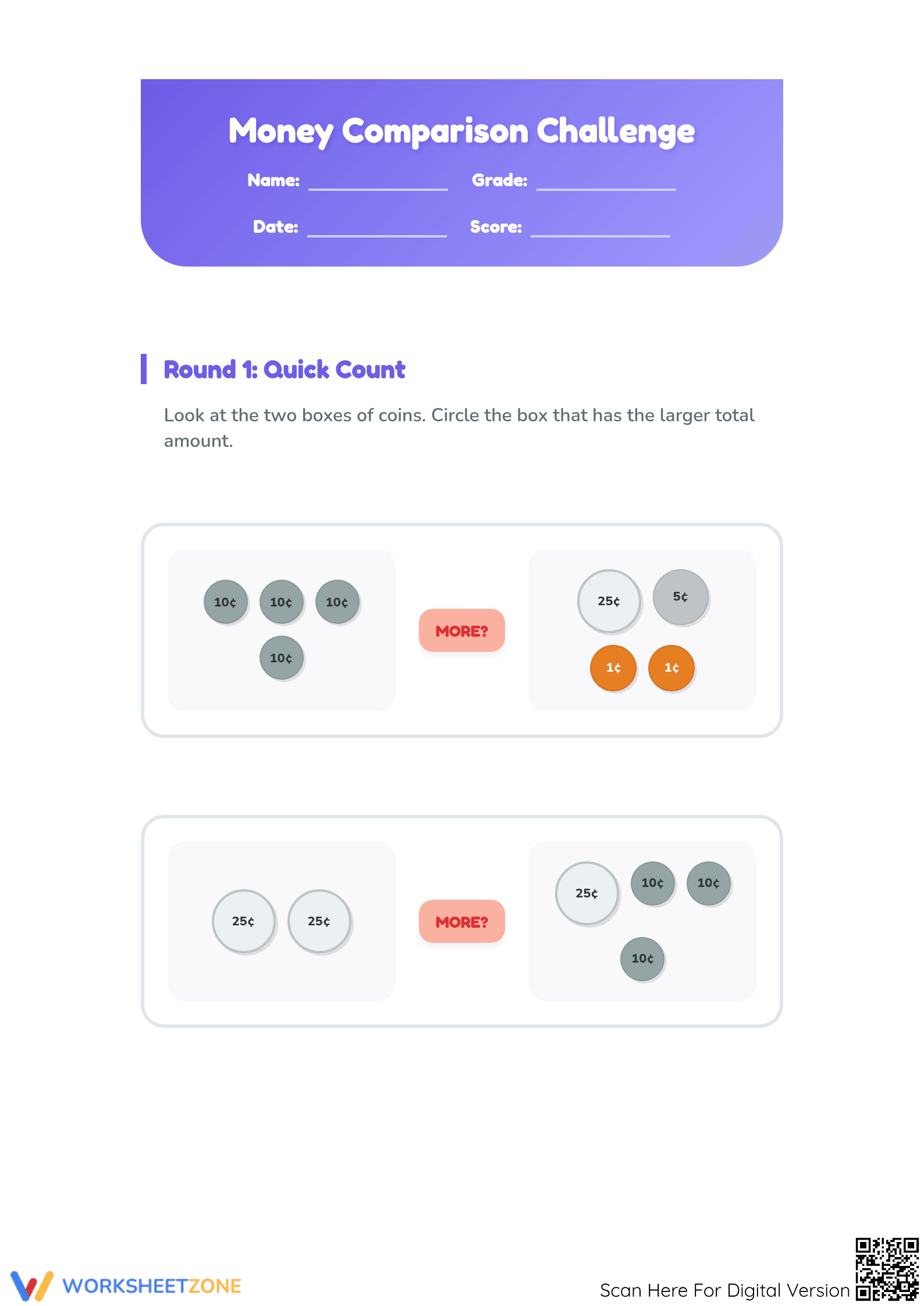
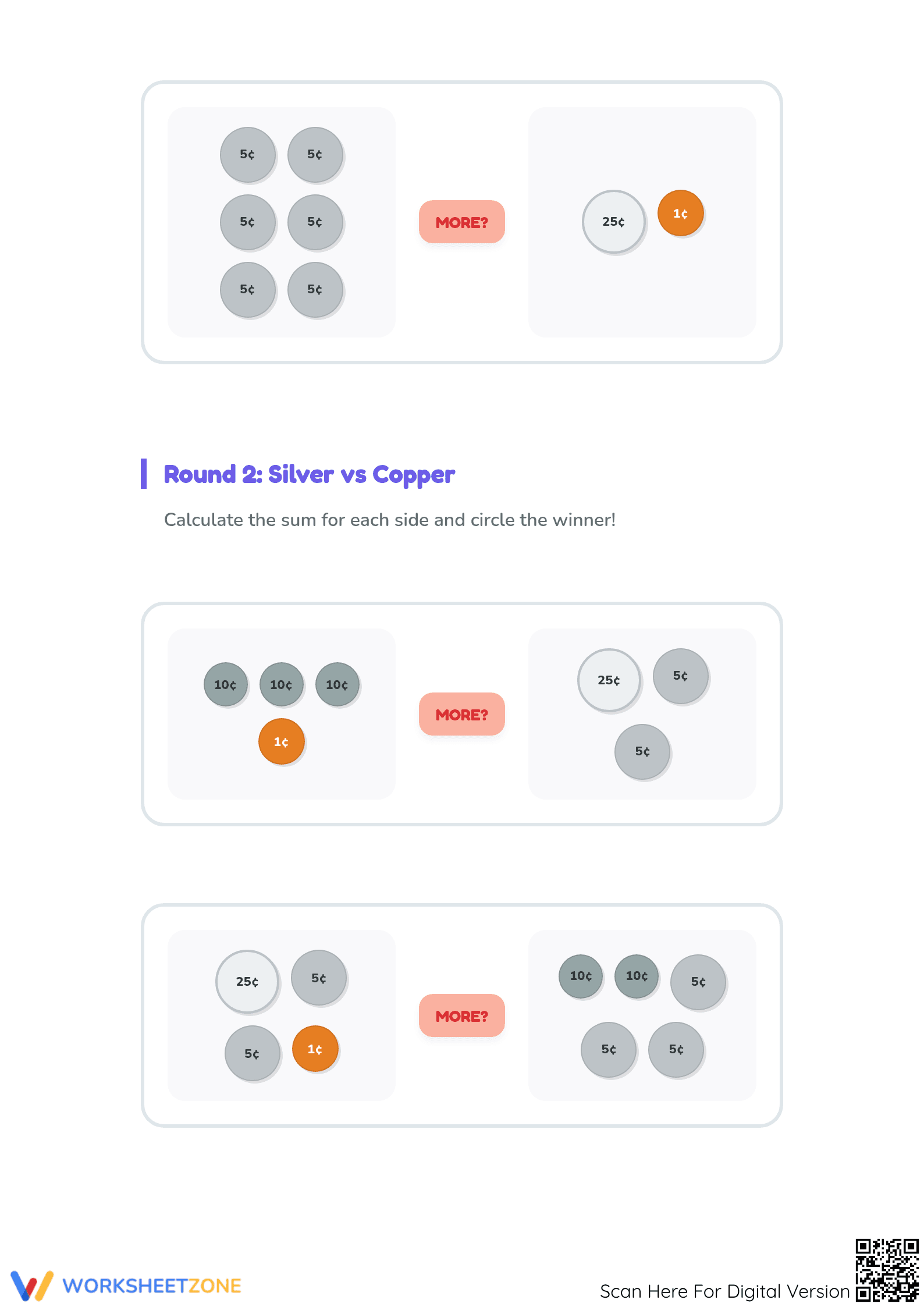
Master the essentials of currency value with this comprehensive money comparison worksheet. Students identify and sum combinations of quarters, dimes, nickels, and pennies to determine which side of a scale holds more value. This resource builds the mental math and comparative logic required for real-world financial literacy and foundational arithmetic.
At a Glance
- Grade: 2 · Subject: Math
- Standard:
CCSS.MATH.CONTENT.2.MD.C.8— Solve problems involving quarters, dimes, nickels, and pennies using the cent symbol- Skill Focus: Counting coins and value comparison
- Format: 4 pages · 8 problems · Answer key included · PDF
- Best For: Small group instruction or math centers
- Time: 20–30 minutes
What's Inside
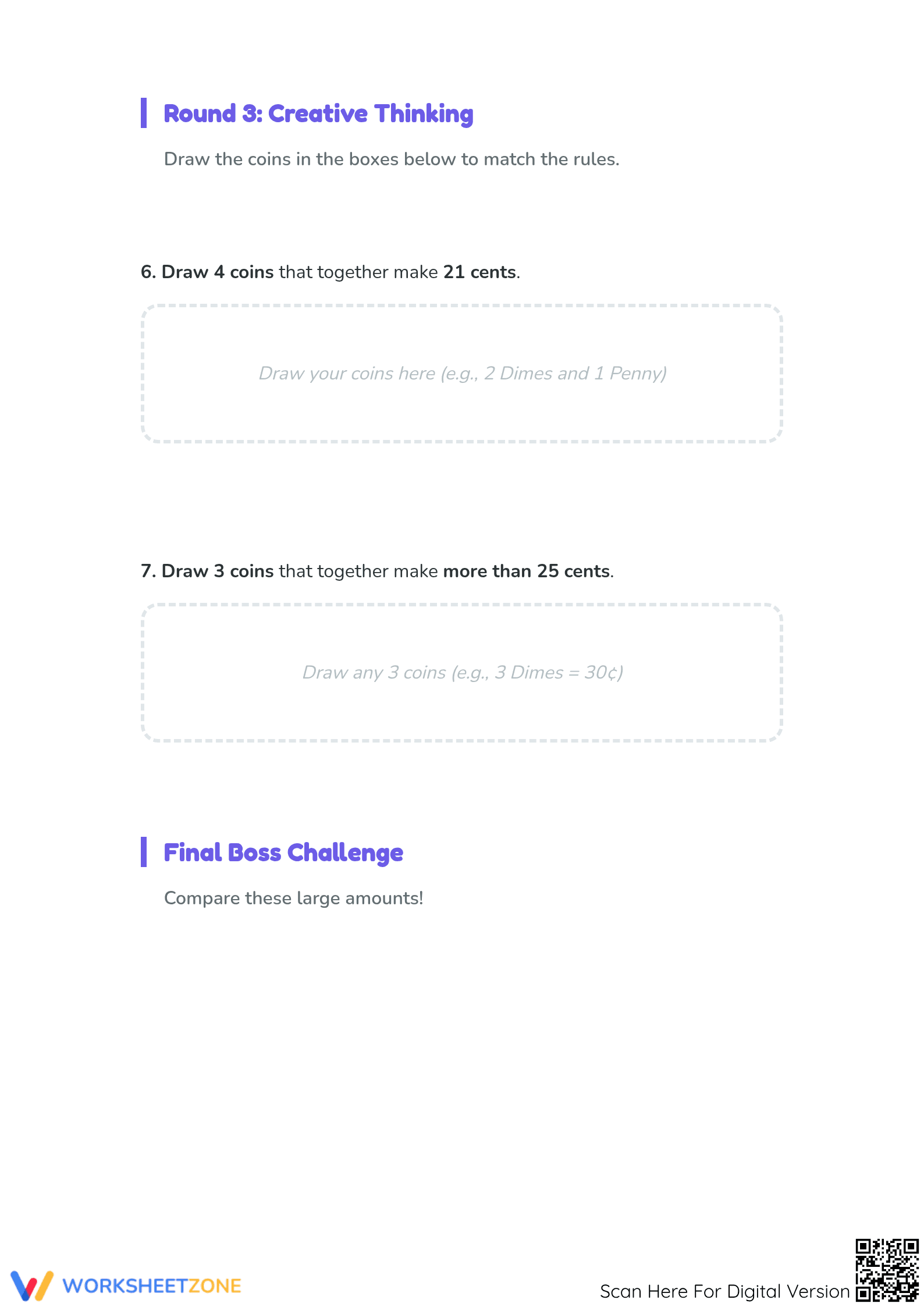
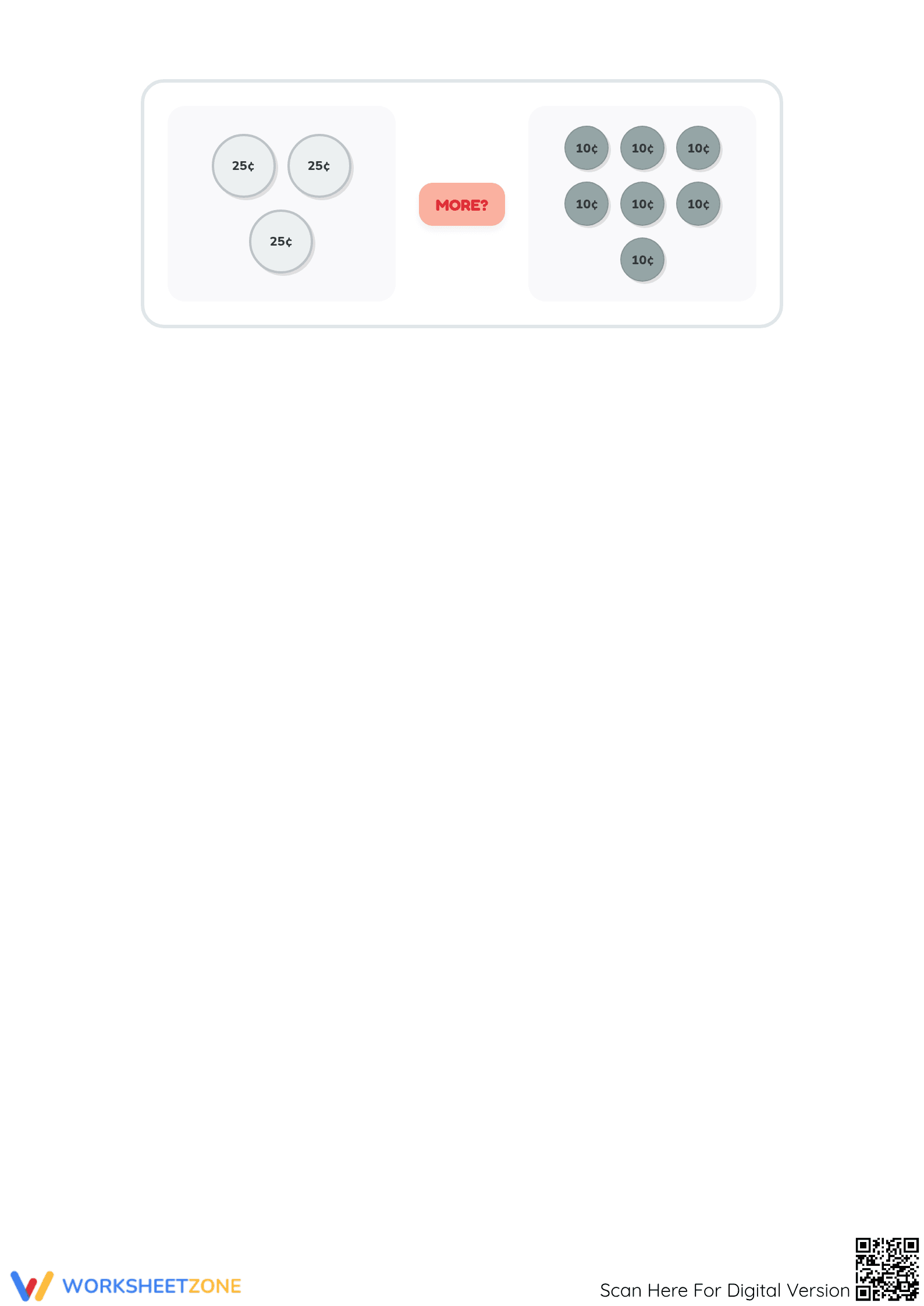
This 4-page PDF contains 8 structured tasks divided into four distinct "Rounds." Students engage with clear visual representations of US coins, including quarters, dimes, nickels, and pennies. The packet includes comparison challenges, sum calculation exercises, and creative drawing tasks where students must select specific coins to meet a target value. A full answer key is provided for immediate feedback and self-correction.
Skill Progression
- Guided Practice: The initial "Quick Count" round presents side-by-side coin sets, allowing students to visually estimate and then calculate totals to find the larger amount with minimal steps.
- Supported Practice: In the "Silver vs Copper" section, students are prompted to calculate exact sums for each side, reinforcing the relationship between different coin denominations before making a final comparison.
- Independent Practice: The "Creative Thinking" and "Final Boss" rounds require students to work backward from a total or compare high-value sets without scaffolding, promoting higher-order thinking and mastery.
Standards Alignment
This resource is strictly aligned with CCSS.MATH.CONTENT.2.MD.C.8, which requires students to solve word problems and computational tasks involving dollar bills and coins. The worksheet specifically targets the cent symbol usage and the ability to find the total value of a collection of coins. This standard code can be copied directly into lesson plans, IEP goals, or district curriculum mapping tools.
How to Use It
Use this worksheet as a mid-unit check during your measurement and data instruction. It works exceptionally well in a math center where students can use physical coin manipulatives to verify their answers. Teachers should observe students during Round 3 to see if they can efficiently combine denominations to reach a target value. Expected completion time is approximately 25 minutes.
Who It's For
Designed for Grade 2 students mastering currency, this worksheet also serves as an excellent enrichment tool for Grade 1 students or a remediation resource for Grade 3 learners. It provides visual support for English Language Learners and students with IEPs through the use of clear coin illustrations rather than text-heavy word problems.
Educational research consistently highlights the importance of visual-spatial representation in early mathematics instruction. According to the RAND AIRS 2024 report on elementary numeracy, students who regularly engage with visual models of currency demonstrate a 22% higher accuracy rate in mental addition compared to those who rely solely on abstract numbers. This worksheet facilitates that transition by providing clear images of coins alongside numerical cent values, allowing Grade 2 students to bridge the gap between physical objects and mathematical symbols. By requiring students to not only count but also compare and draw specific coin combinations, the resource aligns with best practices for cognitive load management. Integrating this standard-aligned tool into a curriculum ensures that students meet the CCSS.MATH.CONTENT.2.MD.C.8 requirements while developing the fluency needed for complex financial problem-solving in higher grades.


