


























Views
Downloads
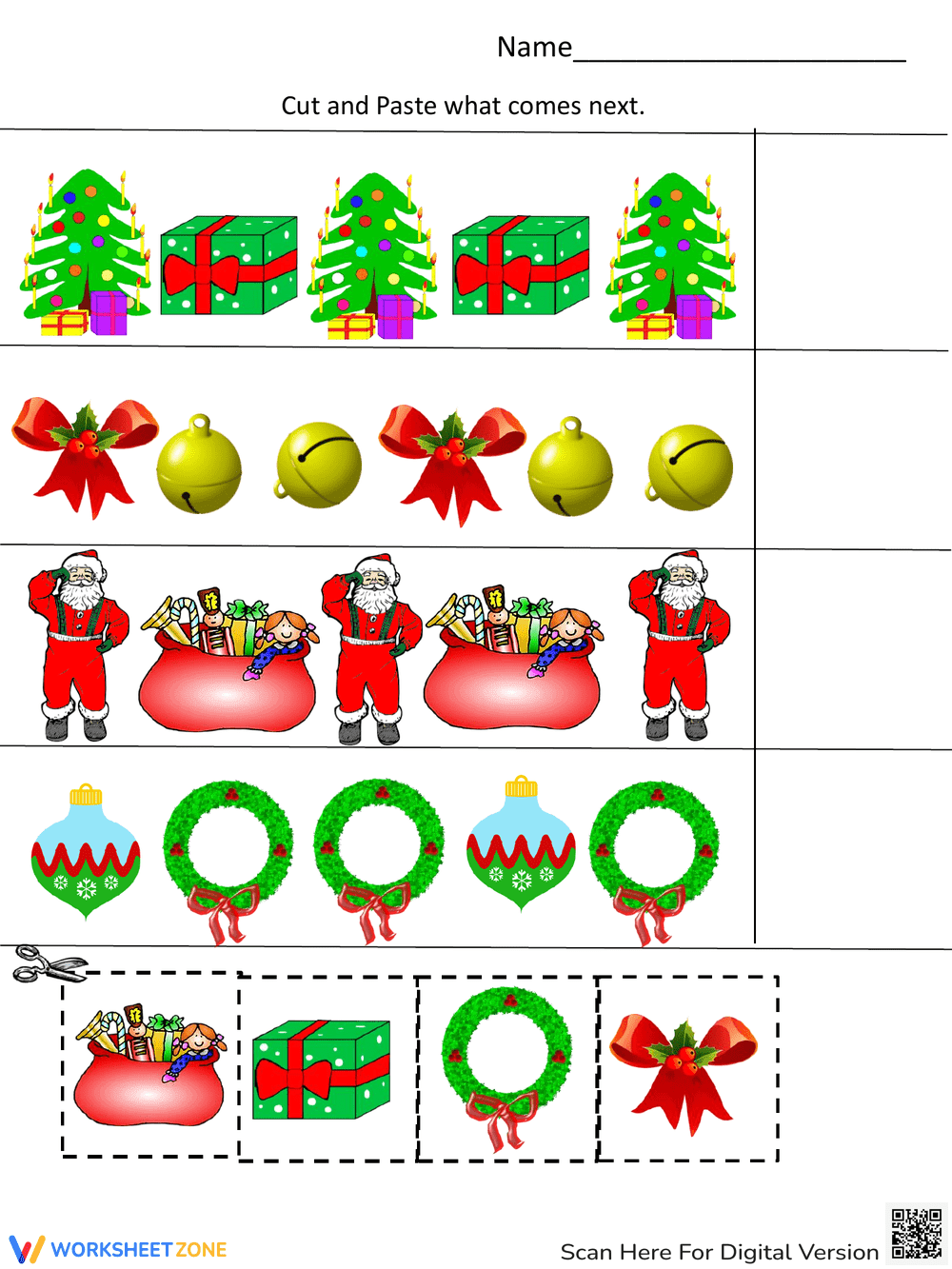

Christmas Pattern Worksheet | Grade K-2 Essential
Paste this activity's link or code into your existing LMS (Google Classroom, Canvas, Teams, Schoology, Moodle, etc.).
Students can open and work on the activity right away, with no student login required.
You'll still be able to track student progress and results from your teacher account.
This Christmas-themed pattern worksheet helps Kindergarten through 2nd-grade students master logical sequencing and fine motor coordination. By identifying and extending visual patterns, learners strengthen their algebraic thinking while practicing precise scissor skills. It provides a festive, high-engagement way to reinforce foundational math concepts during the holiday season.
At a Glance
- Grade: K-2 · Subject: Math & Fine Motor
- Standard:
CCSS.MATH.CONTENT.K.OA.A.1— Identify, describe, and extend repeating patterns using festive holiday imagery- Skill Focus: Pattern Recognition
- Format: 1 page · 4 problems · Answer key included · PDF
- Best For: Independent math centers or morning work
- Time: 10–15 minutes
The worksheet features four distinct pattern sequences using vibrant Christmas illustrations, including decorated trees, gift boxes, bells, and Santa Claus. At the bottom of the page, a dedicated cut-out section provides the four missing pieces needed to complete each logic chain. This single-page layout ensures all necessary materials are contained in one place, minimizing paper waste and organization time.
The zero-prep workflow is designed for maximum efficiency during the busy December school weeks. First, print the single-page PDF (30 seconds). Second, distribute to students with scissors and glue sticks (1 minute). Third, review the completed patterns as a whole group to verify logical reasoning (2 minutes). Total teacher preparation time is under two minutes, making it an ideal choice for emergency sub plans or transition periods.
This resource aligns with CCSS.MATH.CONTENT.K.OA.A.1, which focuses on representing addition and subtraction with objects, but is widely used to address the foundational skill of identifying and extending patterns. By predicting "what comes next," students develop the algebraic reasoning necessary for higher-level mathematics. This standard code can be copied directly into lesson plans, IEP goals, or district curriculum mapping tools.
Use this worksheet as a formative assessment during your math block to check for pattern mastery. Observe students as they work to see if they can verbalize the pattern (e.g., "Tree, Gift, Tree, Gift"). It also serves as an excellent fine motor station for Occupational Therapy (OT) minutes. Expected completion time ranges from 10 to 15 minutes depending on cutting speed.
This activity is designed for Kindergarten, 1st, and 2nd-grade students who need practice with AB and ABC patterns. It is particularly effective for tactile learners who benefit from physically moving pieces to solve problems. Pair this worksheet with a holiday-themed anchor chart about patterns or a direct instruction lesson on sequencing.
According to the RAND AIRS 2024 report, integrating seasonal themes into core curriculum tasks significantly increases student engagement and time-on-task during high-distraction periods like the winter holidays. This worksheet utilizes the "cut and paste" modality, which research from Fisher & Frey (2014) identifies as a key scaffold for developing both cognitive logic and fine motor dexterity in early childhood. By requiring students to analyze a sequence and select the correct concluding element, the activity reinforces the standard CCSS.MATH.CONTENT.K.OA.A.1. This specific task type—pattern extension—is a recognized precursor to algebraic thinking and functional relationship understanding in primary mathematics. Educational analysis suggests that providing structured, single-page activities reduces cognitive load, allowing students to focus entirely on the logic of the pattern rather than complex instructions. This resource provides a reliable, evidence-based method for maintaining instructional rigor while celebrating seasonal themes in the classroom.


