


























Views
Downloads


Grade 1 Adjectives Worksheet | Essential Printable
Paste this activity's link or code into your existing LMS (Google Classroom, Canvas, Teams, Schoology, Moodle, etc.).
Students can open and work on the activity right away, with no student login required.
You'll still be able to track student progress and results from your teacher account.
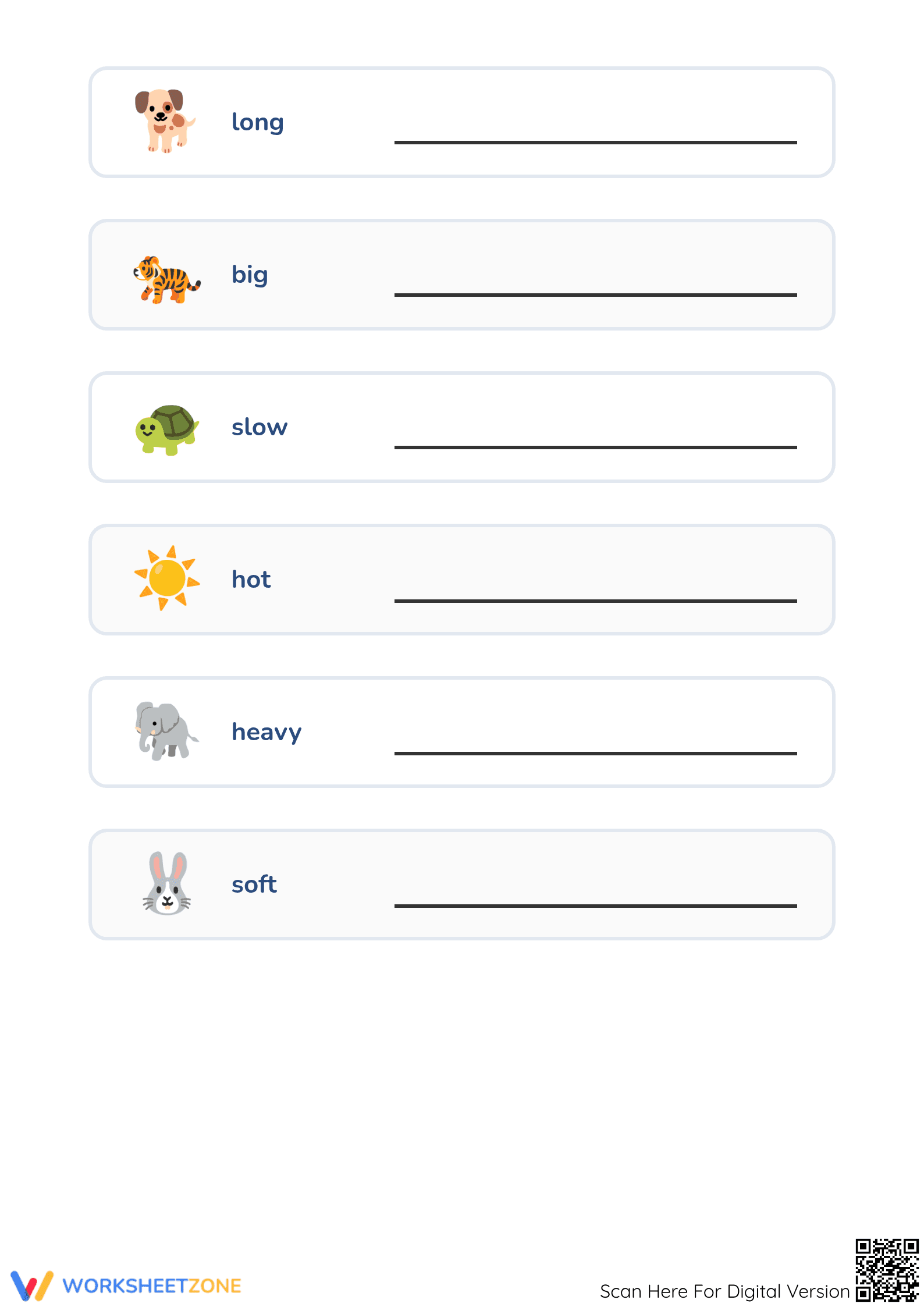
This Grade 1 adjectives worksheet helps students expand their descriptive vocabulary by identifying alternative words for common visual prompts. By moving beyond basic descriptors, young learners develop the linguistic precision needed for effective storytelling and clear communication. Students observe 10 distinct images and generate unique adjectives to describe them.
At a Glance
- Grade: 1 · Subject: ELA
- Standard:
CCSS.ELA-LITERACY.L.1.1.F— Use frequently occurring adjectives to describe people, places, and things- Skill Focus: Descriptive Adjectives
- Format: 2 pages · 10 problems · Answer key included · PDF
- Best For: Independent practice or morning work
- Time: 15–20 minutes
Inside this 2-page PDF, you will find 10 structured tasks featuring high-quality emoji and animal illustrations. Each item provides a baseline adjective (like "funny" or "tall") and challenges the student to write a different, relevant adjective on the provided line. The layout includes clear spacing for early writers and a complete answer key for quick grading.
The zero-prep workflow is designed for busy educators. First, print the 2-page document (30 seconds). Next, distribute the sheets to students with a brief reminder that "many different adjectives can describe any noun" (1 minute). Finally, review the varied student responses using the provided answer key as a guide for acceptable synonyms (5 minutes). This makes it an ideal resource for emergency sub plans.
This resource is aligned with CCSS.ELA-LITERACY.L.1.1.F, which requires students to use frequently occurring adjectives. It also supports L.1.5.D by helping students distinguish shades of meaning among verbs and adjectives. Both standard codes can be copied directly into lesson plans, IEP goals, or district curriculum mapping tools.
Use this worksheet during the independent practice phase of a gradual release lesson on parts of speech. It serves as an excellent formative assessment; observe if students rely on simple colors or if they attempt more complex sensory words like "gigantic" or "chilly." Expected completion time is between 15 and 20 minutes depending on writing speed.
This is ideal for first-grade students, English Language Learners (ELLs) needing visual support, and second graders requiring a quick review. It pairs naturally with a classroom anchor chart of "tired words" to help students find more exciting alternatives to common adjectives during their creative writing time.
According to the RAND AIRS 2024 report, visual-to-text association is a critical component of early literacy development, particularly when students are tasked with generative vocabulary exercises rather than simple multiple-choice selection. This worksheet targets the CCSS.ELA-LITERACY.L.1.1.F standard by requiring students to produce frequently occurring adjectives in response to visual stimuli. By providing a baseline word and asking for a different one, the activity encourages cognitive flexibility and synonym awareness. Research from Fisher & Frey (2014) suggests that such scaffolded practice helps solidify the instructional model, moving students toward independent mastery of descriptive language. The inclusion of 10 distinct items ensures sufficient repetition to build confidence without causing cognitive fatigue in six- and seven-year-old learners. This resource provides a reliable, evidence-based method for tracking student progress in lexical acquisition and grammatical application within the primary classroom environment.


