


























Views
Plays



Ancient Chinese Dynasties & Philosophies | Essential History
Paste this activity's link or code into your existing LMS (Google Classroom, Canvas, Teams, Schoology, Moodle, etc.).
Students can open and work on the activity right away, with no student login required.
You'll still be able to track student progress and results from your teacher account.
This Ancient China worksheet provides a comprehensive review of the foundational dynasties and belief systems that shaped East Asian history. Students will identify key characteristics of the Shang, Zhou, and Qin dynasties while distinguishing between the core tenets of Legalism, Confucianism, and Daoism. This resource ensures students master critical historical vocabulary and geographical context.
At a Glance
- Grade: 6-8 · Subject: History
- Standard:
RH.6-8.4— Determine the meaning of domain-specific words and phrases in history- Skill Focus: Ancient Chinese Civilizations
- Format: 3 pages · 15 problems · Answer key included · PDF
- Best For: Unit review or sub plans
- Time: 20–30 minutes
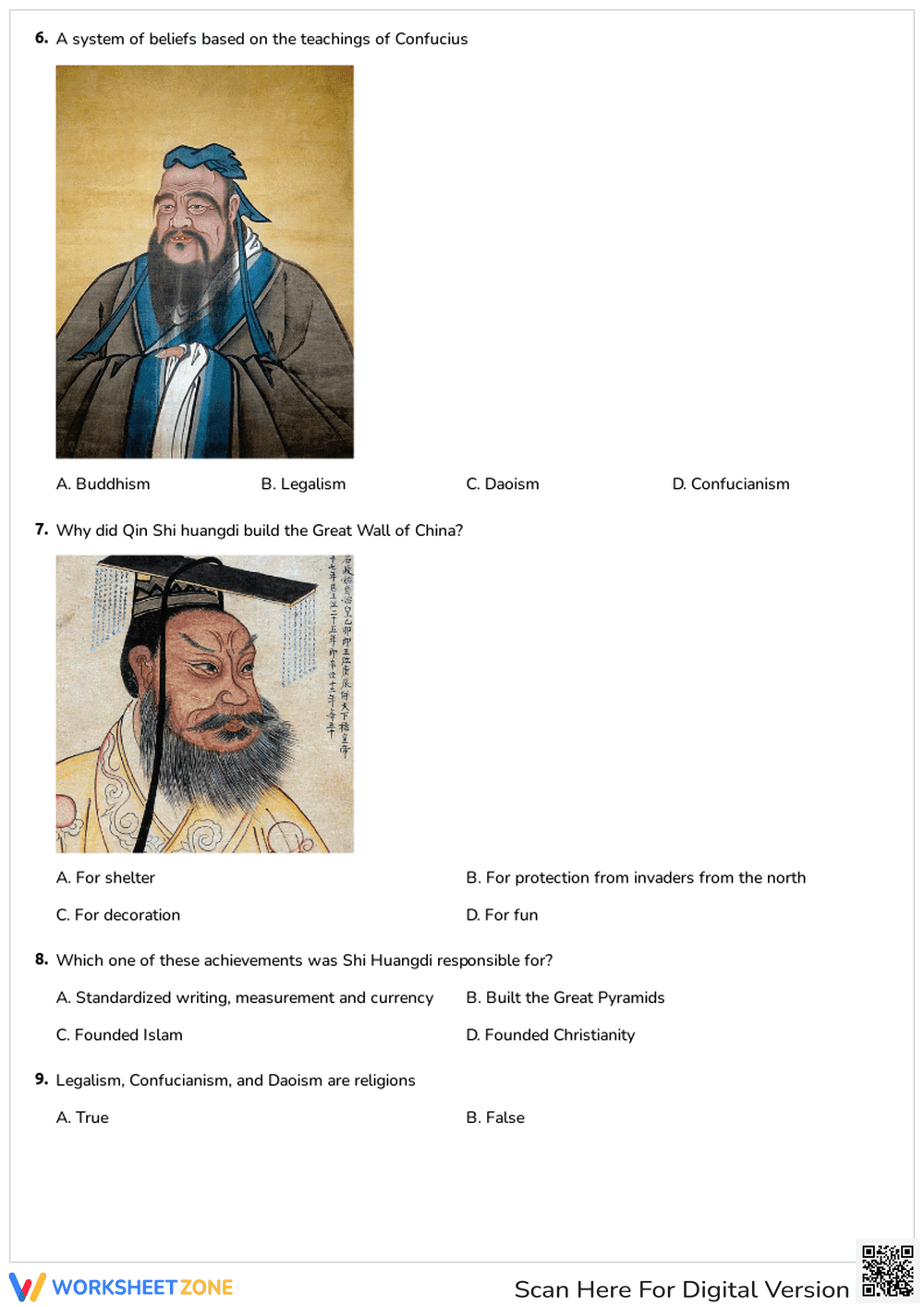
The document contains 15 high-quality multiple-choice questions spread across three clearly formatted pages. It features primary source-style imagery, including portraits of Confucius and Qin Shi Huangdi, a map of China's river systems, and cultural artifacts like oracle bones and the terra cotta warriors. A full answer key is provided to facilitate immediate feedback and data collection.
Teachers can implement this resource with minimal effort. First, print the three-page PDF (30 seconds). Second, distribute the 15-question quiz to students as an independent review or formative assessment (1 minute). Finally, use the included answer key to review responses as a whole class or for quick grading (5 minutes). Total teacher preparation time is under two minutes, making it an ideal choice for unexpected absences or busy grading periods.
The primary standard addressed is CCSS.ELA-LITERACY.RH.6-8.4, which requires students to determine the meaning of domain-specific words and phrases as they are used in a historical context. By correctly identifying terms such as "dynasty" and "Mandate of Heaven," students demonstrate their ability to interpret specialized academic language. Both standard codes can be copied directly into lesson plans, IEP goals, or district curriculum mapping tools.
Use this worksheet as a summative assessment at the conclusion of an Ancient China unit to gauge student mastery of key concepts. Alternatively, it serves as an excellent formative assessment during direct instruction; teachers can observe which students struggle with the distinction between Daoism and Legalism to provide targeted intervention. Completion typically takes 20 to 30 minutes.
This resource is designed for middle school students in grades 6 through 8. The inclusion of visual aids makes it particularly effective for English Language Learners (ELLs) and students with IEPs who benefit from pictorial cues. It pairs naturally with a classroom anchor chart on the Dynastic Cycle or a primary source reading on the Great Wall.
This worksheet aligns with the instructional shifts identified by Fisher & Frey (2014), emphasizing the importance of domain-specific vocabulary in the social studies classroom. By assessing student understanding of terms like "Mandate of Heaven," "Legalism," and "Cultural Diffusion," the resource supports the development of historical literacy. Research from the NAEP suggests that students who can connect geographical features, such as the Huang He and Yangtze rivers, to the development of early civilizations demonstrate higher levels of proficiency in global history. This 15-question assessment provides a structured way to measure these competencies. The inclusion of visual stimuli alongside text-based questions mirrors the multi-modal learning strategies recommended for middle school learners to improve retention of complex philosophical concepts. Educators can utilize the standard code CCSS.ELA-LITERACY.RH.6-8.4 to track mastery of academic language within the Ancient China unit.


