


























Views
Downloads
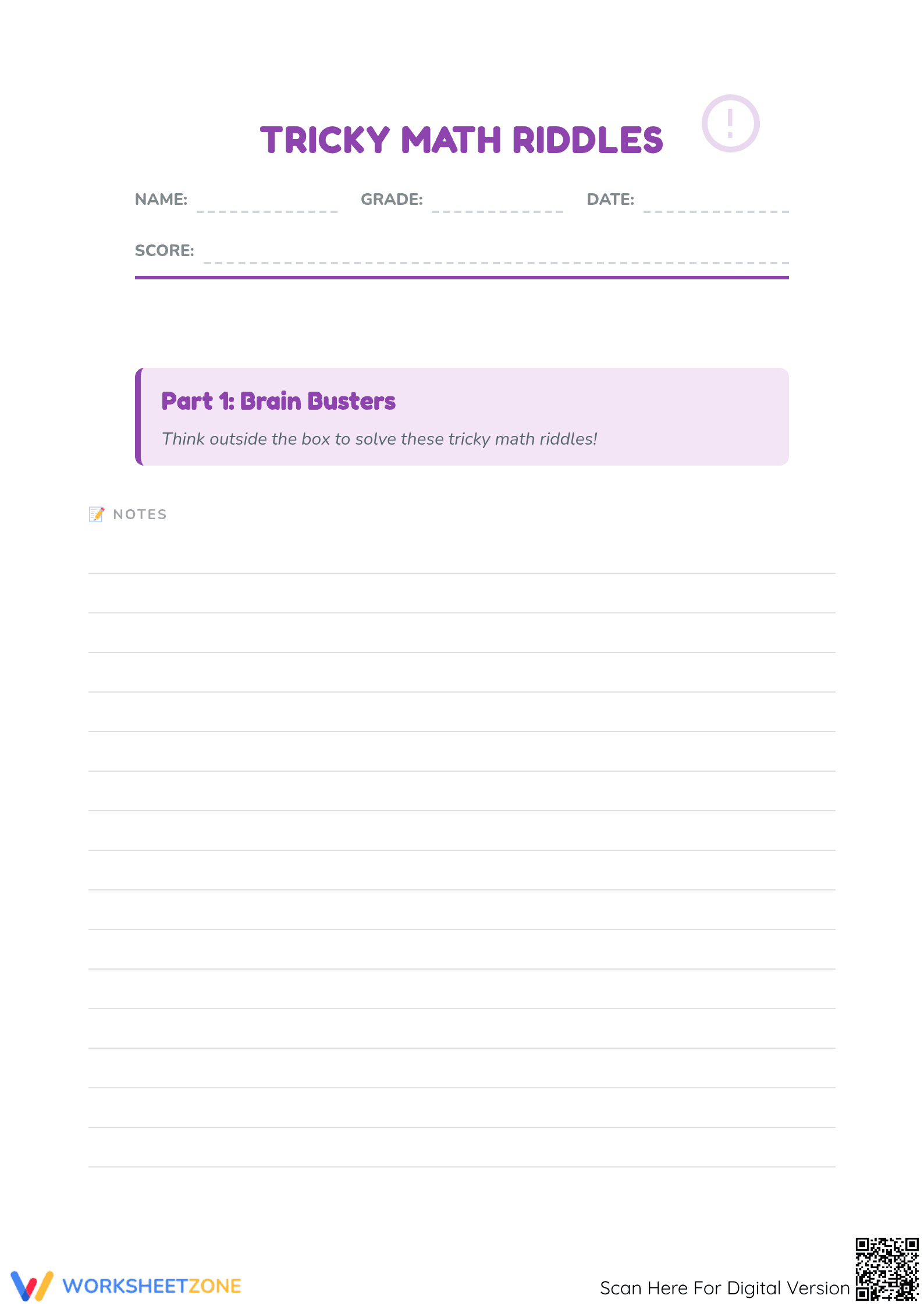



Math Riddles Worksheet | Printable Grade 3-4 Logic
Paste this activity's link or code into your existing LMS (Google Classroom, Canvas, Teams, Schoology, Moodle, etc.).
Students can open and work on the activity right away, with no student login required.
You'll still be able to track student progress and results from your teacher account.
This Grade 3 and Grade 4 math riddles worksheet challenges students to apply logical reasoning and critical thinking to solve multi-step word problems. By working through these brain busters, learners strengthen their foundational math skills while engaging in fun, puzzle-based problem-solving.
At a Glance
- Grade: 3-4 · Subject: Math
- Standard:
CCSS.MATH.CONTENT.4.OA.A.3— Solve multistep word problems using the four operations.- Skill Focus: Logical Reasoning & Word Problems
- Format: 4 pages · 14 problems · Answer key included · PDF
- Best For: Early finishers and sub plans
- Time: 20–30 minutes
This comprehensive packet features three distinct sections: Brain Busters, Quick Wit Riddles, and Logic & Patterns. Across four pages, students will tackle 14 unique challenges ranging from money math and time calculations to tricky wordplay. A complete four-page answer key is provided to ensure accurate grading and easy review.
Zero-Prep Workflow
- Print (1 minute): Generate the four-page student packet and the corresponding answer key.
- Distribute (1 minute): Hand out the riddles as an independent challenge or group activity.
- Review (3 minutes): Use the provided answer key to quickly check student logic and math calculations.
With under two minutes of total teacher prep time, this resource is highly suitable for emergency sub plans or enrichment stations.
Standards Alignment
Aligned to CCSS.MATH.CONTENT.4.OA.A.3, this resource requires students to solve multistep word problems posed with whole numbers and having whole-number answers using the four operations. It also supports critical thinking and reading comprehension in mathematical contexts. Both standard codes can be copied directly into lesson plans, IEP goals, or district curriculum mapping tools.
How to Use It
Deploy this worksheet as an engaging activity for early finishers or as a collaborative Friday math challenge after direct instruction. During independent work, observe how students approach the trick questions to assess their reading comprehension and attention to detail. Expected completion time ranges from 20 to 30 minutes depending on the student's reading level and problem-solving speed.
Who It's For
This resource is designed for third and fourth-grade students who need enrichment or engaging practice with word problems. It naturally differentiates by allowing advanced learners to tackle the logic patterns independently, while others can work in pairs. Pair this activity with a direct instruction lesson on identifying key terms in math word problems.
Integrating logic puzzles into standard math instruction significantly boosts student engagement and problem-solving stamina. Aligned with CCSS.MATH.CONTENT.4.OA.A.3, this resource helps students solve multistep word problems using the four operations. According to Fisher & Frey (2014), providing students with complex, puzzle-based tasks encourages productive struggle and deepens their conceptual understanding of mathematical relationships. By requiring learners to decode tricky phrasing and apply basic operations in novel contexts, these math riddles bridge the gap between rote calculation and higher-order critical thinking. This approach not only builds resilience in young mathematicians but also reinforces essential reading comprehension skills within a mathematical framework. Teachers can effectively utilize these structured challenges to foster a classroom culture that values analytical thinking, peer collaboration, and creative problem-solving over simple rote memorization.


