


























Views
Downloads
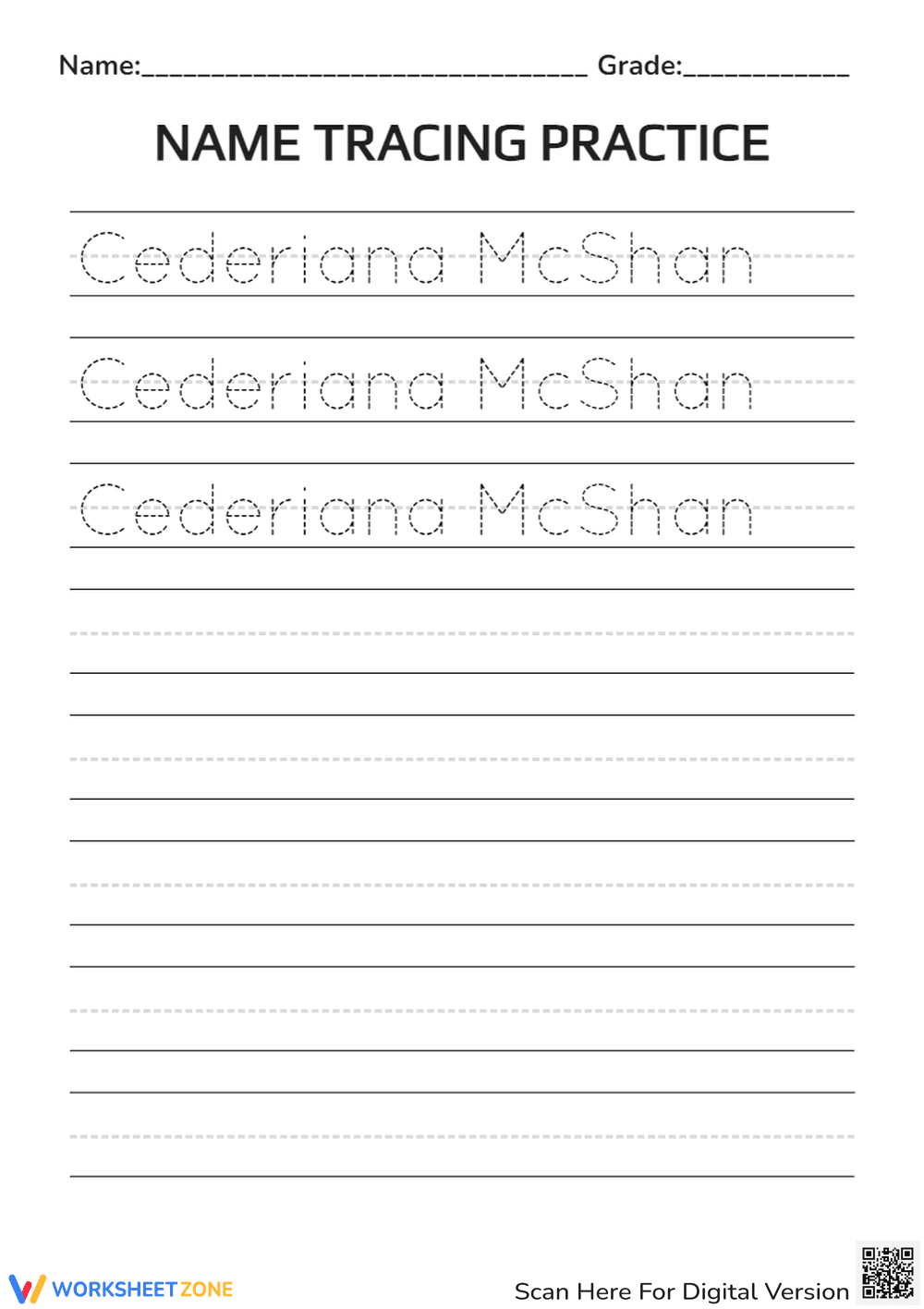

Name Tracing Practice | Essential Grade K-1 Printable
Paste this activity's link or code into your existing LMS (Google Classroom, Canvas, Teams, Schoology, Moodle, etc.).
Students can open and work on the activity right away, with no student login required.
You'll still be able to track student progress and results from your teacher account.
This name tracing worksheet helps early learners master the specific letter formations required to write the name Cederiana McShan. By combining guided tracing with independent practice lines, students develop the muscle memory and fine motor control necessary for legible handwriting. It provides a structured path from imitation to autonomous writing.
At a Glance
- Grade: Kindergarten · Subject: Handwriting
- Standard:
L.K.1.A— Print many upper- and lowercase letters with proper form- Skill Focus: Name tracing and letter formation
- Format: 1 page · 10 tasks · Answer key N/A · PDF
- Best For: Daily morning work or handwriting centers
- Time: 5–10 minutes
The worksheet features three rows of the name "Cederiana McShan" in a clear, dotted font for guided tracing. Below the guided section, seven additional primary-ruled lines provide ample space for students to practice writing the name independently. The layout includes dedicated fields for the student's name and grade at the top of the page.
The zero-prep workflow is designed for busy educators. First, print the single-page PDF (30 seconds). Second, distribute the sheets to students during morning arrival or center rotations (1 minute). Third, provide immediate verbal feedback as students trace the dotted letters and transition to the blank lines (ongoing). Total teacher prep time is under 2 minutes, making it an ideal sub plan addition.
This resource aligns with CCSS.ELA-LITERACY.L.K.1.A, which requires students to print many upper- and lowercase letters. By focusing on a specific name, it also supports personal identity and literacy engagement. This standard code can be copied directly into lesson plans, IEP goals, or district curriculum mapping tools to ensure compliance with state frameworks.
Use this worksheet as a "bell-ringer" activity to settle students as they enter the classroom. It is also an effective formative assessment tool; observe the student's pencil grip and stroke direction during the tracing phase. Most Kindergarten students will complete the full page in approximately 8 minutes, while Grade 1 students may finish more quickly.
This practice sheet is ideal for Kindergarten and first-grade students who are learning to recognize and write their names. It serves as a perfect companion to alphabet anchor charts or direct instruction on letter strokes. It is particularly helpful for students needing extra fine motor support or those working on specific letter heights.
According to the RAND AIRS 2024 report, consistent handwriting practice in early childhood is a significant predictor of later reading and writing fluency. This worksheet addresses the foundational need for letter formation mastery through a gradual release of responsibility. By starting with dotted-line scaffolds and moving toward independent production, students internalize the spatial requirements of complex names like Cederiana McShan. Research from Fisher & Frey (2014) emphasizes that such structured practice helps bridge the gap between cognitive recognition of letters and the physical execution of writing. This specific resource provides 10 distinct opportunities for repetition, ensuring that the motor patterns become automatic. Educators can utilize this tool to meet CCSS.ELA-LITERACY.L.K.1.A requirements while fostering a sense of ownership over personal writing tasks. The clear, uncluttered design minimizes cognitive load, allowing young learners to focus entirely on the precision of their strokes and the sequence of letters.


