




























1 / 2
0
Views
0
Downloads

0.0
0
Save
0 Likes
Share
Causation and Correlation Worksheet
0 Views
0 Downloads

Paste this activity's link or code into your existing LMS (Google Classroom, Canvas, Teams, Schoology, Moodle, etc.).
Students can open and work on the activity right away, with no student login required.
You'll still be able to track student progress and results from your teacher account.
Information
Description
What It Is:
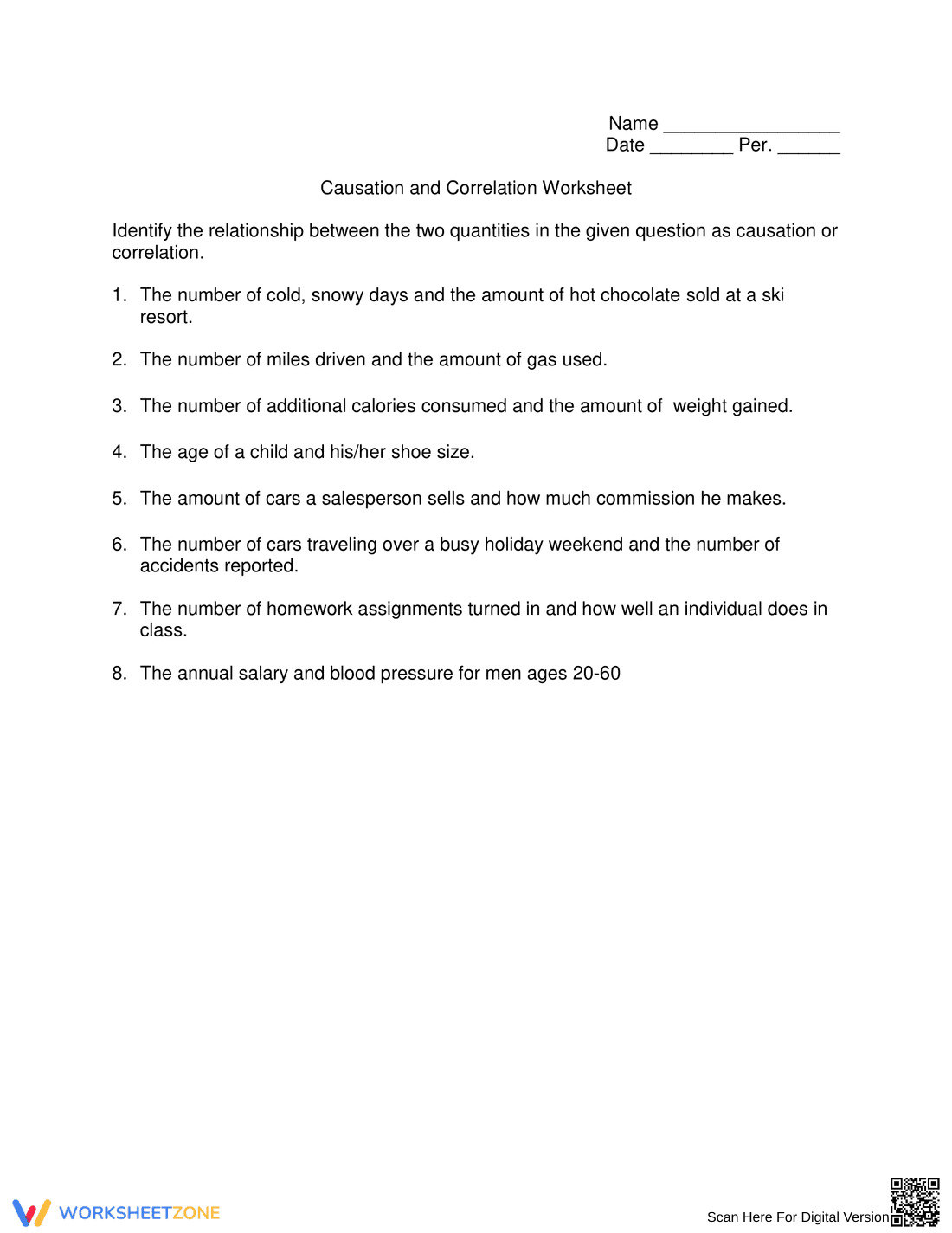
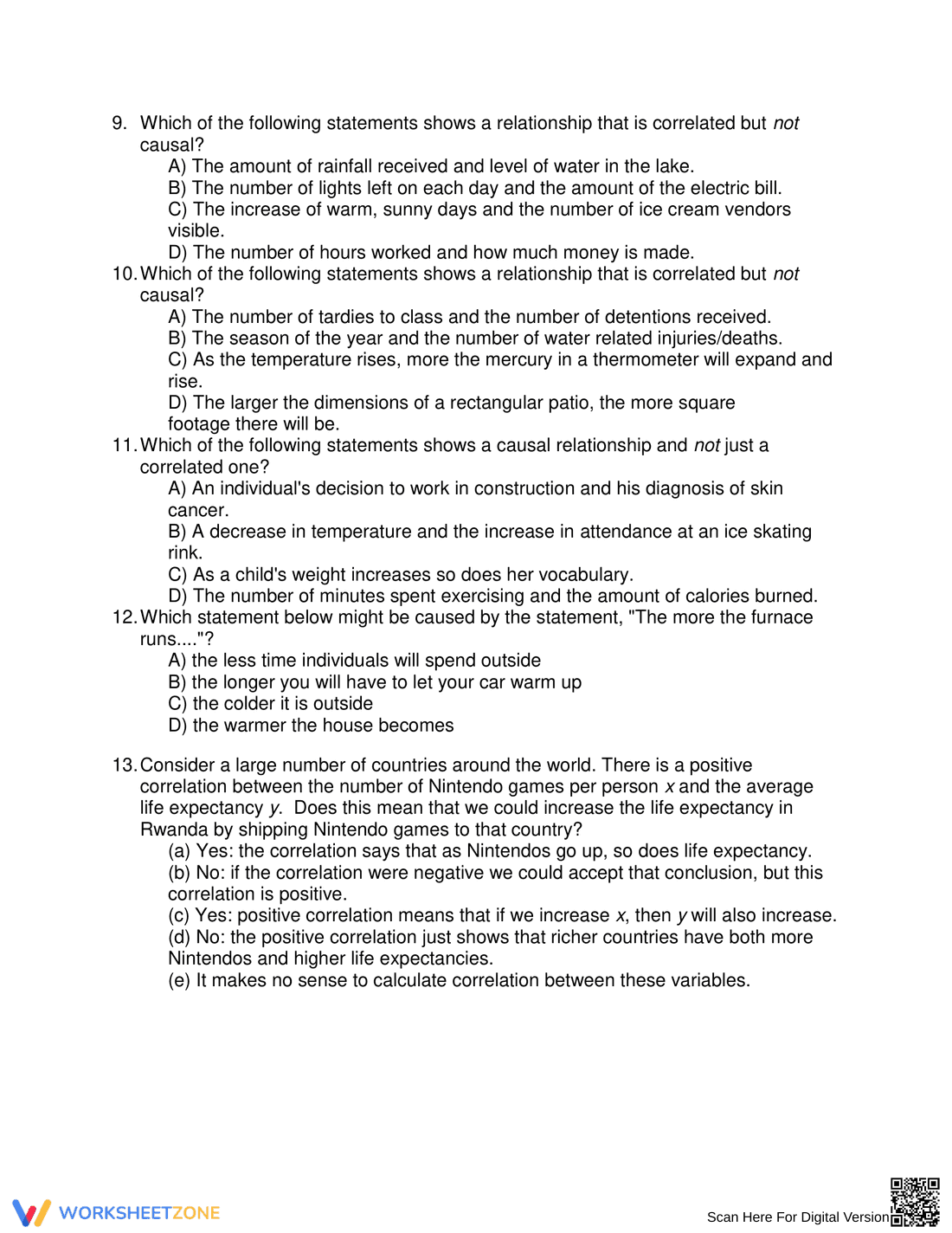
This is a worksheet titled 'Causation and Correlation Worksheet.' It presents eight scenarios and asks the student to identify the relationship between two quantities in each scenario as either causation or correlation. The scenarios include examples like the number of cold days and hot chocolate sales, miles driven and gas used, and homework turned in and class performance.
Grade Level Suitability:
This worksheet is suitable for grades 7-10. It requires analytical thinking and an understanding of the difference between causation and correlation, concepts typically introduced in middle school and reinforced in high school science and math classes.
Why Use It:
This worksheet helps students develop critical thinking skills by analyzing real-world scenarios and distinguishing between causation and correlation. It reinforces the understanding that correlation does not equal causation and encourages students to consider potential confounding variables.
How to Use It:
Students should read each scenario carefully and determine if one quantity directly causes the other (causation) or if they are simply related (correlation). They should provide a written explanation for their answer, justifying their reasoning.
Target Users:
The target users are middle school and high school students learning about statistics, scientific methods, or critical thinking. It is also suitable for teachers looking for a quick and easy way to assess students' understanding of causation and correlation.
This is a worksheet titled 'Causation and Correlation Worksheet.' It presents eight scenarios and asks the student to identify the relationship between two quantities in each scenario as either causation or correlation. The scenarios include examples like the number of cold days and hot chocolate sales, miles driven and gas used, and homework turned in and class performance.
Grade Level Suitability:
This worksheet is suitable for grades 7-10. It requires analytical thinking and an understanding of the difference between causation and correlation, concepts typically introduced in middle school and reinforced in high school science and math classes.
Why Use It:
This worksheet helps students develop critical thinking skills by analyzing real-world scenarios and distinguishing between causation and correlation. It reinforces the understanding that correlation does not equal causation and encourages students to consider potential confounding variables.
How to Use It:
Students should read each scenario carefully and determine if one quantity directly causes the other (causation) or if they are simply related (correlation). They should provide a written explanation for their answer, justifying their reasoning.
Target Users:
The target users are middle school and high school students learning about statistics, scientific methods, or critical thinking. It is also suitable for teachers looking for a quick and easy way to assess students' understanding of causation and correlation.


