


























Views
Downloads

Essential Common and Proper Nouns Worksheet | Grade 1-3
Paste this activity's link or code into your existing LMS (Google Classroom, Canvas, Teams, Schoology, Moodle, etc.).
Students can open and work on the activity right away, with no student login required.
You'll still be able to track student progress and results from your teacher account.
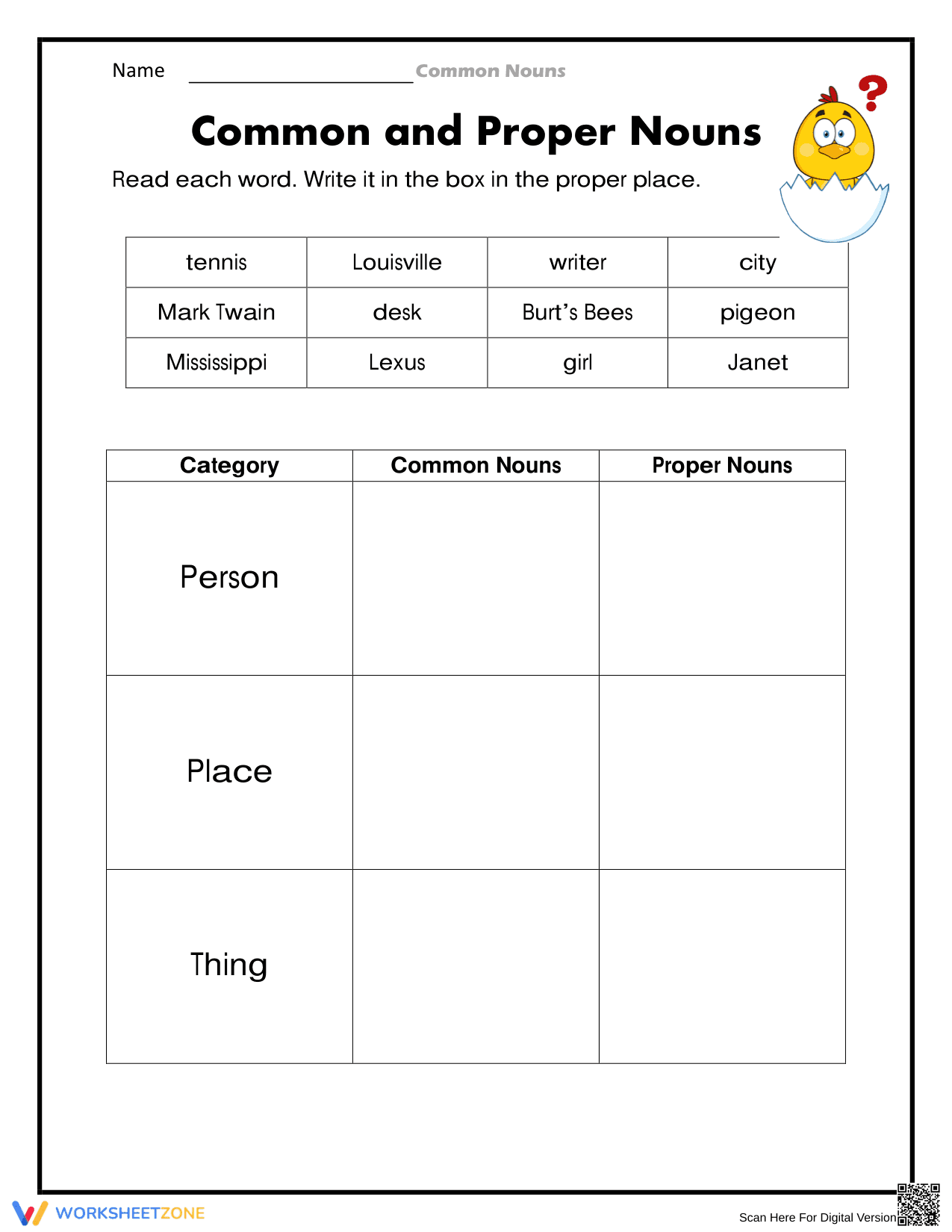
This printable grammar worksheet provides first through third-grade students with a focused activity to master the distinction between common and proper nouns. By categorizing twelve words into person, place, or thing, learners develop essential capitalization skills. This resource ensures students can accurately identify and sort nouns in various contexts.
At a Glance
- Grade: 1-3 · Subject: English Language Arts
- Standard:
CCSS.ELA-LITERACY.L.1.1.B— Use common, proper, and possessive nouns in sentences and writing- Skill Focus: Common vs. Proper Noun Categorization
- Format: 1 page · 12 problems · Answer key included · PDF
- Best For: Independent practice or literacy centers
- Time: 10–15 minutes
What's Inside
The worksheet features a clean structure designed for visual clarity. A word bank contains twelve nouns, including proper names like "Janet" and "Louisville" alongside general terms like "desk" and "city." Below, a comprehensive grid asks students to sort these words across three semantic categories: Person, Place, and Thing. This dual-axis sorting method reinforces both parts of speech and basic noun classification for early learners.
Zero-Prep Workflow
- Step 1: Print the single-page PDF for your entire class (approx. 10 seconds).
- Step 2: Distribute the copies to students during your grammar block or as a morning work activity (approx. 30 seconds).
- Step 3: Use the included answer key for a rapid whole-class review or individual grading (approx. 60 seconds).
With a total teacher preparation time under two minutes, it serves as an ideal emergency sub plan or quick formative assessment tool for busy classrooms.
Standards Alignment
This resource is explicitly aligned with CCSS.ELA-LITERACY.L.1.1.B, which requires students to use common, proper, and possessive nouns. By isolating the capitalization rules of proper nouns, it provides the foundation for sentence construction. This code can be copied directly into lesson plans, IEP goals, or curriculum mapping tools to ensure instructional compliance and progress tracking.
How to Use It
Use this worksheet as independent practice following a direct instruction lesson on capitalization. To maximize impact, have students highlight the capital letters in the proper nouns before writing them in the grid. As a formative assessment tip, observe whether students correctly place "Burt’s Bees" or "Louisville," as these items test their understanding of brand names and specific locations. Completion time is typically 10 to 15 minutes.
Who It's For
Designed for elementary students in grades 1, 2, and 3, this worksheet is effective for learners who struggle with consistent capitalization. It provides a scaffolded environment where students focus on the analytical task of sorting rather than generating their own examples. This resource pairs naturally with short reading passages or noun anchor charts to reinforce the concept across instructional modes.
The systematic categorization of nouns is a cornerstone of early literacy development, as evidenced by the RAND AIRS 2024 report which emphasizes structural grammar in reading comprehension. This worksheet targets CCSS.ELA-LITERACY.L.1.1.B, facilitating the transition from general noun recognition to specific identification. By engaging students in sorting twelve distinct items across three categories (Person, Place, Thing), the activity builds the cognitive schemas necessary for advanced writing. Mastery of proper noun capitalization prevents mechanical errors in student compositions and supports the alignment of classroom activities with evidence-based instructional practices. Educators can rely on this focused practice to bridge the gap between isolated skill drills and applied writing. This self-contained resource is an essential component for any primary grammar curriculum seeking to meet rigorous standards while maintaining learner engagement through clear, actionable tasks.


