




























Views
Downloads

Essential Muscles Worksheet | Grade 3-4 Ready

Paste this activity's link or code into your existing LMS (Google Classroom, Canvas, Teams, Schoology, Moodle, etc.).
Students can open and work on the activity right away, with no student login required.
You'll still be able to track student progress and results from your teacher account.
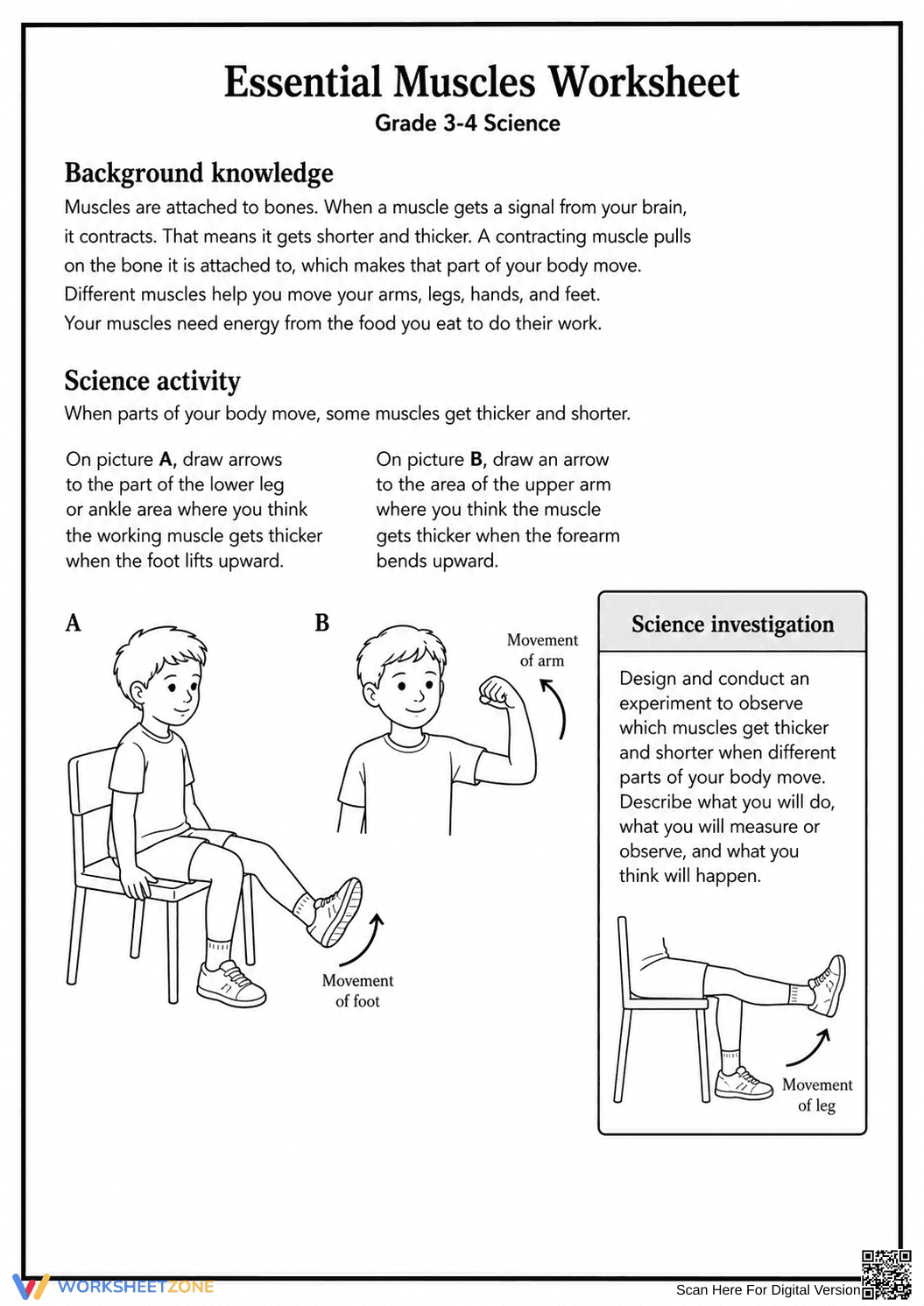
This Grade 3-4 science worksheet helps students identify how muscles contract to create movement. By connecting background knowledge about muscle fibers to physical changes in the arms and legs, learners build a foundation for human anatomy. Students explore the mechanics of contraction through targeted drawing tasks and a design-based science investigation.
At a Glance
- Grade: 3–4 · Subject: Science
- Standard:
4-LS1-1— Construct an argument that animals have internal structures that function to support behavior- Skill Focus: Muscular System & Muscle Contraction
- Format: 1 page · 3 tasks · Answer key not included · PDF
- Best For: Introductory anatomy or human body systems unit
- Time: 20–30 minutes
This single-page resource includes a concise background section explaining muscle physiology and energy use. The "Science Activity" requires students to visualize muscle thickening in the foot and forearm diagrams. A "Science Investigation" prompt challenges students to design an original experiment observing muscle changes across the body, encouraging higher-order thinking and scientific inquiry.
Zero-Prep Workflow
Our zero-prep workflow saves time: 1. Print the PDF for your class in under one minute. 2. Distribute and allow five minutes for students to read the background information. 3. Review the drawing results for ten minutes. This workflow requires zero teacher preparation time and is perfectly suited for emergency sub plans or quick science reinforcements.
Standards Alignment
Primary alignment is `4-LS1-1`, focusing on internal and external structures that support survival and behavior. This worksheet specifically addresses the internal muscular structures that facilitate movement. This standard code can be copied directly into lesson plans, IEP goals, or district curriculum mapping tools to ensure alignment with state and national science frameworks.
How to Use It
Use this during the "Explore" phase of a body systems unit. It serves as a formative assessment tool; observe if students correctly identify thickening points during movement. Expected completion time is 25 minutes. Pair this with a physical demonstration of "making a muscle" to bridge the gap between the text and biological reality.
Who It's For
This resource is designed for Grade 3 and 4 students starting human anatomy. It is helpful for visual learners who benefit from diagram-based tasks. For students needing support, provide an anchor chart of the muscular system as a pairing resource to help them visualize the internal structures mentioned in the background information text.
According to NAEP data, students who engage in active scientific investigation and design-based learning demonstrate higher proficiency in understanding complex biological systems. This Grade 3-4 resource facilitates this inquiry by requiring students to apply the concept of 4-LS1-1 muscle contraction to their own physical movements. By investigating how internal structures like muscles and the skeleton interact to produce behavior, learners develop a robust mental model of human physiology. This instructional approach aligns with NAEP recommendations for incorporating cross-cutting concepts, such as structure and function, into elementary science curricula. The shift from passive reading to active experimentation ensures that students do not just memorize facts but actually comprehend the mechanics of the body. This worksheet provides a structured environment for students to propose, test, and observe biological phenomena, effectively bridging the gap between theoretical knowledge and practical evidence in a classroom setting.


