


























Views
Downloads

Printable Grade 1 Sound Science: Can You Hear Me Now?
Paste this activity's link or code into your existing LMS (Google Classroom, Canvas, Teams, Schoology, Moodle, etc.).
Students can open and work on the activity right away, with no student login required.
You'll still be able to track student progress and results from your teacher account.
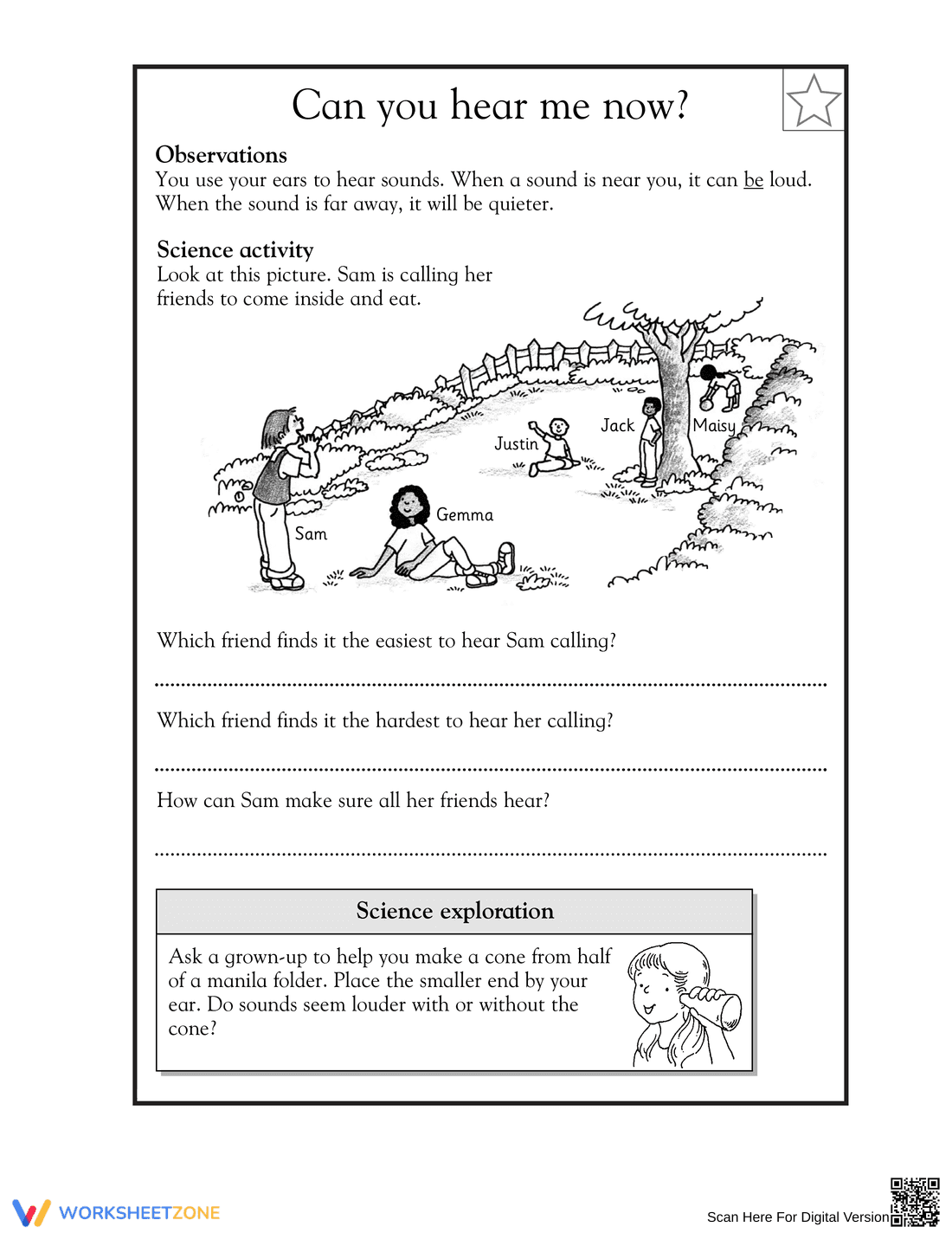
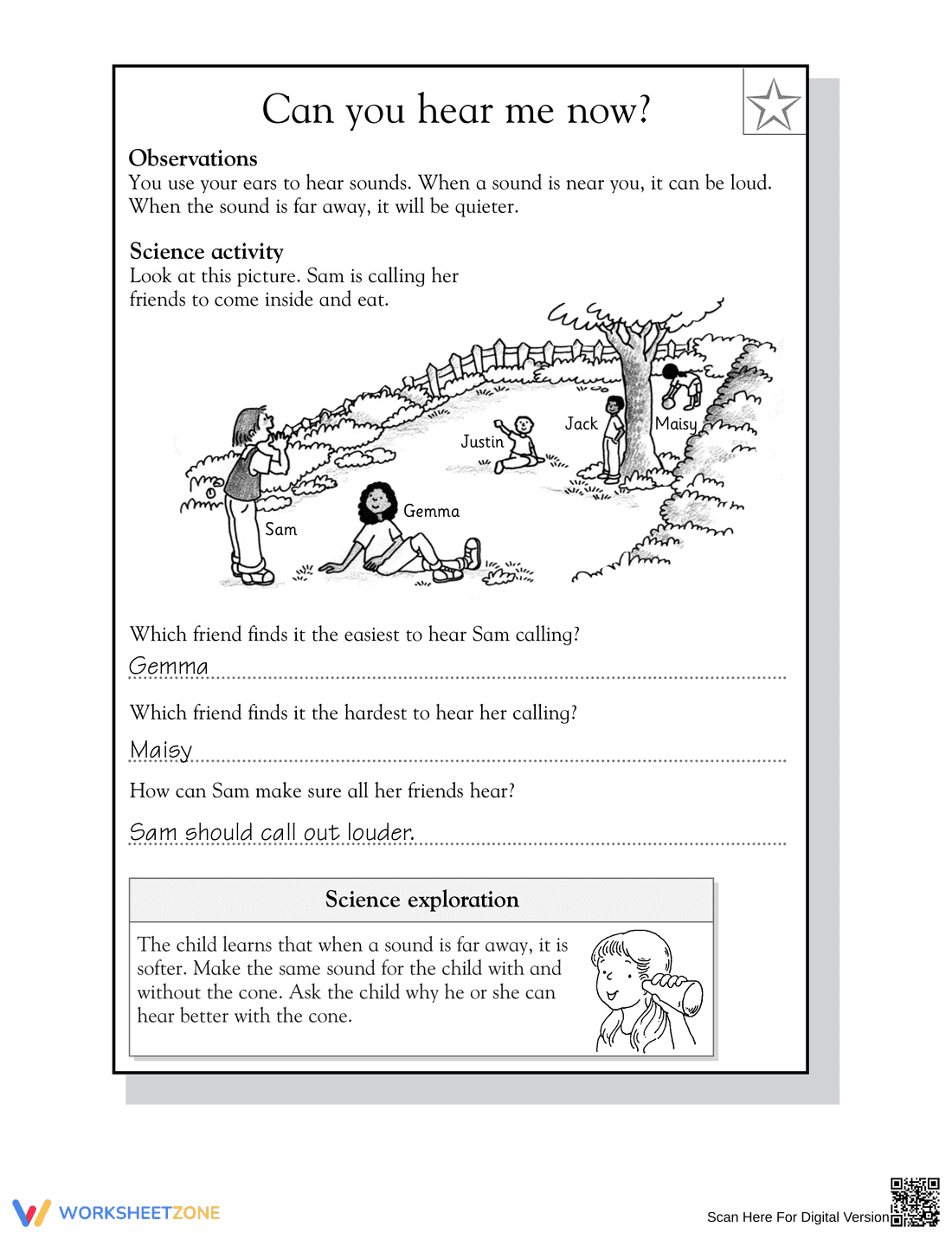
This engaging Grade 1 sound science worksheet provides a hands-on exploration of how volume changes with distance. Students observe a real-world scenario to identify how proximity affects loudness before designing a simple amplification tool. It’s an essential resource for making abstract physical science concepts concrete through direct observation and inquiry-based learning.
At a Glance
- Grade: 1 · Subject: Science
- Standard:
1-PS4-4— Design a device using sound to communicate over a distance.- Skill Focus: Sound Properties (Loudness & Distance)
- Format: 2 pages · 4 tasks · Answer key included · PDF
- Best For: Whole-class intro, science centers, sub plan
- Time: 15–20 minutes
This two-page PDF includes a student worksheet and a comprehensive answer key. The worksheet begins with foundational observations about sound travel, followed by a "Science Activity" featuring an illustrated scenario with three critical-thinking questions. Finally, the "Science Exploration" section provides instructions for a hands-on experiment where students create a paper cone to investigate how tools can amplify sound waves for communication.
Zero-Prep Workflow
Designed for maximum efficiency, this worksheet requires less than two minutes of preparation to implement in your classroom:
- Print (1 minute): Generate one copy per student. The high-contrast black-and-white design ensures clear visibility on standard school copiers and printers.
- Distribute (1 minute): Hand out the materials. The intuitive layout allows students to begin the observation phase with minimal introductory instruction from the teacher.
- Review (5 minutes): Use the included answer key for immediate feedback or to guide a post-activity discussion about the results of the cone experiment.
Standards Alignment
This resource is meticulously aligned to Next Generation Science Standard 1-PS4-4. This standard tasks students with using materials to design a device that uses sound to solve the problem of communicating over a distance. By constructing and testing a simple megaphone, students gather empirical evidence on sound amplification. Both standard codes can be copied directly into lesson plans, IEP goals, or curriculum mapping tools.
How to Use It
Implement this worksheet as an anticipatory set to kick off a unit on waves or energy. It also works perfectly as a station in a science center rotation. For a formative assessment tip, observe students during the exploration phase; their ability to articulate why the cone makes sound louder provides insight into their understanding of energy direction. Completion typically takes 15 to 20 minutes.
Who It's For
This worksheet is tailored for first and second-grade students. The visual prompts make it accessible for English Language Learners and students requiring literacy support. For differentiation, ask advanced learners to compare different cone sizes or materials. It pairs naturally with an anchor chart detailing vibrations and volume. The clear structure supports independent work while building foundational science skills.
Research from EdReports (2024) emphasizes that early exposure to physical science through hands-on modeling significantly improves long-term retention of NGSS-aligned concepts. This worksheet leverages the "Science Exploration" model to move beyond passive reading, requiring students to actively test the 1-PS4-4 standard via a constructed device. By investigating how a physical tool alters the perceived loudness of a source, students develop the foundational mental models necessary for later mastery of wave behavior. Studies in ScienceDirect (2024) indicate that connecting abstract physics to immediate sensory experiences—like the change in volume when using a paper cone—reduces cognitive load and increases student engagement in STEM disciplines. This resource serves as a high-leverage tool for implementing inquiry-based instruction in the primary classroom, ensuring that scientific vocabulary like "distance" and "loudness" is grounded in observable physical phenomena rather than rote memorization alone.


