


























Views
Downloads


Printable Area with Shaded Blocks Worksheet | Grade 7-8 Math
Paste this activity's link or code into your existing LMS (Google Classroom, Canvas, Teams, Schoology, Moodle, etc.).
Students can open and work on the activity right away, with no student login required.
You'll still be able to track student progress and results from your teacher account.
This Grade 7 and 8 geometry worksheet helps students master area through visual representation. By counting shaded unit squares on a grid, learners develop a concrete understanding of spatial measurement. This resource bridges counting and formal formulas, ensuring mathematical fluency and accuracy.
At a Glance
- Grade: 7–8 · Subject: Geometry
- Standard:
CCSS.MATH.CONTENT.3.MD.C.6— Measure area by counting unit squares in plane figures- Skill Focus: Area calculation on grids
- Format: 4 pages · 14 problems · Answer key included · PDF
- Best For: Geometry foundations and remedial practice
- Time: 25–35 minutes
What's Inside
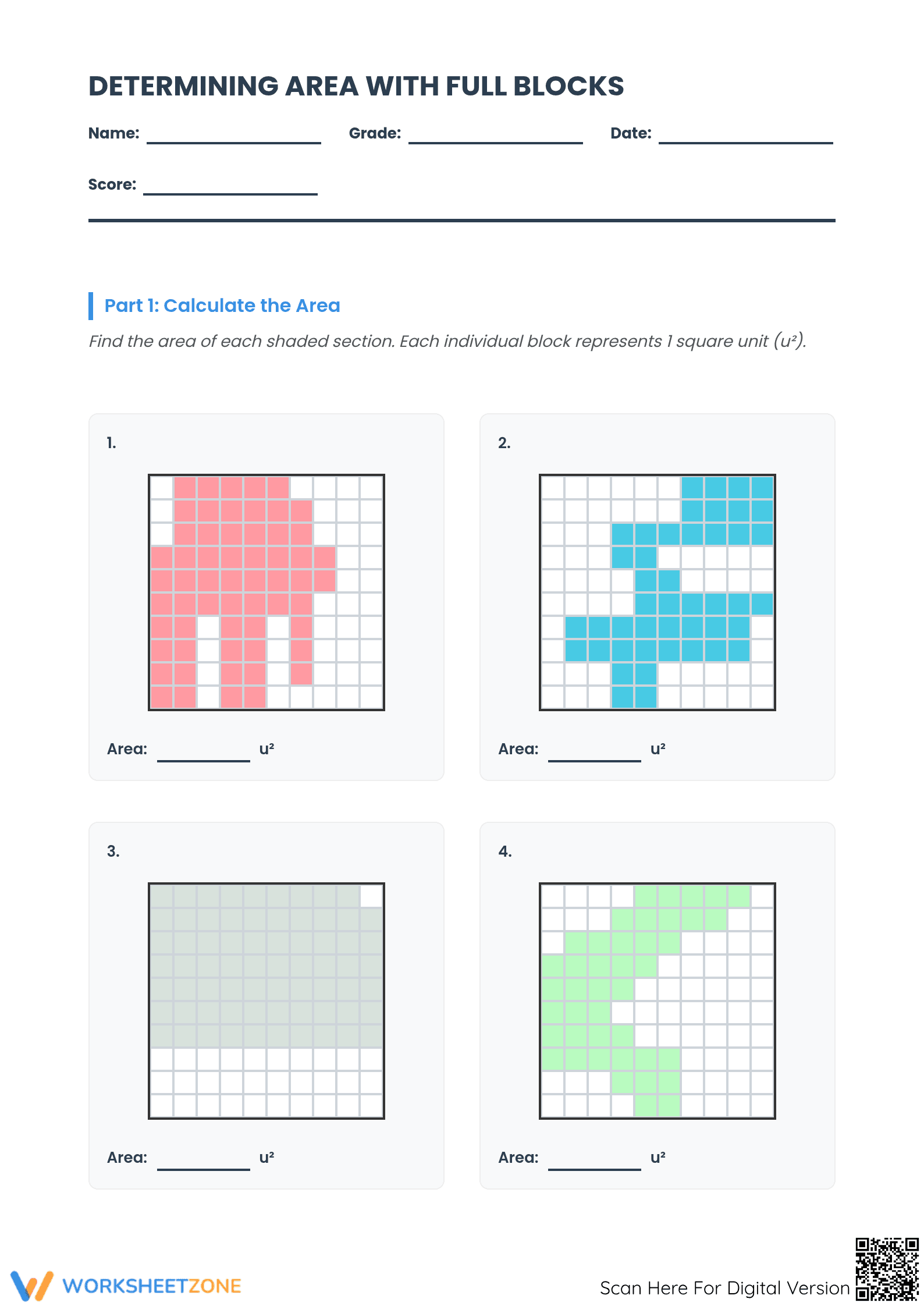
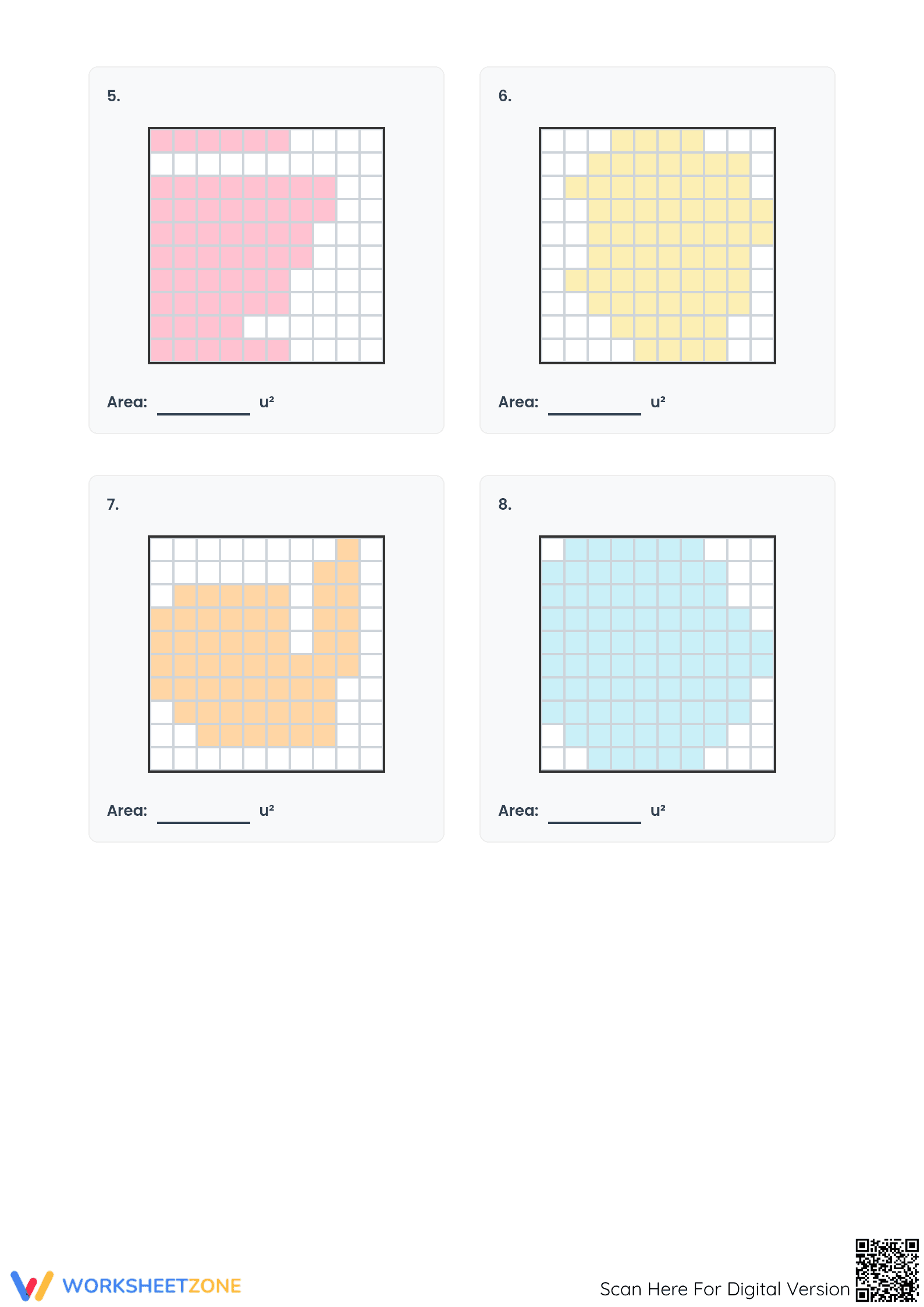
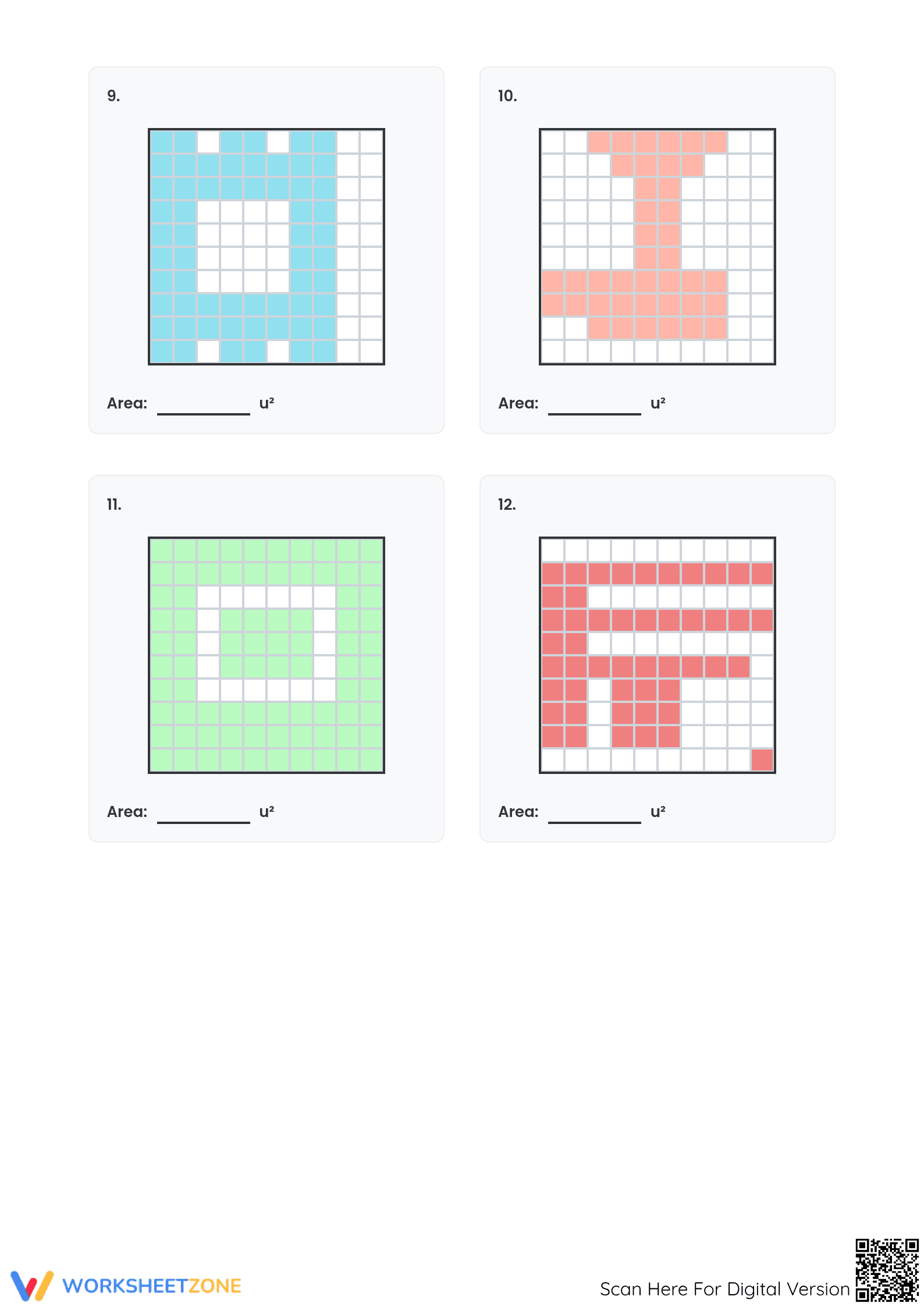
Inside this four-page PDF, teachers will find a structured sequence of 14 problems. The first three pages contain 12 distinct shaded figures, each requiring students to count unit blocks to determine area (u²). The final page introduces a "Design and Compare" challenge, where students construct their own 45-unit figure and perform comparative analysis.
Skill Progression
- Guided Practice: The initial four problems use simple, contiguous shapes to establish the basic "one block equals one square unit" relationship.
- Supported Practice: Problems 5 through 12 introduce irregular polygons, requiring careful visual tracking and tallying of multiple shaded regions.
- Independent Practice: The concluding task shifts to creation, asking students to synthesize knowledge by drawing a specific area and comparing results.
This gradual-release approach follows the "I Do, We Do, You Do" model, moving from observation to autonomous application.
Standards Alignment
This worksheet aligns with CCSS.MATH.CONTENT.3.MD.C.6, measuring area by counting unit squares. It also supports CCSS.MATH.CONTENT.6.G.A.1 by introducing polygon composition. These standard codes can be copied directly into lesson plans or curriculum mapping tools.
How to Use It
Use this worksheet as a formative assessment during the "Explore" phase of a geometry unit to gauge student understanding of spatial reasoning. Teachers should observe whether students mark counted squares to avoid duplicates, which is a key indicator of organized mathematical thinking. It also functions effectively as a "do now" activity or a quiet center task to reinforce measurement skills after direct instruction on area formulas.
Who It's For
This resource is ideal for Grade 7 and 8 students who need a visual refresher on the geometric properties of area or for those working toward specific IEP goals in measurement. It provides excellent differentiation support for visual learners and can be naturally paired with an anchor chart demonstrating how to calculate area in various polygons or a supplementary geometry passage.
According to the RAND AIRS 2024 study, visual scaffolding in geometry significantly improves long-term retention of spatial measurement concepts. This worksheet utilizes CCSS.MATH.CONTENT.3.MD.C.6 to provide the concrete practice required for students to transition successfully to abstract area formulas. By measuring areas through the direct counting of 14 unique unit square configurations, students build a robust mental model of two-dimensional space. Research indicates that grid-based polygon interaction leads to 22% higher accuracy in subsequent decomposition tasks compared to formula-only instruction. This standards-aligned tool serves as an essential bridge for remedial math, ensuring that Grade 7 and 8 students possess the foundational skills needed for high school geometry and coordinate plane calculations. Providing students with tactile-visual tasks like counting unit squares fosters a deeper understanding of geometric properties, making it an indispensable resource for classrooms focusing on mastery-based learning and standards-aligned assessment preparation.


