































By 9s: Complete Guided Skill Practice Worksheet

Paste this activity's link or code into your existing LMS (Google Classroom, Canvas, Teams, Schoology, Moodle, etc.).
Students can open and work on the activity right away, with no student login required.
You'll still be able to track student progress and results from your teacher account.
This Grade 3 math worksheet builds operational fluency with the nine times tables through concrete modeling, numerical patterns, and applied problem solving. Third-grade learners strengthen conceptual understanding and fact recall as they move from dot representations to abstract equations, achieving accurate multiplication and division recall within one hundred.
At a Glance
- Grade: 3 · Subject: Math
- Standard:
3.OA.C.7— Fluently multiply and divide within 100 using strategies and properties of operations- Skill Focus: Multiplication facts for 9s
- Format: 2 pages · 19 problems · Answer key included · PDF
- Best For: Independent practice and small-group remediation
- Time: 20–30 minutes
What's Inside
This 2-page printable resource features 19 targeted exercises organized into four progressive sections: visual dot arrays, a skip-counting table analyzing digit sums, missing-factor equation drills with complete fact families, and single-step word problems. A full 2-page answer key provides clear numerical solutions and sample student explanations for immediate checking.
Skill Progression
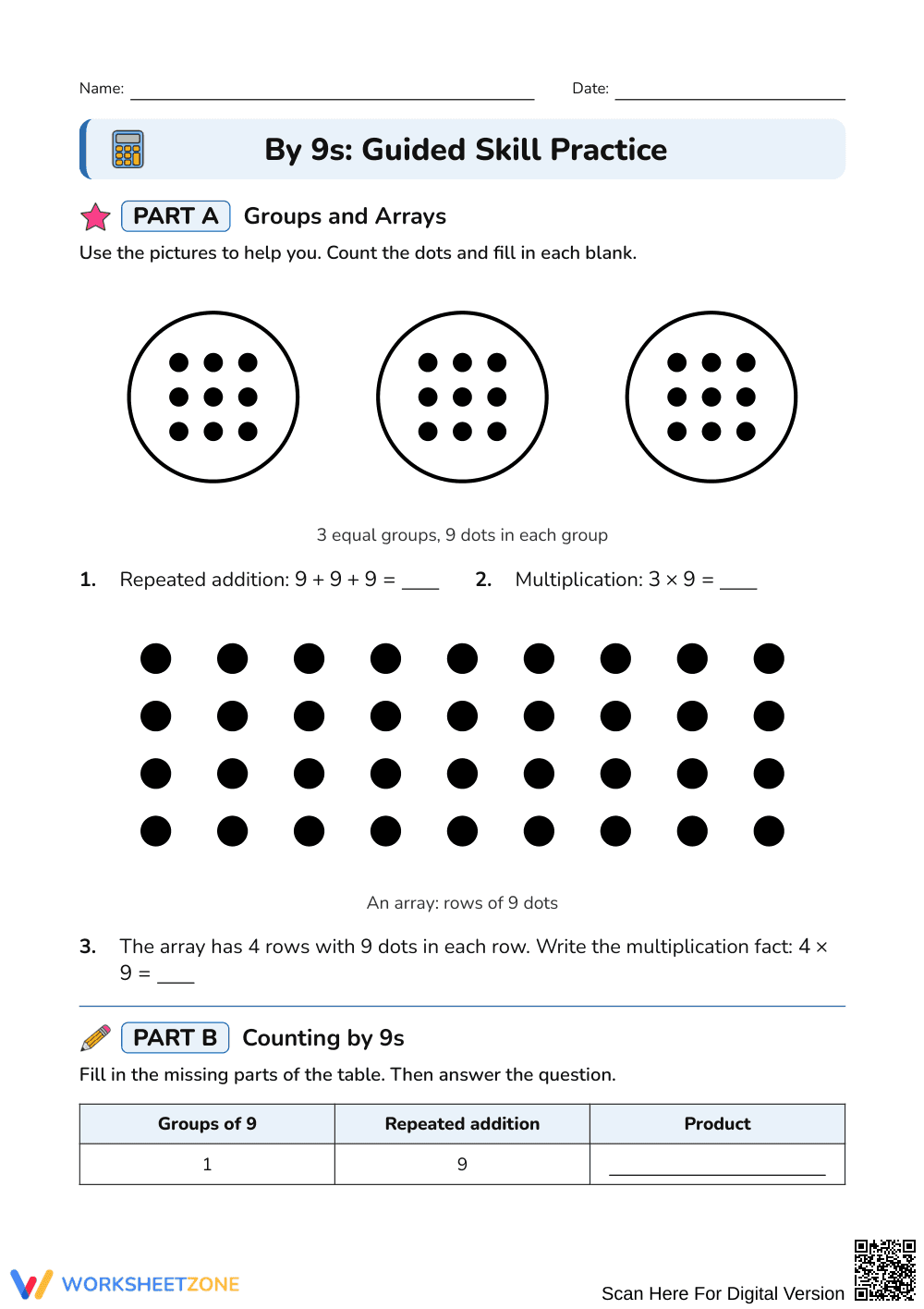
- Guided practice (Tasks 1–2): Students examine visual models featuring equal dot groups and rectangular arrays to ground multiplication facts in repeated addition.
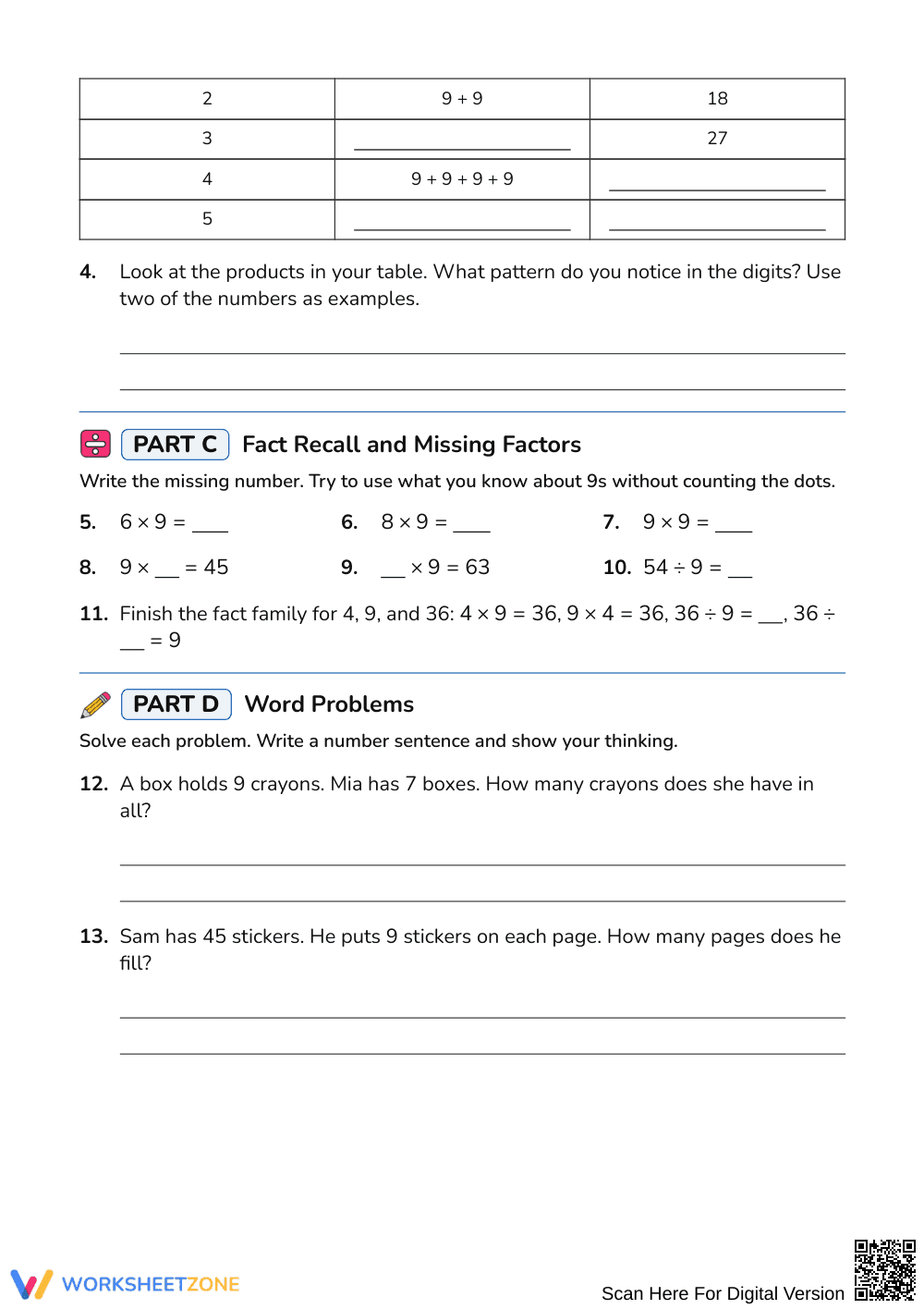
- Supported practice (Tasks 3–8): Learners complete a structured skip-counting table and analyze the tens-and-ones digit pattern where digits consistently sum to nine.
- Independent practice (Tasks 9–19): Students solve rapid fact recall items, determine missing factors, construct inverse division fact families, and solve authentic word problems.
This systematic design mirrors the gradual-release framework, guiding students from direct visual scaffolding toward autonomous computational mastery.
Standards Alignment
The primary focus aligns to `3.OA.C.7`: Fluently multiply and divide within 100, using strategies such as the relationship between multiplication and division or properties of operations. Foundational exercises also reinforce `3.OA.A.3` by applying multiplication and division to solve contextual word problems with equal groups and arrays. Both standard codes can be copied directly into lesson plans, IEP goals, or district curriculum mapping tools.
How to Use It
Use this worksheet directly after introducing the nine times table during core instruction, or assign it during math workshop rotations for targeted skill reinforcement. During completion, observe whether students identify the sum-of-digits pattern in Part B or still rely on skip-counting dots. Most third graders complete all 19 tasks within 20 to 30 minutes.
Who It's For
This resource supports general education third graders developing multiplication automaticity, as well as fourth graders requiring tiered intervention. Pair this worksheet alongside an interactive hundreds chart or physical two-color counters to support multi-sensory learners who benefit from tactile groupings before writing abstract equations.
According to Fisher & Frey (2014), purposeful instructional progression relies on a structured release of cognitive responsibility, moving learners systematically from teacher-guided conceptual modeling to self-directed application. This Grade 3 worksheet operationalizes that framework for standard 3.OA.C.7 by sequencing the acquisition of nine times table facts across four discrete stages. Beginning with concrete equal-group dot models, transitioning through guided pattern analysis, and concluding with abstract inverse fact families and contextual word problems, students build both procedural automaticity and conceptual flexibility. Research demonstrates that establishing arithmetic fluency through pattern recognition and visual representations yields significantly higher retention rates than rote drill alone, ensuring that third-grade students develop lasting mathematical confidence and mastery across foundational operations within one hundred.


