































By 8s: Essential Prerequisite Check Worksheet

Paste this activity's link or code into your existing LMS (Google Classroom, Canvas, Teams, Schoology, Moodle, etc.).
Students can open and work on the activity right away, with no student login required.
You'll still be able to track student progress and results from your teacher account.
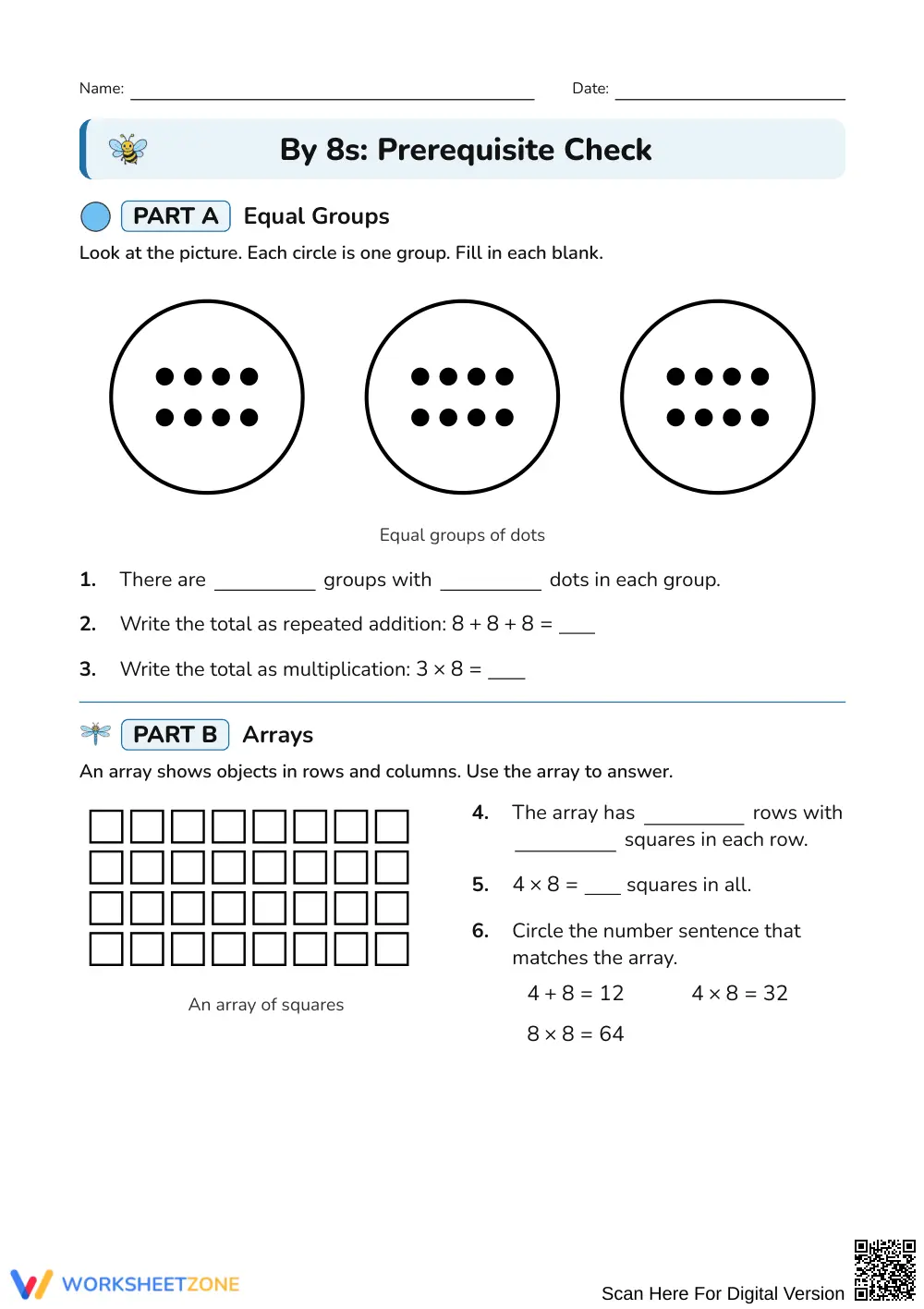
This Grade 3 math worksheet provides targeted prerequisite review for multiplying by 8, establishing essential fluency with visual representations. Designed as a diagnostic readiness check, it equips third graders to interpret products through equal groups, arrays, and skip-counting before tackling advanced multiplication facts.
At a Glance
- Grade: 3 · Subject: Math
- Standard:
3.OA.A.1— Interpret products of whole numbers using equal groups and visual models- Skill Focus: Foundational prerequisite visual models for multiplying by 8
- Format: 2 pages · 21 problems · Answer key included · PDF
- Best For: Diagnostic prerequisite check and small-group review
- Time: 20–30 minutes
What's Inside
This 2-page printable worksheet includes 21 diagnostic problems arranged across four distinct parts. Tasks cover equal-group dot diagrams, array equations, skip-counting number lines, and repeated addition tables. A complete 2-page answer key provides worked solutions and conceptual explanations.
Skill Progression
- Guided Practice (Part A): Students examine equal-group dot models to connect repeated addition (8 + 8 + 8 = 24) to multiplication notation across 4 supported items.
- Supported Practice (Parts B & C): Students analyze a 4-by-8 array, select matching equations, trace a skip-counting number line, and complete an input-output table across 10 items.
- Independent Practice (Part D): Learners solve 7 mixed calculation items, solve a real-world spider word problem, and explain how rotating an array demonstrates the commutative property.
This sequence implements a gradual-release model, moving students smoothly from visual scaffolding to independent multiplication reasoning.
Standards Alignment
This worksheet aligns directly to Common Core standard `3.OA.A.1`, focusing on interpreting products of whole numbers through equal groups. It also supports `3.OA.B.5` as students apply the commutative property to explain why rotated arrays share identical products. Both standard codes can be copied directly into lesson plans, IEP goals, or district curriculum mapping tools.
How to Use It
Use this diagnostic check before formal direct instruction on multiplying by 8 to gauge baseline fluency with equal groups. During independent work, watch for students who count dots individually rather than skip-counting by 8s. Expected completion time is 20 to 30 minutes.
Who It's For
This printable resource is ideal for Grade 3 math students beginning multiplication by 8, intervention groups needing visual group reinforcement, and special education teachers tracking IEP arithmetic objectives. Pair this worksheet with two-color counters or a multiplication chart during guided small-group instruction.
Grounding early multiplication instruction in concrete visual representations and explicit prerequisite checks accelerates conceptual mastery and procedural fluency. According to research on gradual release by Fisher & Frey (2014), structuring student tasks from guided visual models to independent relational reasoning creates optimal conditions for long-term skill retention. This 2-page Grade 3 mathematics resource addresses Common Core standard 3.OA.A.1 by establishing the prerequisite conceptual notation required for multiplying by 8. Through 21 carefully sequenced tasks, students interpret products of whole numbers by connecting equal-group models, rectangular arrays, skip-counting number lines, and repeated addition tables. By requiring learners to articulate why rotating an array illustrates the commutative property, the worksheet transitions students from basic counting to multiplicative reasoning. Teachers and curriculum specialists can deploy this standards-aligned diagnostic tool to identify student misconceptions prior to memorization, ensuring equitable access to upper-elementary algebraic foundations.


