































By 5s: Complete Guided Skill Practice Worksheet

Paste this activity's link or code into your existing LMS (Google Classroom, Canvas, Teams, Schoology, Moodle, etc.).
Students can open and work on the activity right away, with no student login required.
You'll still be able to track student progress and results from your teacher account.
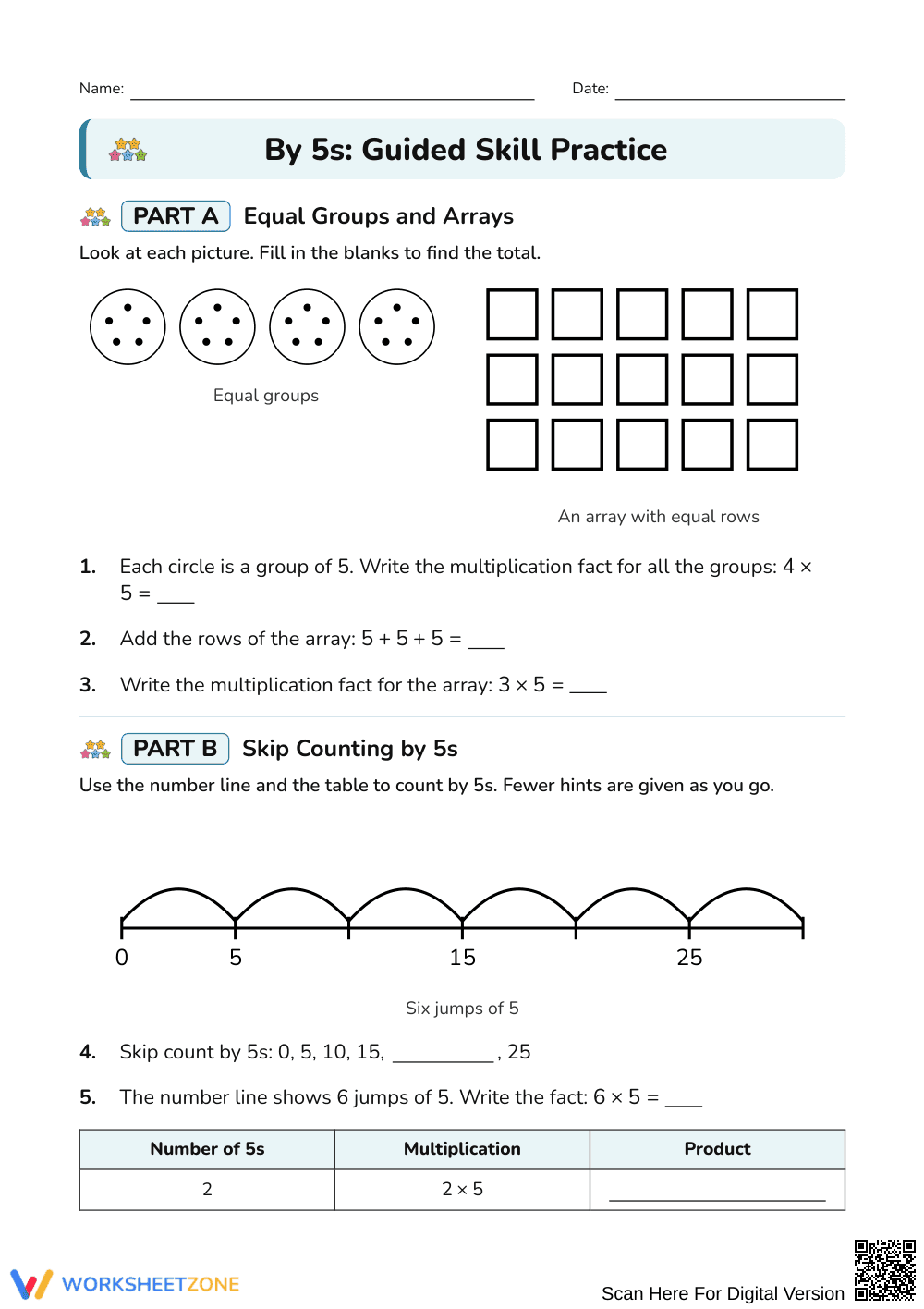
Mastering multiplication facts for 5s requires connecting visual models to abstract numeric relationships. This two-page math worksheet guides third-grade learners through equal groups, array models, skip-counting number lines, and fact families. Students systematically develop computational fluency across 13 carefully structured tasks, culminating in contextual word problem solving that solidifies conceptual understanding.
At a Glance
- Grade: 3 · Subject: Math
- Standard:
3.OA.C.7— Fluently multiply and divide within 100 using properties and fact families- Skill Focus: Multiplying by 5s using visual representations
- Format: 2 pages · 13 problems · Answer key included · PDF
- Best For: Core instruction and targeted small-group intervention
- Time: 20–30 minutes
What's Inside
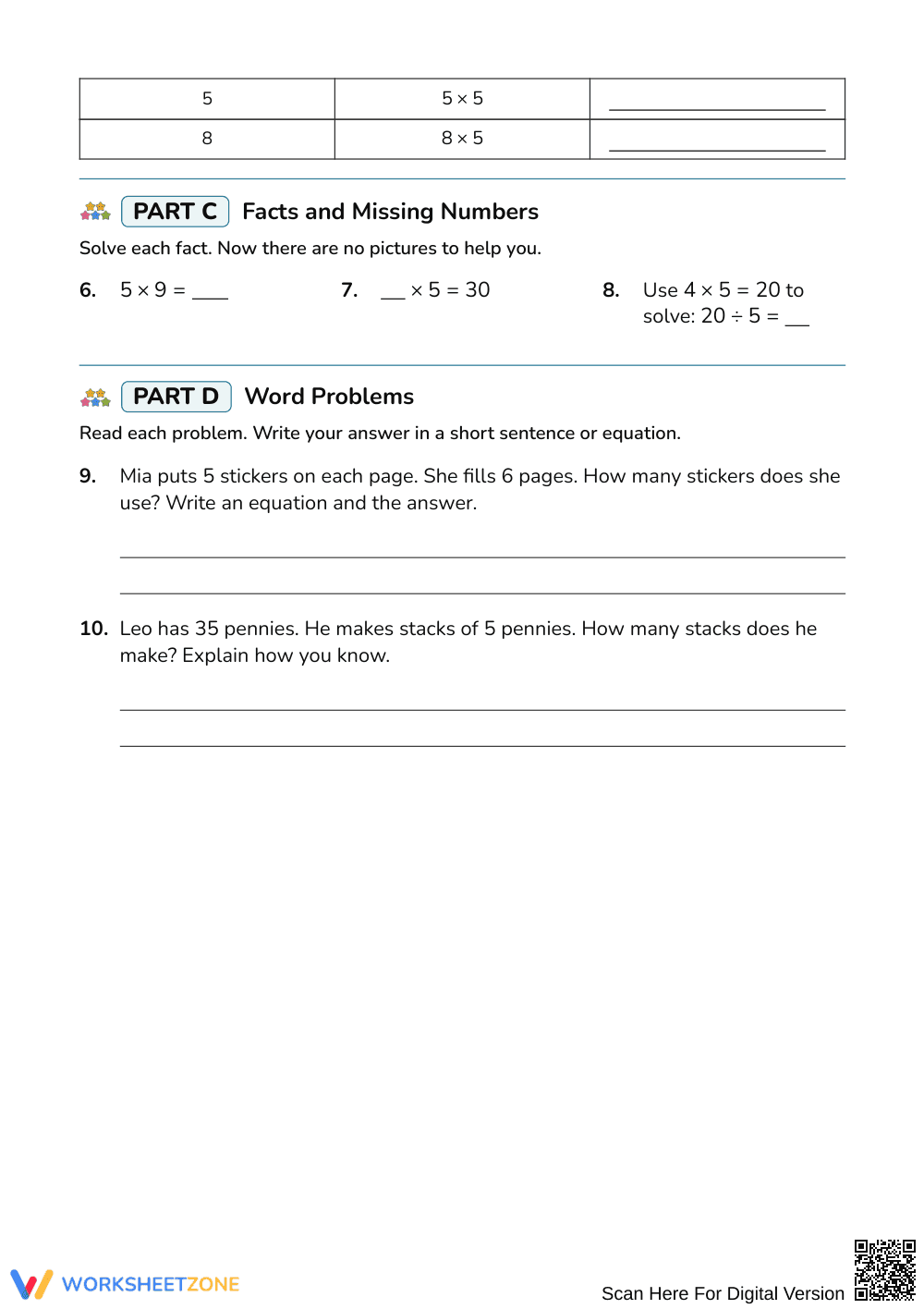
The activity spans two student pages containing 13 targeted math items across four sections. Part A introduces concrete models, prompting students to interpret equal circle groupings and repeated-addition arrays. Part B provides a number line with six jumps of 5 alongside a multiplication table. Part C presents abstract mental math and related division equations, while Part D features short contextual word problems. A two-page answer key provides complete solutions.
Skill Progression
- Guided Practice (Part A, 3 items): Visual models prompt students to connect equal groups and repeated addition directly to multiplication equations.
- Supported Practice (Part B, 5 items): Skip counting along a number line and table patterns reduces reliance on pictures.
- Independent Practice (Parts C and D, 5 items): Missing factors, division facts, and word problems challenge students to apply strategies independently.
This deliberate sequence follows the gradual release of responsibility model, moving learners smoothly from visual modeling to abstract computation.
Standards Alignment
The primary focus aligns directly to 3.OA.C.7: fluently multiply and divide within 100 using strategies like the relationship between operations. Supporting tasks align with 3.OA.A.3 for solving multiplication word problems. Both standard codes can be copied directly into lesson plans, IEP goals, or district curriculum mapping tools.
How to Use It
Deploy this worksheet immediately after direct instruction as a 20- to 25-minute practice activity. It also works well in math rotations to evaluate retention. For formative assessment, observe whether students calculate Part C by counting on their fingers or by recalling patterns from Part B.
Who It's For
Designed for Grade 3 classrooms, this resource supports elementary students building fact automaticity, as well as Grade 4 intervention groups. Pair this sheet with a classroom skip-counting anchor chart to support developing learners during practice.
According to Fisher & Frey (2014), structured instructional materials that follow an intentional gradual-release framework produce measurable gains in conceptual math understanding and automatic recall. This Grade 3 worksheet operationalizes standard 3.OA.C.7 by moving learners from concrete equal groups and array diagrams to semi-abstract skip counting and fully abstract fact fluency. Integrating 13 focused items across two instructional pages ensures students explore the reciprocal connection between multiplication and division rather than memorizing algorithms in isolation. Research emphasizes that pairing visual models with contextual word problems deepens number sense, especially when learners verbalize mathematical reasoning. By transitioning systematically from visual prompts to independent problem solving, students build foundational automaticity required for multi-digit multiplication and division in upper elementary grades. The included two-page reference key supports rapid formative feedback to correct misconceptions promptly.


