































By 4s: Reasoning & Justification Complete Worksheet

Paste this activity's link or code into your existing LMS (Google Classroom, Canvas, Teams, Schoology, Moodle, etc.).
Students can open and work on the activity right away, with no student login required.
You'll still be able to track student progress and results from your teacher account.
This Grade 3 math worksheet builds conceptual fluency with multiplication by 4s through mathematical reasoning, justification, and pattern analysis. Students move beyond rote facts to defend solutions, analyze visual models, and evaluate peer claims. By explaining why statements are true or false, third graders develop durable number sense.
At a Glance
- Grade: 3 · Subject: Math
- Standard:
3.OA.C.7— Fluently multiply within one hundred using arrays, patterns, and properties of operations- Skill Focus: Mathematical reasoning and written justification for multiplying by 4s
- Format: 3 printable student pages · 20 structured problems · Complete answer key included · PDF
- Best For: Small group intervention, guided instruction, or independent math centers
- Time: 25–35 minutes
What's Inside
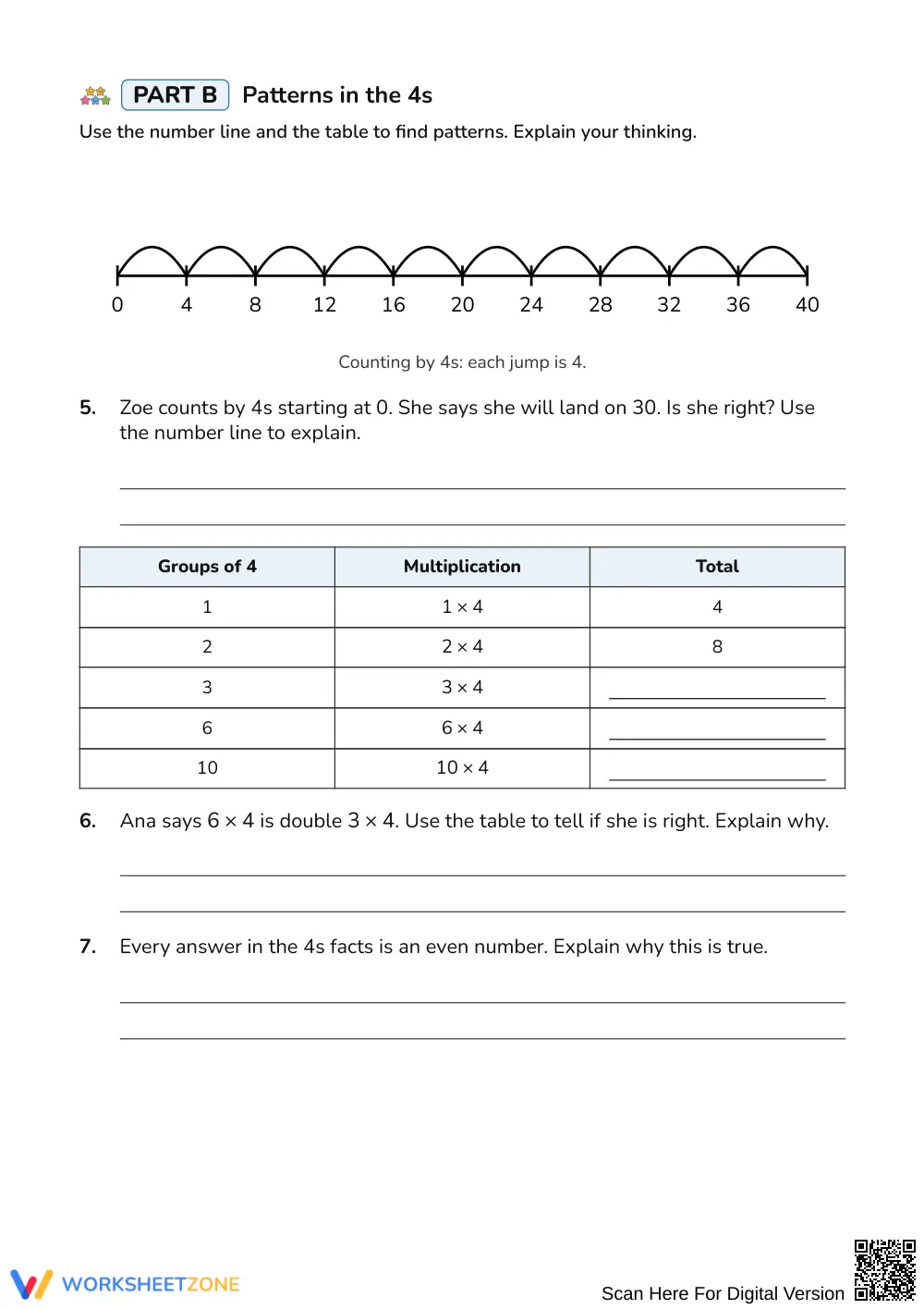
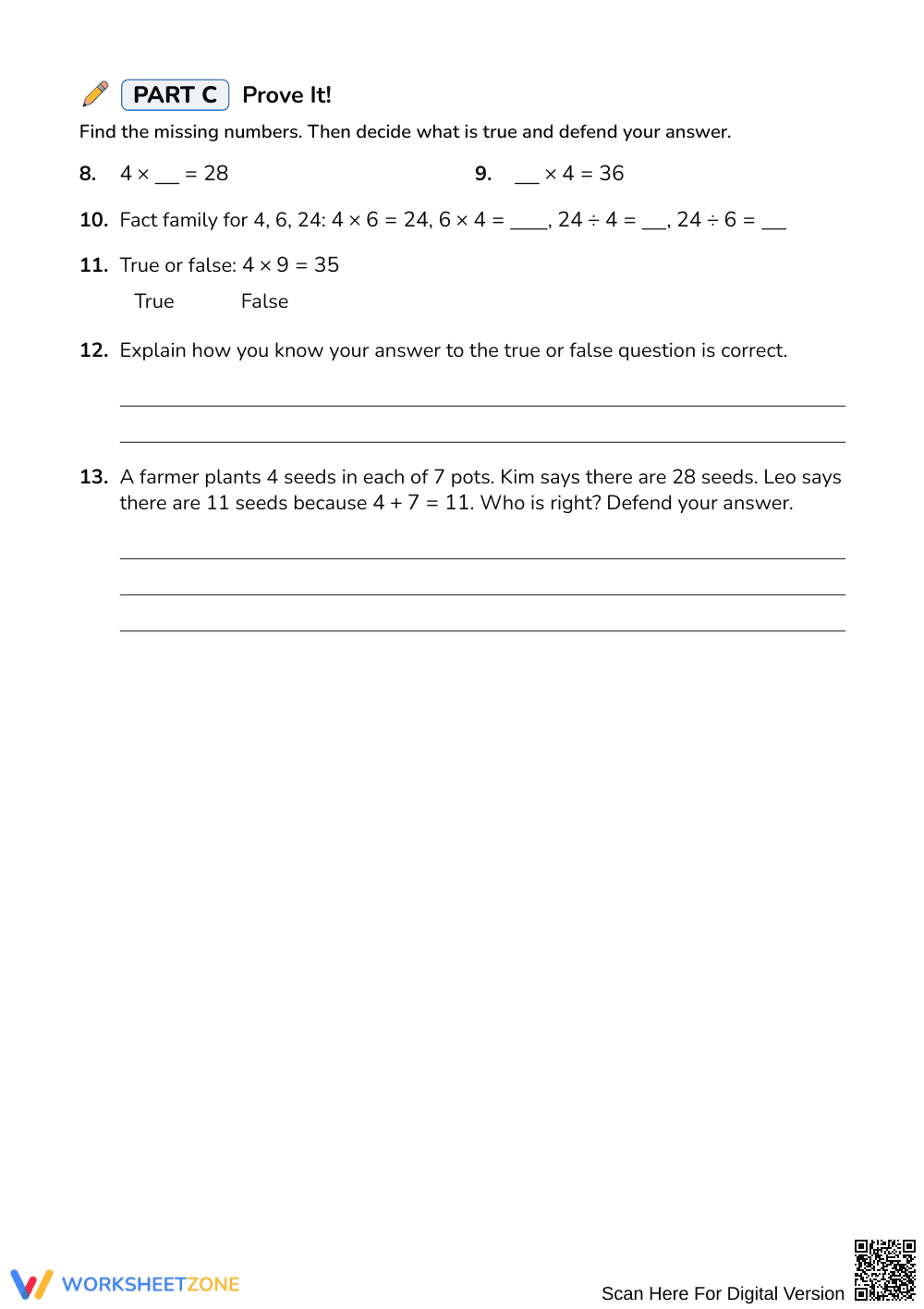
The 3-page printable worksheet contains 20 problems organized into three parts. Students examine visual arrays, equal groups, a skip-counting number line, a factor table, and true-or-false statements. Each prompt includes lined response spaces for written explanations. A complete 3-page answer key provides step-by-step solutions and model explanations.
Skill Progression
- Guided practice (Part A, 6 problems): High scaffold. Students interpret arrays and equal groups to explain commutative properties and disprove incorrect sums.
- Supported practice (Part B, 7 problems): Moderate scaffold. Students examine number lines and tables to identify patterns, proving doubling rules and even-number properties.
- Independent practice (Part C, 7 problems): Low scaffold. Students calculate missing factors, write fact families, and defend answers to word problems.
This structure follows the gradual-release model, moving learners smoothly from visual models to independent mathematical proof.
Standards Alignment
The primary standard is `3.OA.C.7`: Fluently multiply and divide within 100, using properties of operations and relationships between operations. Tasks also reinforce `3.OA.B.5` by applying commutative and distributive properties. Both standard codes can be copied directly into lesson plans, IEP goals, or district curriculum mapping tools.
How to Use It
Use Part A during direct instruction after introducing arrays to stimulate peer discussion. Assign Parts B and C after whole-group lessons during independent practice or math stations. While monitoring, watch for students who mistakenly add factors (like adding 4 + 7 = 11) instead of multiplying equal groups. Completion takes 25 to 35 minutes.
Who It's For
This worksheet supports Grade 3 general classrooms, tier-two intervention groups, and students developing written response skills in mathematics. Visual models and structured lines assist English language learners. Pair this printable with a skip-counting anchor chart or base-ten blocks to connect visual representations with abstract equations.
According to Fisher & Frey (2014), providing structured opportunities for students to justify solutions and explain their thinking transforms procedural practice into durable conceptual understanding. This Grade 3 worksheet operationalizes standard 3.OA.C.7 by presenting 20 problems that challenge learners to explain multiplication patterns, defend problem-solving methods, and evaluate mathematical assertions involving multiples of four. Rather than simply calculating products, students interpret visual arrays to prove commutativity, track skip-counting sequences along number lines, and refute common additive misconceptions. Embedded writing lines and visual scaffolds ensure all learners articulate why mathematical relationships hold true. As Fisher & Frey (2014) demonstrate, systematically embedding student-led justifications within daily computational tasks fosters metacognitive monitoring and accelerates arithmetic fluency. Consequently, this resource provides an effective balance of conceptual exploration, written evidence, and rigorous standards-aligned elementary multiplication mastery across diverse classroom settings.


