































By 4s: Essential Prerequisite Check Worksheet

Paste this activity's link or code into your existing LMS (Google Classroom, Canvas, Teams, Schoology, Moodle, etc.).
Students can open and work on the activity right away, with no student login required.
You'll still be able to track student progress and results from your teacher account.
This Grade 3 diagnostic math worksheet reviews foundational multiplication concepts to prepare students for multiplying by 4. Learners examine equal groups, interpret arrays, practice skip-counting on a number line, and solve fact families. The 25 focused tasks establish whether third graders possess required conceptual understanding before tackling new multiplication facts.
At a Glance
- Grade: 3 · Subject: Math
- Standard:
3.OA.A.1— Interpret products of whole numbers using equal groups and arrays- Skill Focus: Prerequisite multiplication models and notation for 4s
- Format: 2 pages · 25 problems · Answer key included · PDF
- Best For: Diagnostic readiness check and prerequisite review
- Time: 20–30 minutes
What's Inside
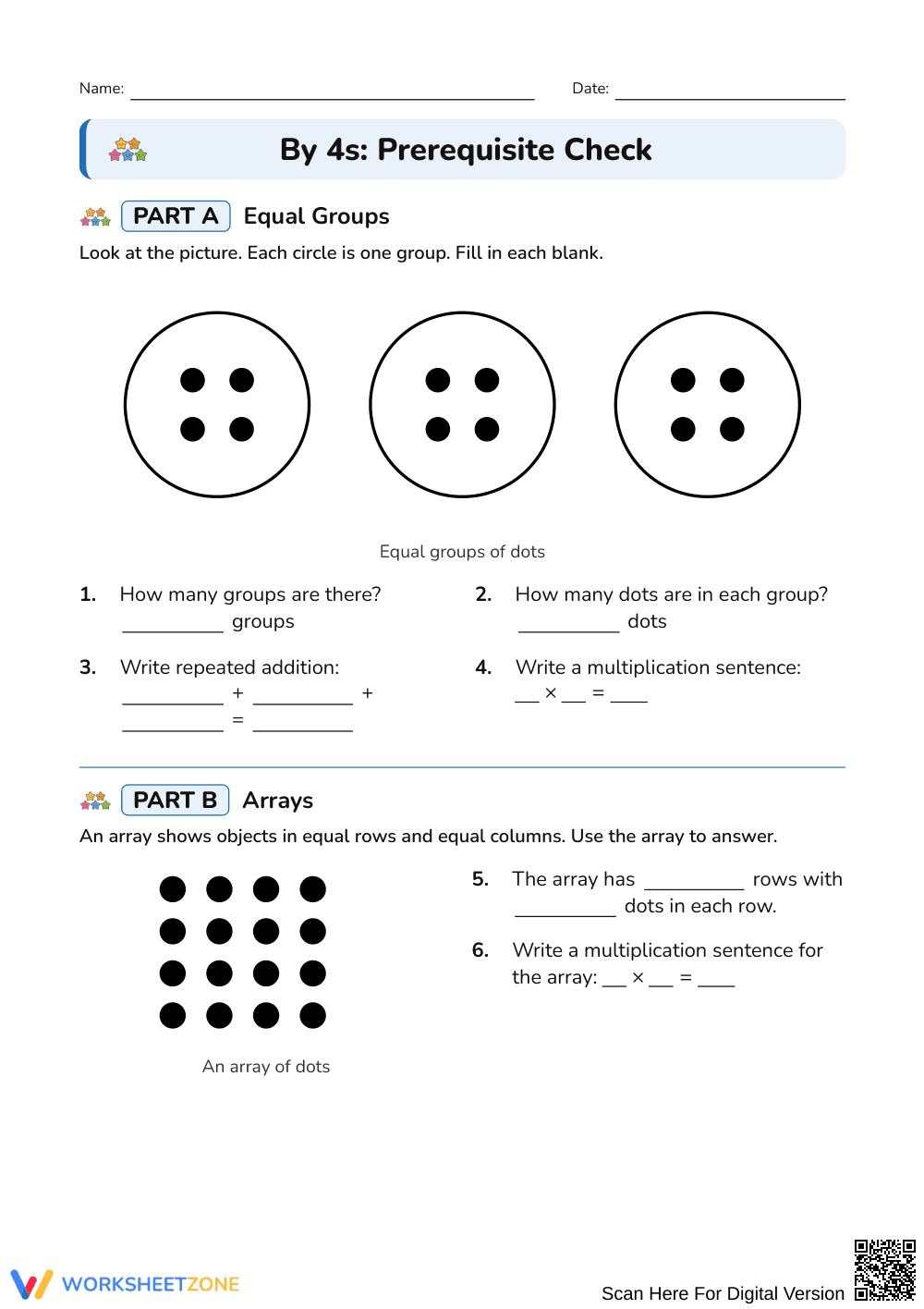
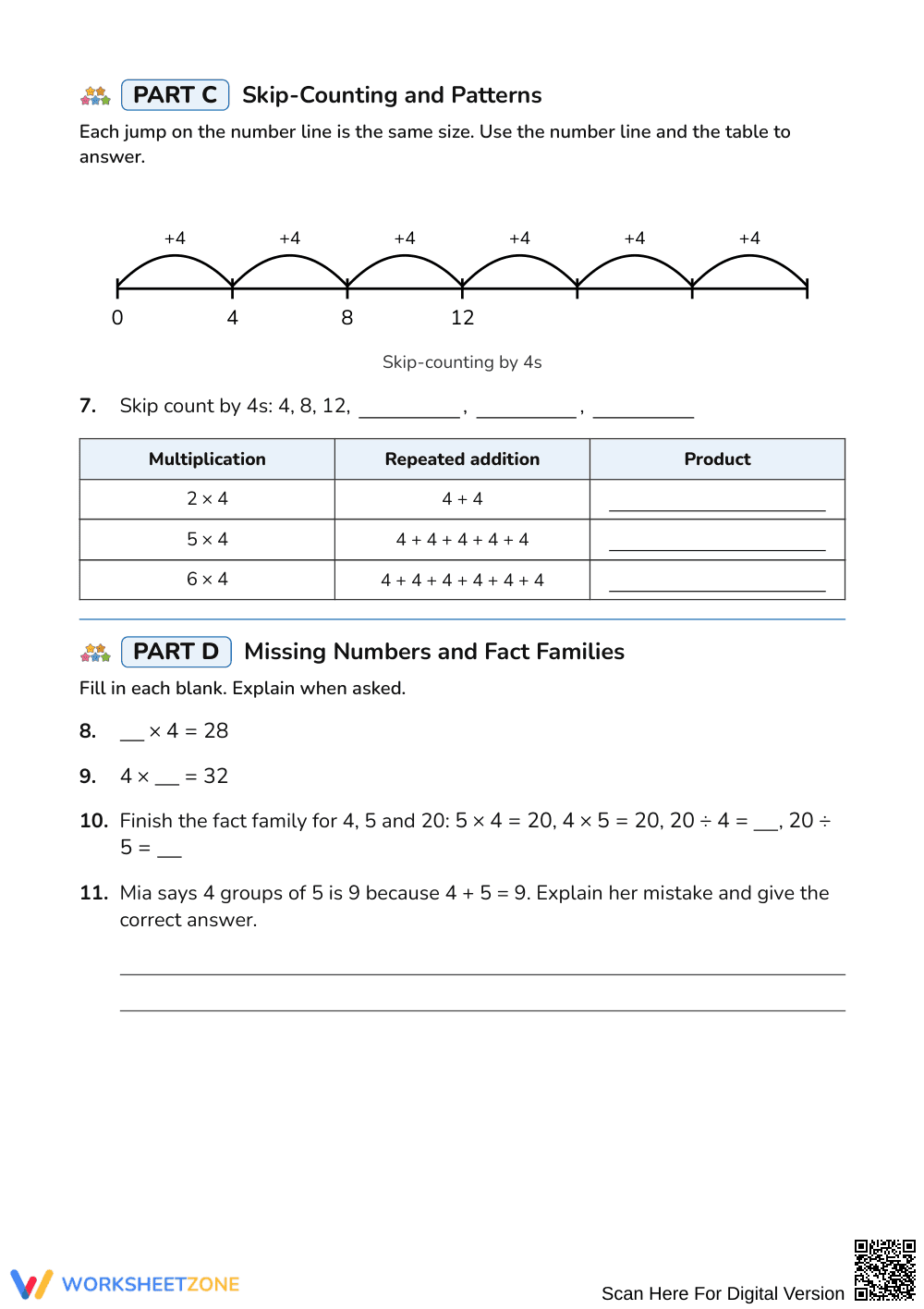
This two-page printable resource includes 25 diagnostic problems across four sections. Part A assesses equal groups using dot diagrams and repeated addition. Part B checks array interpretation, while Part C uses a number line and table to reinforce skip-counting by 4s. Part D evaluates fact families alongside an error-analysis task. A full two-page answer key provides complete solutions.
Skill Progression
- Guided practice (Parts A & B): Students complete 8 scaffolded items using visual dot diagrams and array models to connect repeated addition with multiplication sentences.
- Supported practice (Part C): Learners tackle 9 semi-structured problems using a visual number line and a table to track skip-counting sequences and products.
- Independent practice (Part D): Students solve 8 evaluative items with minimal scaffolding, completing factor equations, writing related division facts, and correcting conceptual errors.
This sequence embodies gradual-release instruction, transitioning learners from visual modeling to independent mathematical reasoning.
Standards Alignment
This resource aligns directly to 3.OA.A.1: Interpret products of whole numbers using equal groups and arrays. Supporting standard 3.OA.C.7 reinforces fluency with single-digit multiplication and related division facts. Both standard codes can be copied directly into lesson plans, IEP goals, or district curriculum mapping tools.
How to Use It
Administer this worksheet before direct instruction on multiplying by 4 to diagnose gaps, or assign it during small-group intervention. When circulating, observe whether students confuse factor addition with group counting during Part D's error analysis. Third graders typically complete the two pages within 20 to 30 minutes.
Who It's For
This worksheet serves third-grade classrooms, math intervention groups, and special education resource rooms needing visual representations. Differentiate by offering counters for struggling learners or using the fact-family analysis as an extension for advanced students. Pair this practice with an anchor chart illustrating equal groups and rectangular arrays.
According to Fisher & Frey (2014), structured diagnostic assessment and gradual-release instruction enable teachers to identify foundational misunderstandings before introducing new algorithms. Aligned to 3.OA.A.1, this two-page resource evaluates whether Grade 3 students can interpret multiplication through equal groups, visual arrays, and number line skip-counting. Grounding multiplication notation in visual representations prevents common additive errors, such as treating factors as addends rather than group counts. The 25 diagnostic items offer immediate insight into student mastery across equal groupings, repeated addition, and reciprocal division fact families. By pinpointing prerequisite knowledge gaps prior to instruction on multiplication by 4, educators can target interventions and strengthen the conceptual bridge between repeated addition and multiplication. The included answer key supports precise formative evaluation, ensuring all elementary learners establish the prerequisite fluency necessary for sustained curricular success.


