































By 4s: Complete Cumulative Assessment Worksheet

Paste this activity's link or code into your existing LMS (Google Classroom, Canvas, Teams, Schoology, Moodle, etc.).
Students can open and work on the activity right away, with no student login required.
You'll still be able to track student progress and results from your teacher account.
This Grade 3 math worksheet develops multiplication fluency for the 4s facts using equal groups, arrays, and pattern analysis. Students solve missing factor equations, complete fact families, and resolve word problems. Designed for cumulative assessment or targeted review, it ensures third graders build complete conceptual understanding and computational fluency.
At a Glance
- Grade: 3 · Subject: Math
- Standard:
3.OA.C.7— Fluently multiply within 100 using strategies such as arrays and properties of operations- Skill Focus: Multiplication Fluency for 4s Facts
- Format: 3 pages · 23 problems · Answer key included · PDF
- Best For: Cumulative assessment and fluency check
- Time: 25–35 minutes
What's Inside
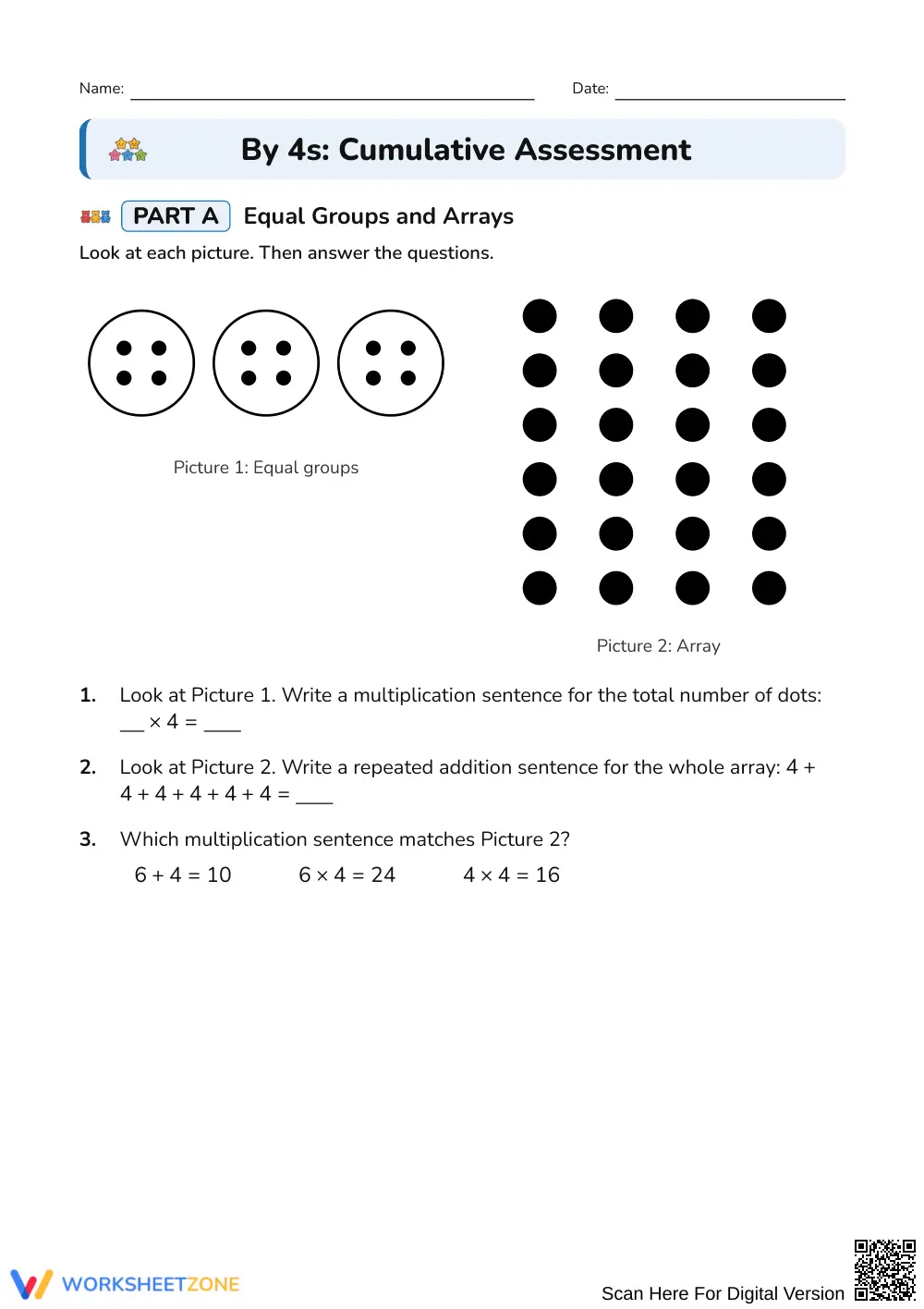
This 3-page printable resource features 23 structured problems organized across four assessment parts. Part A uses dot groups and arrays to connect repeated addition to multiplication sentences. Part B incorporates a skip-counting number line, an input-output table, and an analytical pattern question. Part C provides five missing factor problems and a full fact family. Part D presents two authentic word problems and an error-analysis reasoning task. A 3-page answer key provides complete solutions.
Skill Progression
- Guided practice (Part A, 3 problems): Visual dot groups and arrays scaffold the transition from repeated addition to multiplication equations.
- Supported practice (Part B, 6 problems): A number line and input-output table support skip-counting patterns and digit analysis.
- Independent practice (Parts C & D, 14 problems): Students solve missing factor equations, complete fact families, and explain reasoning in word problems.
This gradual-release structure guides students from visual models toward independent mastery.
Standards Alignment
This worksheet aligns with primary standard 3.OA.C.7: Fluently multiply and divide within 100, using strategies such as the relationship between multiplication and division. The application tasks also support 3.OA.A.3 through word problems involving equal groups. Both standard codes can be copied directly into lesson plans, IEP goals, or district curriculum mapping tools.
How to Use It
Administer this assessment after completing direct instruction on multiplying by 4 to gauge cumulative mastery during a 25 to 35-minute assessment period. For small-group intervention, use Parts A and B to review arrays before assigning Parts C and D. Formatively observe whether students rely on counting by ones or apply known facts like 4 × 5 to derive 4 × 6.
Who It's For
Designed for Grade 3 math students, this resource also supports Grade 4 intervention and special education settings tracking multiplication IEP goals. Support developing learners with physical counters for arrays, and challenge advanced students to generate reciprocal division word problems. Pair this activity with a skip-counting 4s anchor chart.
According to Fisher & Frey (2014), structured instructional progressions that transition learners from visual representations to independent retrieval significantly accelerate computational automaticity. This Grade 3 mathematics assessment operationalizes primary standard 3.OA.C.7, guiding elementary learners to fluently multiply and divide within 100 using fact families, arrays, and strategic number patterns. By pairing concrete dot groups with missing factor equations and reasoning prompts, the 23-task curriculum provides verifiable formative data regarding whether third-grade students have mastered basic 4s multiplication facts through conceptual understanding rather than isolated memorization. Teachers can evaluate whether pupils leverage known relationships, such as connecting five times four to find adjacent products. This scaffolded assessment format bridges visual grouping strategies and abstract fact retention, delivering an effective diagnostic measurement tool that systematically documents standards mastery and arithmetic proficiency across diverse elementary classroom settings.


