































By 4s: Compare Strategies Complete Practice Guide

Paste this activity's link or code into your existing LMS (Google Classroom, Canvas, Teams, Schoology, Moodle, etc.).
Students can open and work on the activity right away, with no student login required.
You'll still be able to track student progress and results from your teacher account.
This Grade 3 math worksheet strengthens multiplication fluency by guiding students to analyze and compare solution strategies for multiplying by 4. Moving past basic skip-counting, learners investigate doubling and array decomposition, developing mathematical reasoning and computational efficiency across 24 structured tasks.
At a Glance
- Grade: 3 · Subject: Math
- Standard:
3.OA.C.7— Multiply fluently within 100 using strategies such as doubling and properties of operations- Skill Focus: Multiplication strategy comparison for ×4 facts
- Format: 3 pages · 24 problems · Answer key included · PDF
- Best For: Small group intervention and fluency stations
- Time: 25–35 minutes
What's Inside
Across 3 printable pages, students explore visual number lines, split arrays, doubling tables, and error-analysis tasks. The resource includes worked examples comparing skip-counting against doubling twice, multiple-choice efficiency prompts, and written response items. A complete 3-page answer key provides worked explanations for fast grading.
Skill Progression
- Guided Practice (Part A): Students examine side-by-side methods for 4 × 6, using a number line and worked doubling example to identify the most efficient approach.
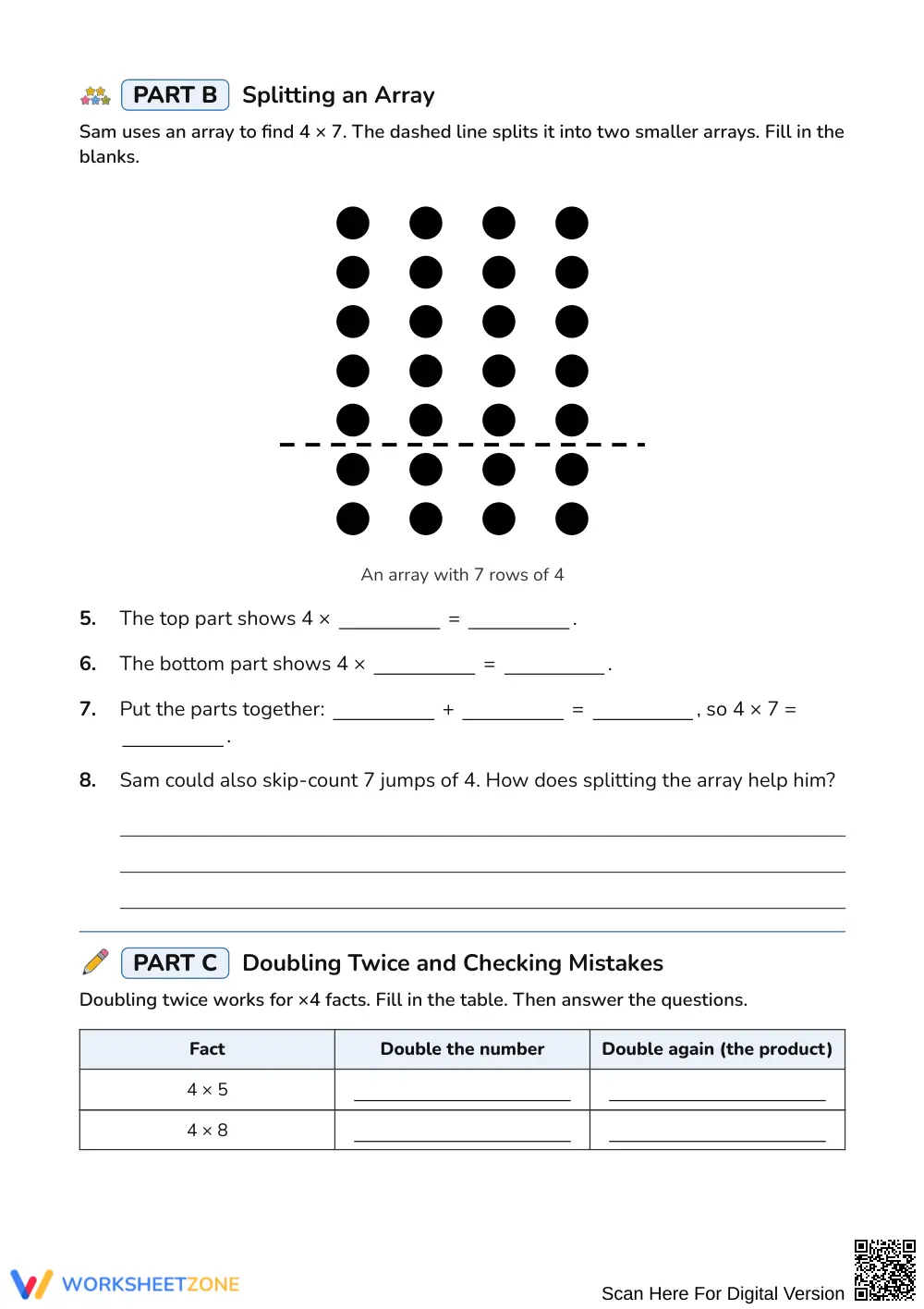
- Supported Practice (Parts B & C): Learners decompose a 4 × 7 array into smaller facts and complete a doubling table to catch skip-counting errors.
- Independent Practice (Part D): Students independently evaluate a word problem, determining why doubling twice is faster than dot-counting for 8 × 4.
This sequence follows a gradual-release model (I Do, We Do, You Do), moving learners from visual comparison to independent reasoning.
Standards Alignment
This resource aligns with primary standard `3.OA.C.7`: Fluently multiply and divide within 100 using strategies and properties of operations. It also supports `3.OA.B.5` as students apply the distributive property to decompose arrays. Both standard codes can be copied directly into lesson plans, IEP goals, or district curriculum mapping tools.
How to Use It
Implement this worksheet during the guided practice phase following direct instruction on derived facts, or assign it during independent math workshop stations. During Part C, observe whether students identify Sam's omitted jump or attempt to recount from zero, providing immediate formative feedback. The 24 problems take students approximately 25 to 35 minutes to complete.
Who It's For
This worksheet serves Grade 3 general education students, Tier 2 intervention groups, and resource rooms building multiplication fluency. Visual models support developing learners, while error-analysis tasks stretch proficient mathematicians. Pair this printable with a concrete tile-array lesson or a multiplication strategy anchor chart displaying the double-double technique.
According to Fisher & Frey (2014), purposeful strategy comparison accelerates mathematical fluency by prompting learners to evaluate structural efficiency rather than relying strictly on mechanical memorization. This Grade 3 instructional resource targets standard 3.OA.C.7 by challenging students to compare multiplication strategies for ×4 facts, specifically contrasting additive skip-counting with derived-fact doubling and array decomposition. By analyzing 24 targeted tasks across 3 structured pages, students assess cognitive load, identify procedural counting errors, and justify why doubling twice offers greater reliability for larger factors like 4 × 8 and 4 × 9. Research confirms that structured opportunities to contrast valid and partially valid solutions strengthen conceptual schema and promote flexible arithmetic retrieval in elementary learners. Educators can utilize this rigorous practice module to advance student understanding from perceptual grouping to robust operational fluency within 100.


