



























By 1s: Complete Reasoning & Justification Guide
Paste this activity's link or code into your existing LMS (Google Classroom, Canvas, Teams, Schoology, Moodle, etc.).
Students can open and work on the activity right away, with no student login required.
You'll still be able to track student progress and results from your teacher account.
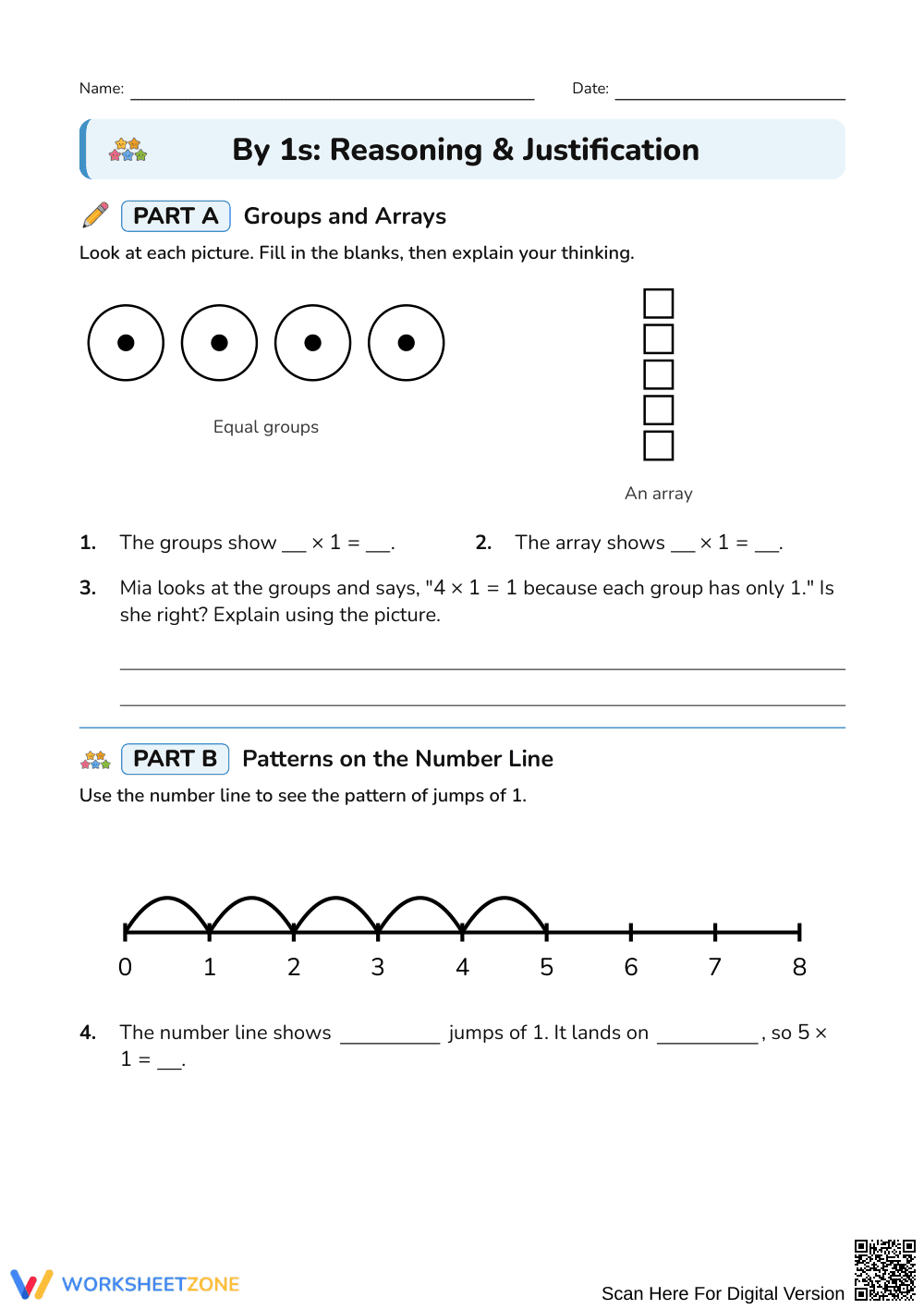
This Grade 3 math worksheet strengthens multiplication fluency for times-one facts through targeted conceptual reasoning and justification. Students analyze equal groups, interpret arrays, trace jumps on number lines, and evaluate common misconceptions. By defending their thinking with visual models and equations, third graders develop a solid foundation for multiplication properties.
At a Glance
- Grade: 3 · Subject: Math
- Standard:
3.OA.A.1— Interpret products of whole numbers as equal groups, arrays, and jumps on lines- Skill Focus: Multiplication by 1 with non-routine reasoning and justification
- Format: 2 pages · 15 problems · Answer key included · PDF
- Best For: Small group intervention and conceptual core practice
- Time: 25–35 minutes
What's Inside
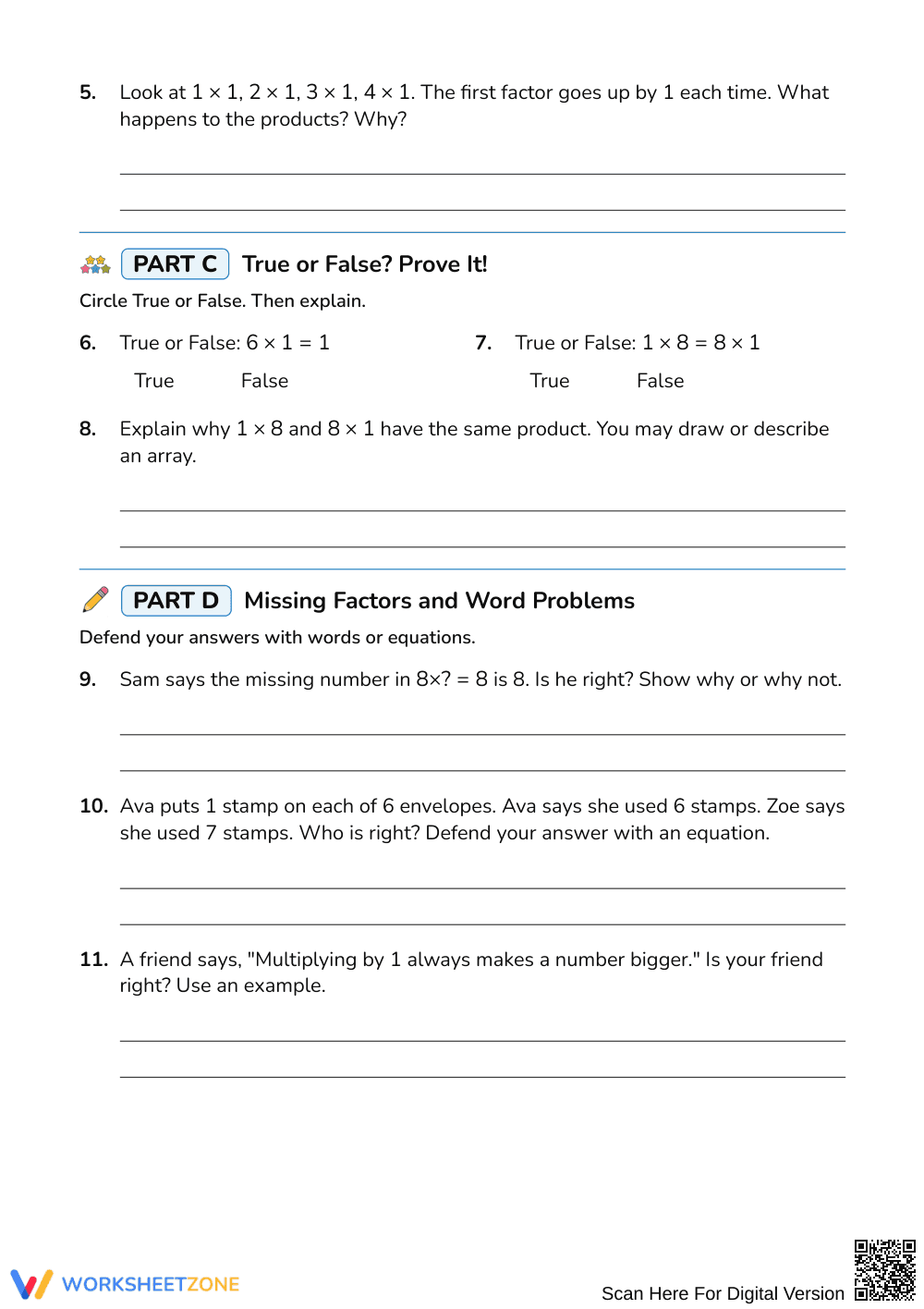
The 2-page resource features 15 non-routine tasks across four distinct parts. Students explore concrete equal groups, examine 5-by-1 arrays, analyze jumps along number lines, and evaluate true-or-false multiplication statements. Visual models and structured prompts guide learners to explain their thinking. A full 2-page answer key provides worked explanations and sample justifications for every problem.
Skill Progression
- Guided practice (Part A, 4 problems): Visual equal groups and arrays build conceptual meaning, prompting students to critique common arithmetic errors with supportive pictorial cues.
- Supported practice (Parts B and C, 6 problems): Number line models and true-or-false proofs prompt students to connect additive patterns and demonstrate the commutative property.
- Independent practice (Part D, 5 problems): Word problems and missing factor equations require students to defend mathematical claims and debunk arithmetic rules using written reasoning.
This sequence follows a gradual-release framework, shifting third graders from visual models toward autonomous mathematical justification.
Standards Alignment
This worksheet aligns with CCSS `3.OA.A.1`, which requires students to interpret products of whole numbers by viewing 5 × 1 as the total objects in 5 groups of 1. It also reinforces supporting standard `3.OA.B.5` as learners apply properties of operations. Both standard codes can be copied directly into lesson plans, IEP goals, or district curriculum mapping tools.
How to Use It
Implement this worksheet during core math instruction immediately following direct teaching on multiplication concepts, or assign it during small-group intervention. During independent work, observe whether students identify 8 × 1 as 8 groups of 1 rather than conflating factors with products. Most Grade 3 students complete the 15 problems in 25 to 35 minutes.
Who It's For
This resource serves general education third graders, English learners needing visual representations, and students receiving Tier 2 math intervention. Teachers can pair this printable with hands-on counters or an anchor chart displaying the identity property of multiplication.
According to research on structured instructional design from Fisher & Frey (2014), guiding elementary students through progressive visual models and rigorous explanation tasks establishes deep conceptual understanding. This Grade 3 mathematics resource addresses standard 3.OA.A.1 by developing multiplication fluency for times-one facts through non-routine reasoning and justification problems. Rather than relying solely on rote repetition of identity facts, the 15 structured exercises require learners to interpret concrete equal groups, trace sequential number line increments, and defend numerical claims using written evidence. By asking students to actively critique common misconceptions and explain why products remain identical under factor reversal, the worksheet cements foundational algebraic thinking. Incorporating regular written mathematical arguments helps third-grade students transition successfully from additive counting to multiplicative reasoning, securing the conceptual mastery essential for multi-digit computation and fractions in subsequent grade levels.


