































By 1s: Compare Strategies Printable Worksheet

Paste this activity's link or code into your existing LMS (Google Classroom, Canvas, Teams, Schoology, Moodle, etc.).
Students can open and work on the activity right away, with no student login required.
You'll still be able to track student progress and results from your teacher account.
This Grade 3 multiplication worksheet develops conceptual understanding of multiplying by one through strategy comparison. Students analyze equal groups, repeated addition, arrays, and number lines to discover why factors multiplied by one equal themselves. By evaluating efficiency and correcting common errors, learners strengthen procedural fluency and mathematical reasoning.
At a Glance
- Grade: 3 · Subject: Math
- Standard:
3.OA.A.1— Interpret products of whole numbers as total objects in equal groups- Skill Focus: Comparing efficiency and representations for multiplying by 1
- Format: 3 printable pages · 19 problems · Full answer key included · PDF
- Best For: Small group intervention and guided math practice
- Time: 25–35 minutes
What's Inside
This 3-page printable contains 19 structured problems divided into three sections: group models versus repeated addition, array and number line comparisons, and error analysis. Students evaluate visual representations, complete commutative fact tables, and justify their reasoning in writing. A full 3-page answer key provides sample explanations for every prompt.
Skill Progression
- Guided practice (Part A, 4 tasks): Students compare two valid strategies for 5 × 1, contrasting repeated addition with direct group counting to assess efficiency.
- Supported practice (Part B, 5 tasks): Learners evaluate arrays and number lines for 6 × 1, selecting optimal methods for larger facts like 12 × 1.
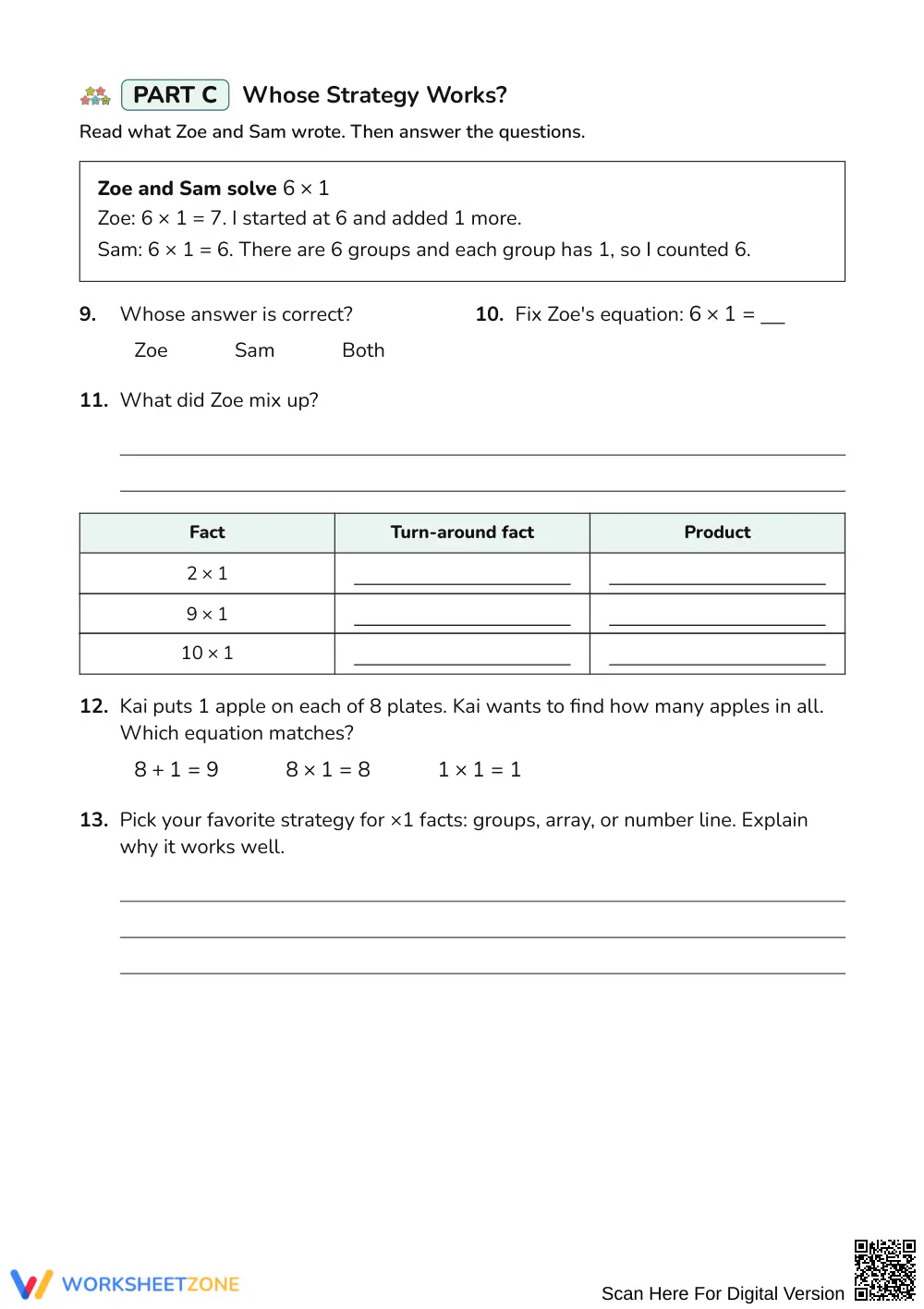
- Independent practice (Part C, 10 tasks): Students identify why adding one differs from multiplying by one, complete turn-around tables, and solve word problems.
This sequence follows gradual-release principles, moving learners from scaffolded comparisons toward independent error correction.
Standards Alignment
This resource aligns directly with 3.OA.A.1, requiring students to interpret products as representations of equal groups. It also supports 3.OA.B.5 through commutative and identity properties. Both standard codes can be copied directly into lesson plans, IEP goals, or district curriculum mapping tools.
How to Use It
Use this worksheet after direct instruction on the identity property or during guided small-group math. When reviewing Part C, check whether students confuse 6 × 1 with 6 + 1 to assess conceptual understanding. Expected completion time is 25 to 35 minutes.
Who It's For
Designed for Grade 3 general math classrooms and Grade 4 intervention groups reviewing multiplication fundamentals. Visual arrays and clear prompts provide scaffolds for English learners. Pair this activity with an identity property anchor chart or hands-on counter manipulatives.
According to Fisher & Frey (2014), evaluating multiple mathematical representations accelerates conceptual mastery by prompting students to articulate procedural efficiency. This Grade 3 math worksheet operationalizes standard 3.OA.A.1 by guiding learners to interpret products of whole numbers through concrete equal groups, linear number lines, and area arrays. Across 19 scaffolded items, students compare repeated addition against direct group counting when multiplying by 1, establishing why identity facts function predictably. By requiring third graders to diagnose misconceptions—such as confusing multiplication by one with adding one—the resource transforms basic fact memorization into rigorous mathematical argumentation. The accompanying 3-page answer key provides exemplar reasoning benchmarks that support targeted formative assessment and instructional feedback. Consequently, educators gain an evidence-based tool that secures foundational multiplication concepts while advancing metacognitive discourse, ensuring students construct robust mental models that transfer directly to multi-digit operations and algebraic reasoning.


