































By 12s: Prerequisite Check - Complete Math Review

Paste this activity's link or code into your existing LMS (Google Classroom, Canvas, Teams, Schoology, Moodle, etc.).
Students can open and work on the activity right away, with no student login required.
You'll still be able to track student progress and results from your teacher account.
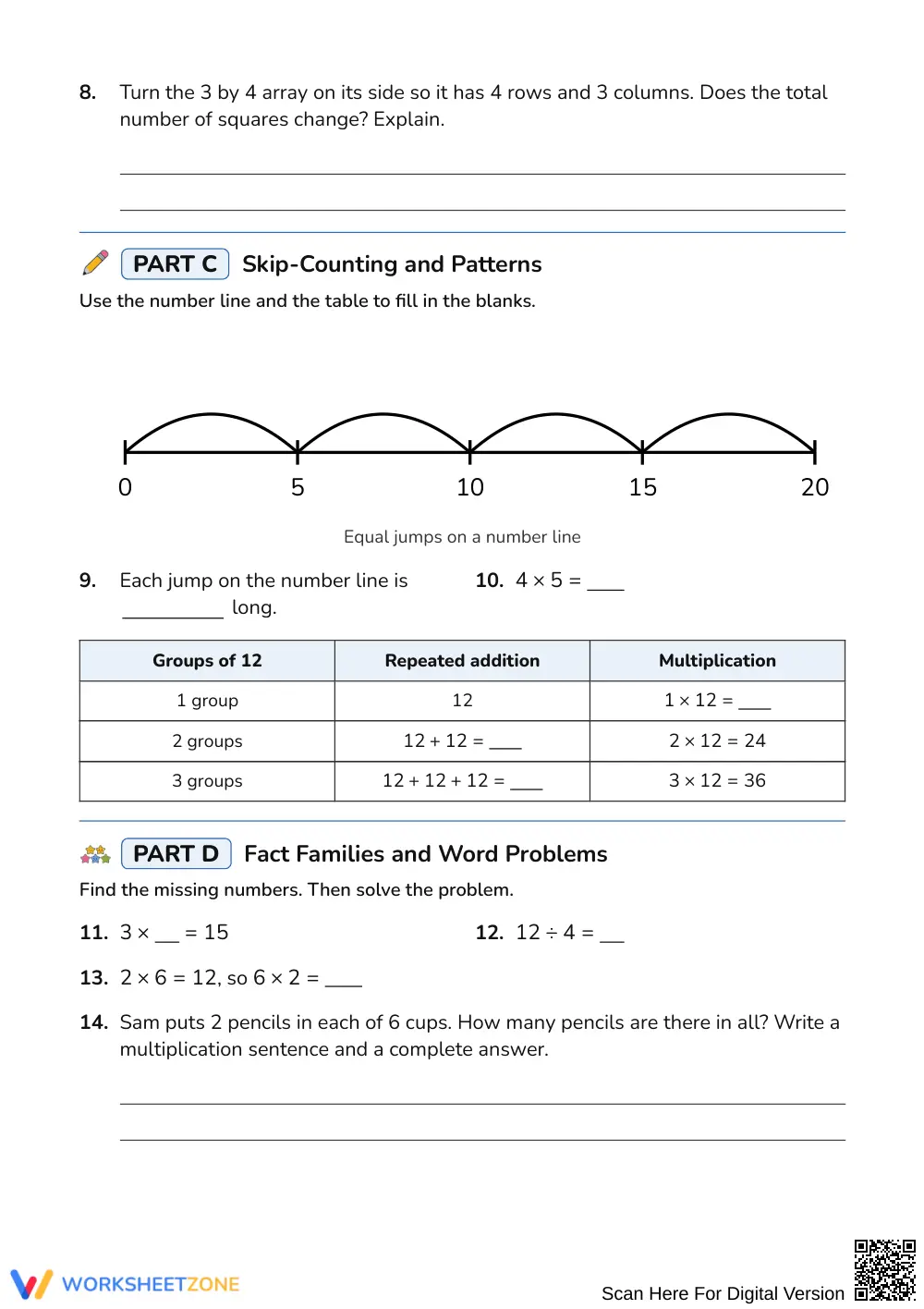
This Grade 3 diagnostic worksheet reinforces essential multiplication prerequisites before students tackle multiplying by 12. Learners evaluate equal groups, analyze rectangular arrays, complete skip-counting sequences, and solve one-step word problems. By connecting visual models directly to multiplication equations, students establish conceptual clarity and prepare for fluent recall of twelve facts.
At a Glance
- Grade: 3 · Subject: Math
- Standard:
3.OA.A.1— Interpret products of whole numbers using equal groups and visual models- Skill Focus: Multiplication prerequisite ideas and notation
- Format: 2 pages · 17 problems · Answer key included · PDF
- Best For: Diagnostic prerequisite check before unit instruction
- Time: 20–30 minutes
What's Inside
The 2-page resource features 17 targeted tasks divided across four distinct sections: equal groups with dot diagrams, rectangular arrays demonstrating the commutative property, number-line skip-counting paired with repeated addition tables, and fact family equations with an applied word problem. A complete 2-page answer key provides filled-in diagrams, exact equations, and sample written explanations for streamlined grading.
Skill Progression
- Guided practice (Tasks 1–5): Visual dot groups and array diagrams introduce core multiplication vocabulary, prompting students to identify factors, products, rows, and columns with structured fill-in prompts.
- Supported practice (Tasks 6–12): Number-line jumps and structured repeated addition tables connect skip-counting patterns to basic multiplication notation with partial table scaffolding.
- Independent practice (Tasks 13–17): Students complete missing factors, apply inverse division relationships, and independently formulate an equation to solve a contextual word problem.
This sequence embodies a gradual-release instructional model, moving systematically from concrete visual representations to abstract mathematical equations.
Standards Alignment
The primary focus aligns to `3.OA.A.1`: Interpret products of whole numbers, such as interpreting 5 × 7 as the total number of objects in 5 groups of 7 objects each. This diagnostic also reinforces supporting standard `3.OA.B.5` by examining commutative properties in rectangular arrays. Both standard codes can be copied directly into lesson plans, IEP goals, or district curriculum mapping tools.
How to Use It
Administer this worksheet before direct instruction on the twelve facts to identify specific student misunderstandings regarding grouping notation and array orientation. During class, monitor how learners explain array rotations in Part B as a formative check for understanding commutative relationships. The complete activity takes approximately 20 to 30 minutes during small-group remediation or independent morning work.
Who It's For
This resource is designed for Grade 3 general education math classes, tier-2 intervention groups, and special education resource rooms needing targeted multiplication review. Differentiate by providing counters for Part A or pairing the worksheet with a multiplication array anchor chart during direct instruction.
According to Fisher & Frey (2014), structured diagnostic assessments that activate prior knowledge significantly accelerate mathematics mastery across upper-elementary classrooms. This Grade 3 worksheet directly targets standard 3.OA.A.1 by assessing students' ability to interpret products of whole numbers through concrete equal groups, rectangular arrays, and repeated addition representations. Grounded in systematic cognitive progression, the 17-problem diagnostic set isolates prerequisite skills required before learners engage with more challenging multiplication, specifically the facts of 12. By transitioning pupils from guided visual models of factor-product relationships to independent algebraic equations and real-world word problems, the resource surfaces specific operational misconceptions early in the instructional sequence. Educators gain clear formative data on whether students recognize multiplication as equal groupings or merely memorize procedural steps, ensuring targeted, research-backed intervention before introducing higher factor tables during subsequent daily mathematics lessons.


