































By 12s Error Analysis: Complete Practice Worksheet

Paste this activity's link or code into your existing LMS (Google Classroom, Canvas, Teams, Schoology, Moodle, etc.).
Students can open and work on the activity right away, with no student login required.
You'll still be able to track student progress and results from your teacher account.
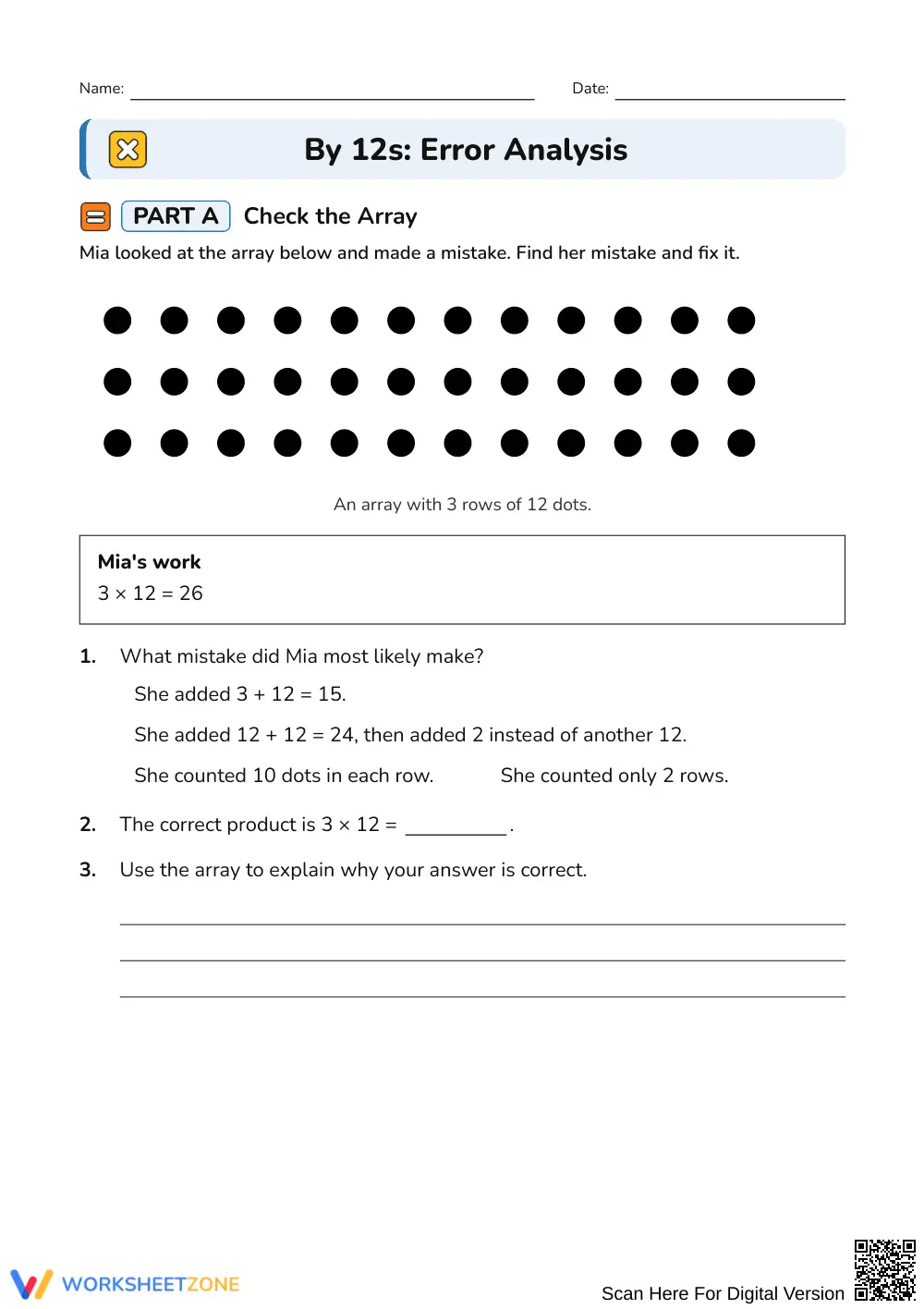
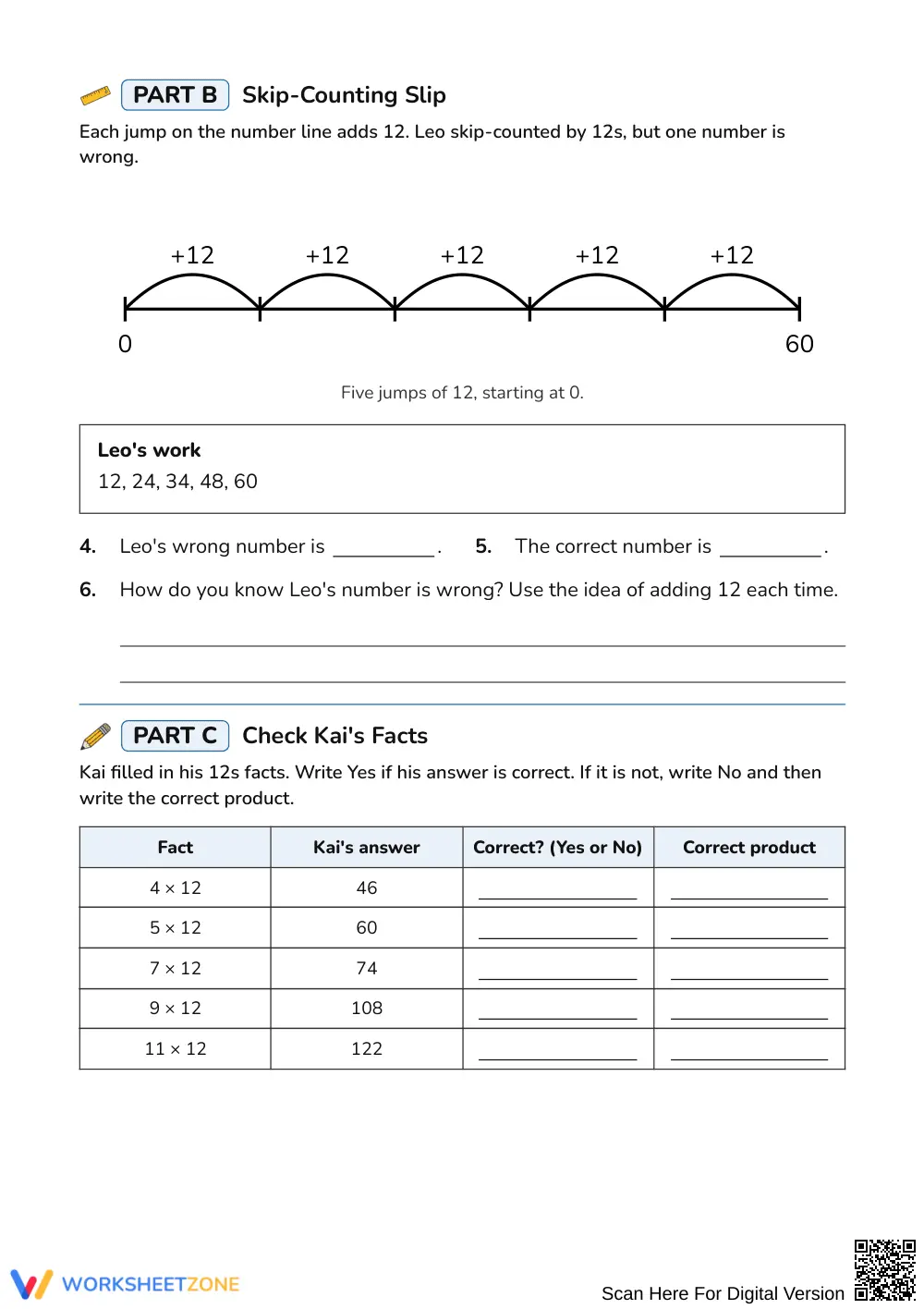
This Grade 3 multiplication worksheet develops mathematical reasoning by asking students to analyze, correct, and justify solutions to common multiplication errors with 12s. Learners examine visual arrays, number line patterns, arithmetic facts, and applied word problems to build conceptual understanding and computational fluency across 23 targeted tasks.
At a Glance
- Grade: 3 · Subject: Math
- Standard:
3.OA.C.7— Fluently multiply and divide within 100 using strategies and properties of operations- Skill Focus: Multiplication by 12 error analysis and written mathematical justification
- Format: 3 student pages · 23 structured problems · Full answer key included · Printable PDF
- Best For: Targeted small group intervention and skill review
- Time: 25–35 minutes
This 3-page worksheet contains 23 tasks organized across four targeted parts. Students examine visual array models, skip-counting number lines, fact-verification tables, and applied word problems. Scaffolded prompt frames guide written explanations, supported by a complete 3-page answer key.
Skill Progression
- Guided practice (Parts A & B, 6 tasks): Students examine arrays and number lines with multiple-choice error detection and guided prompts.
- Supported practice (Part C, 10 tasks): Learners audit multiplication tables, verifying accuracy and computing correct products.
- Independent practice (Part D, 7 tasks): Students critique word problems, missing factors, and division fact families with written justifications.
This sequence follows the gradual-release model, shifting students from guided detection to independent reasoning.
Standards Alignment
This resource aligns directly with `3.OA.C.7`: Fluently multiply and divide within 100 using strategies and operational properties. The tasks also support standard `3.OA.A.3` through contextual word problems involving equal groups. Both standard codes can be copied directly into lesson plans, IEP goals, or district curriculum mapping tools.
How to Use It
Use this worksheet after direct instruction on 12s facts for partner discourse, having pairs defend their corrections. Alternatively, assign Part D as a mid-unit formative check. Observe whether students reference equal groupings or rely on repeated addition. Expected completion time is 25 to 35 minutes.
Who It's For
This resource serves third graders mastering multiplication facts and older students requiring intervention. Provide array cards for learners needing visual scaffolding, or prompt advanced students to generate their own non-examples. Pair with an anchor chart detailing the distributive property for 12.
According to Fisher & Frey (2014), analyzing non-examples and correcting common errors significantly deepens conceptual understanding compared to repetitive rote computation alone. This Grade 3 mathematics resource addresses standard 3.OA.C.7 by challenging learners to identify, rectify, and justify corrections for common multiplication mistakes involving the 12s fact family. Rather than simply calculating 12 times 3 or 12 times 5, students examine authentic misconceptions including miscounted arrays, faulty skip-counting sequences, confusion between addition and multiplication in word problems, and inverse division errors. Research shows that verbalizing mathematical reasoning and explaining why an incorrect method fails fosters durable schema development and metacognitive awareness. By guiding third graders through structured error analysis across 23 rigorous items, this instructional tool transforms standard fact practice into high-level evaluative thinking, preparing learners to achieve sustainable fluency and conceptual mastery across all foundational operations.


