































By 12s: Concrete or Visual Model Printable Worksheet

Paste this activity's link or code into your existing LMS (Google Classroom, Canvas, Teams, Schoology, Moodle, etc.).
Students can open and work on the activity right away, with no student login required.
You'll still be able to track student progress and results from your teacher account.
This Grade 3 math worksheet builds multiplication fluency for the twelve times tables through concrete grouping and visual models. Students connect equal groups, arrays, and number lines to symbolic equations, developing conceptual understanding rather than relying on rote memorization. The multi-step progression guides learners from visual foundations to independent problem-solving.
At a Glance
- Grade: 3 · Subject: Math
- Standard:
3.OA.C.7— Fluently multiply within 100 using strategies like arrays and the distributive property- Skill Focus: Multiplication fluency for twelve times tables using concrete and visual representations
- Format: 3 student pages · 26 problems · Complete answer key included · Printable PDF
- Best For: Targeted small group math intervention practice
- Time: 30–45 minutes
What's Inside
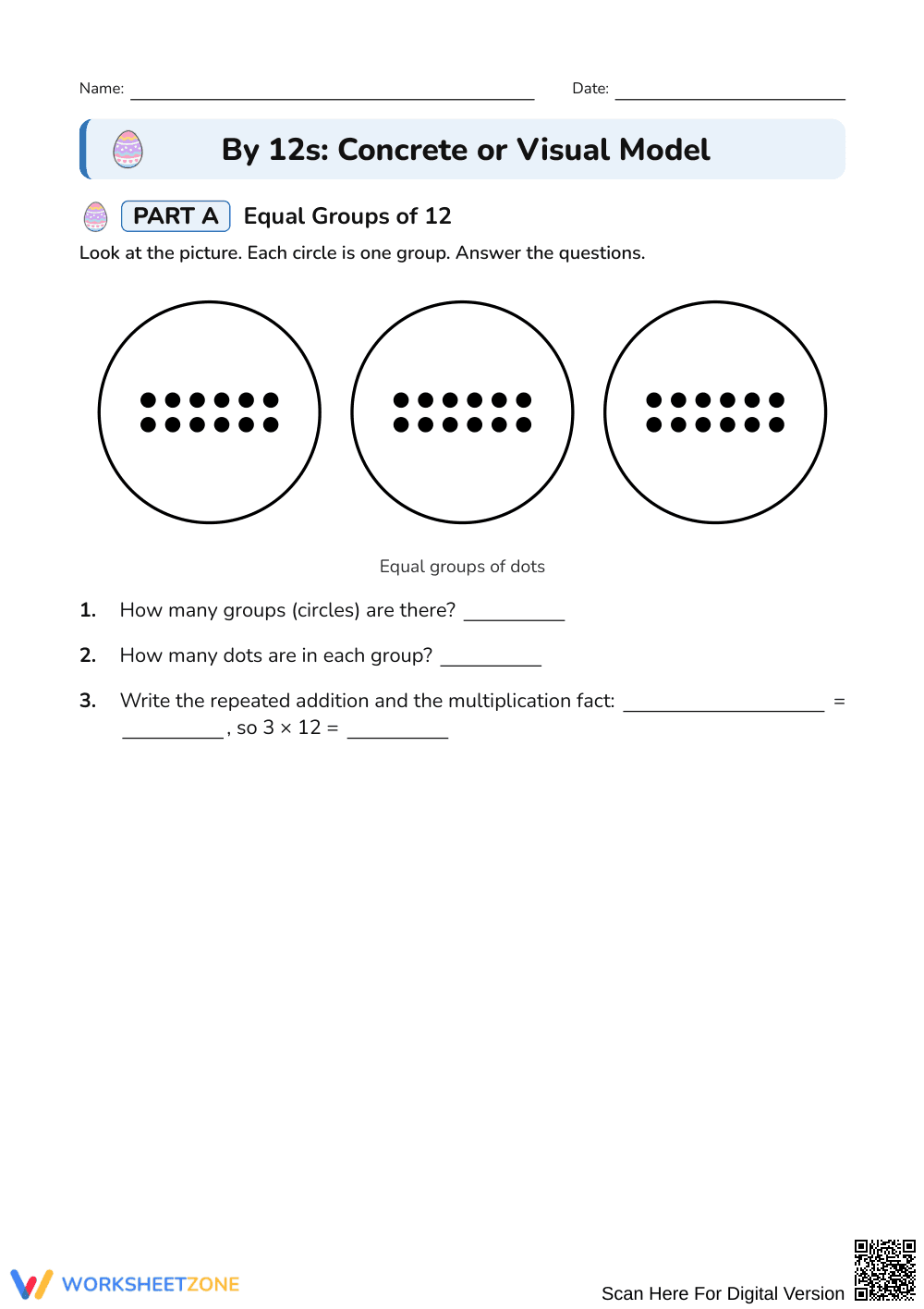
Across 3 pages, this resource delivers 26 structured tasks organized into five parts. Students work through visual dot groups, decomposed area arrays splitting twelve into ten and two, skip-counting number lines, fact patterns, and word problems. A complete 3-page answer key provides solutions with intermediate arithmetic steps to simplify grading.
Skill Progression
- Guided practice: Parts A and B provide 8 introductory problems where visual dot groupings and decomposed area arrays explicitly scaffold multiplication facts, showing how 4 × 12 splits into 4 × 10 plus 4 × 2.
- Supported practice: Parts C and D offer 14 intermediate tasks utilizing skip-counting number lines and patterned fact tables to connect repeated addition, products, and inverse division facts.
- Independent practice: Part E presents 4 word problems and reasoning prompts requiring students to explain doubles relationships and write complete multiplication sentences.
This structure embodies the gradual-release model, shifting learners from teacher-guided visual modeling to confident independent mastery.
Standards Alignment
This worksheet directly aligns to primary standard 3.OA.C.7: Fluently multiply and divide within 100, using strategies such as the relationship between multiplication and division or properties of operations. The visual decomposition also reinforces supporting standard 3.OA.B.5 through the distributive property. Both standard codes can be copied directly into lesson plans, IEP goals, or district curriculum mapping tools.
How to Use It
Deploy this worksheet during guided math rotations following direct instruction on array decomposition, or assign it during Tier 2 intervention to strengthen conceptual foundations. During seatwork, observe whether students actively use the dashed array split to calculate partial products or attempt mental addition. Most third graders will complete the activity in 30 to 45 minutes.
Who It's For
This activity is designed for Grade 3 math students developing operational fluency, as well as Grade 4 learners needing targeted remediation. Struggling students benefit from concrete dot clusters, while advanced learners can explain mathematical patterns in the reasoning prompts. Pair this worksheet directly with base-ten blocks or a hundred chart lesson.
Mastering multiplication facts under standard 3.OA.C.7 requires students to fluently multiply within 100 by connecting visual representations to arithmetic properties rather than relying solely on flashcard memorization. According to research synthesized by Fisher & Frey (2014), structured instructional materials that transition students through guided visual modeling, supported representational practice, and independent reasoning significantly improve procedural fluency and long-term concept retention in elementary mathematics. This 3-page worksheet operationalizes those findings by guiding third graders through 26 targeted problems that link concrete dot groups, decomposed area arrays, and number line skip-counting directly to multiplication equations. By scaffolding the distributive property through visual models before prompting students to justify mathematical relationships in writing, the resource ensures learners develop flexible computational strategies. Educators can utilize this standards-aligned worksheet for small group interventions, formative skill checks, or classroom practice to document measurable progress toward third-grade math proficiency standards.


