































By 12s: Complete Patterns & Missing Values

Paste this activity's link or code into your existing LMS (Google Classroom, Canvas, Teams, Schoology, Moodle, etc.).
Students can open and work on the activity right away, with no student login required.
You'll still be able to track student progress and results from your teacher account.
This Grade 3 math worksheet develops multiplication fluency with 12s facts using number lines, tables, dot arrays, and missing values. Students identify repeating ones-digit patterns and explain mathematical relationships, building strong conceptual foundations for rapid fact recall and algebraic problem-solving.
At a Glance
- Grade: 3 · Subject: Math
- Standard:
3.OA.C.7— Fluently multiply and divide within 100 using relationship strategies and arithmetic patterns- Skill Focus: Multiples of 12 patterns and missing factor equations
- Format: 2 student pages · 21 structured problems · Complete answer key included · PDF
- Best For: Core math instruction, independent practice, and fluency stations
- Time: 25–35 minutes
What's Inside
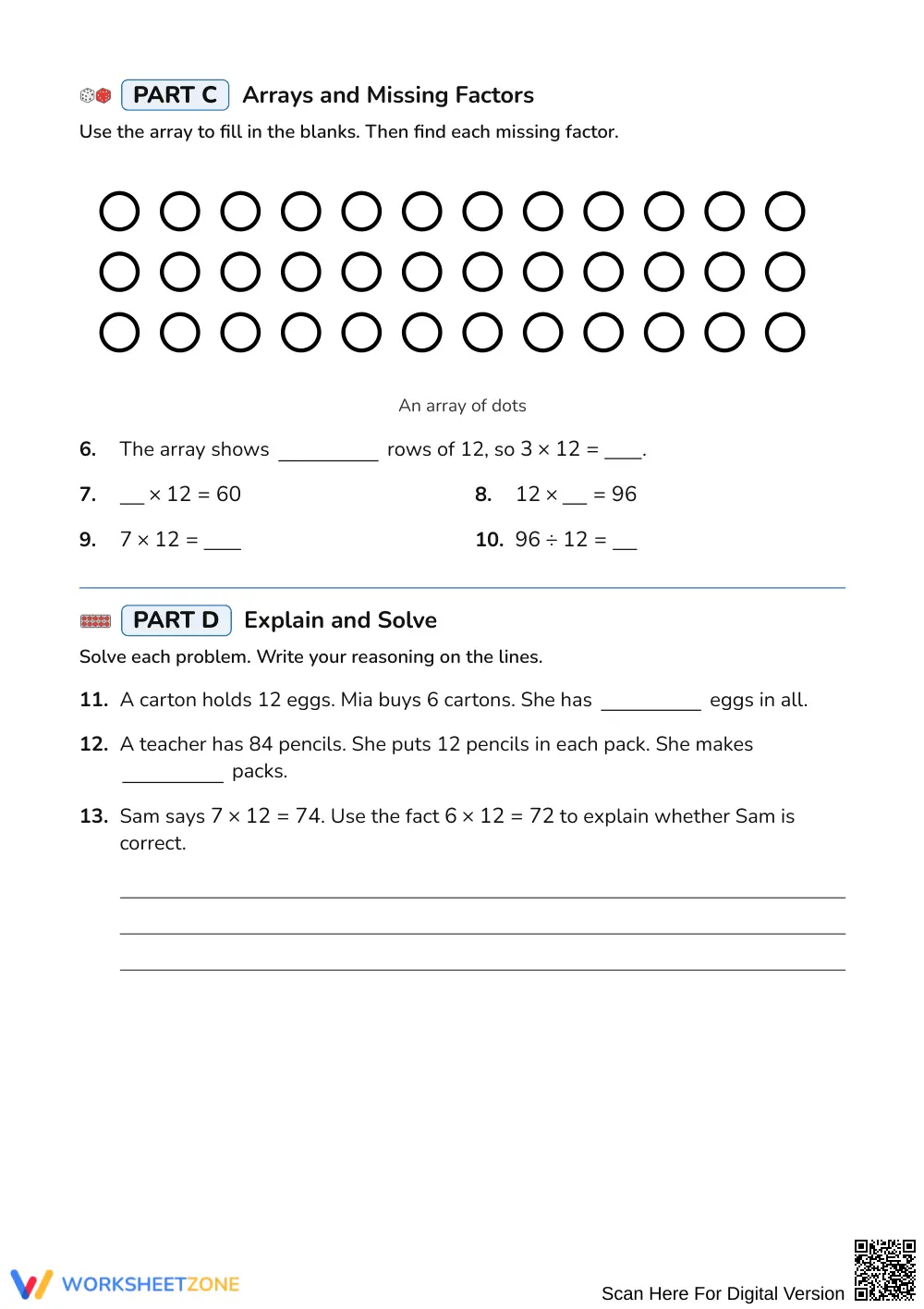
This 2-page resource provides 21 problems across four scaffolded parts. Part A uses a skip-counting number line with benchmarks. Part B features repeated addition tables and digit-pattern analysis. Part C presents dot arrays with missing-factor and related division items. Part D challenges students with explanatory word problems. A full 2-page answer key provides complete solutions.
Skill Progression
- Guided practice (Part A, 7 items): Number line jumps with marked benchmarks scaffold basic skip-counting sequences by 12s.
- Supported practice (Parts B & C, 11 items): Tables and dot arrays prompt students to identify repeating ones digits and solve missing factors with visual support.
- Independent practice (Part D, 3 items): Multi-step word problems require students to apply facts and write mathematical explanations without visual cues.
This structure follows the gradual-release framework, moving learners from guided visual modeling to independent mathematical justification.
Standards Alignment
The core standard is `3.OA.C.7`: Fluently multiply and divide within 100 using properties of operations and relationships between operations. Supporting standard `3.OA.B.5` applies the distributive property to decompose factors. Both standard codes can be copied directly into lesson plans, IEP goals, or district curriculum mapping tools.
How to Use It
Use this worksheet during independent seatwork following direct instruction on 12s facts, or assign it during math rotations. For formative assessment, check whether students solve 7 × 12 in Part D by adding 12 to 72 rather than restarting from zero. Expect completion within 25 to 35 minutes.
Who It's For
This resource serves third graders mastering multiplication facts and fourth graders needing intervention on composite factors. Pair this sheet with a multiplication grid anchor chart for students requiring extra support. Advanced learners can extend the table patterns through 144.
According to findings from Fisher & Frey (2014), structured instructional scaffolds that transition students through guided, collaborative, and autonomous problem sets significantly increase conceptual retention in elementary mathematics. This Grade 3 worksheet directly targets standard `3.OA.C.7` by guiding learners to fluently multiply and divide within 100 through pattern recognition, array modeling, and relational reasoning with multiples of 12. Rather than isolating rote memorization, the 21 structured tasks connect repeated addition, ones-digit cycle analysis, and inverse operations to cultivate durable algebraic thinking. When third graders examine how adding a single group of 12 transforms 6 × 12 into 7 × 12, they develop operational flexibility that bridges basic arithmetic and multi-digit computation. Educators can deploy this two-page resource during guided practice, targeted intervention, or independent review to verify mastery, identify student misconceptions, and document student progress toward grade-level computational benchmarks.


